




Bitcoin is hovering just below $80,000 as President Donald Trump arrives in Beijing for a high-stakes meeting with Chinese President Xi Jinping, making the trip a live test of whether the crypto market’s recent rise in risks will gain enough support to weather a difficult macro week.
The trip comes as traders are already contending with soaring inflation statistics, rising U.S. Treasury yields and a rally in Bitcoin, which relies more on derivatives positioning than spot demand.
This combination has made markets unusually sensitive to headlines emanating from Beijing, and any changes in trade, technology or supply chain policies could quickly impact global risk assets.
For Bitcoin, the visit to China is not about direct digital asset policy, but a broader market signal sent by China.
A constructive meeting could allay fears of another escalation between the world’s two largest economies and help extend the risk-on bid that has pushed Bitcoin back toward $80,000.
On the contrary, a breakdown could backfire, forcing traders to reassess a bull market that is already showing signs of stress.
Visit to China will be a test of Bitcoin risk sentiment
Trump’s arrival in Beijing will be the first visit by a US president to China since 2017, putting trade, technology and strategic competition at the center of global markets this week.
The US presidential delegation reflects economic interests. President Trump will be joined by senior officials, including Secretary of State Marco Rubio and Treasury Secretary Scott Bessent, as well as business leaders from technology and finance.
NVIDIA CEO Jensen Huang, Tesla CEO Elon Musk, and Apple CEO Tim Cook are among executives whose presence reflects how deep the U.S.-China relationship has grown through chips, artificial intelligence, electric vehicles, and global manufacturing.
These issues matter directly for stock markets and indirectly for cryptocurrencies. Bitcoin has traded during recent macro shocks not as an isolated financial hedge, but as a high-beta expression of global liquidity, risk appetite, and investor confidence.
Bitcoin tends to benefit when traders expect financial conditions to ease or geopolitical pressures to ease. As trade tensions increase and yields rise, cryptocurrencies often lose their speculative cushion.
Therefore, the tone of the meeting between President Trump and Mr. Xi will be important. Signals that Washington and Beijing are willing to ease trade barriers, reopen technology regulatory channels and negotiate rare earth exports could support a broader rise in risks.
At the same time, commitments related to agricultural purchases, energy flows, and aircraft orders will also give markets reason to price in reduced trade tensions.
However, the reverse will be more difficult for Bitcoin. Disputes over Taiwan, export controls, rare earth minerals and military status could push investors toward cash, U.S. Treasuries and the dollar.
In that scenario, Bitcoin’s claim as digital gold would be tested again against its recent move as a leveraged risk asset.
Inflation leaves little room for disappointment.
The Beijing summit becomes even more important as the US macro environment is already becoming less tolerant of Bitcoin.
That comes as April’s inflation data show price pressures remain too strong for markets to confidently price in the Fed’s more accommodative path.
The consumer price index rose 3.8% year-on-year, but the core inflation rate, which excludes food and energy, remained at 2.8%. Energy prices rose at an annual rate of 17.9%, with headline inflation well above the Fed’s 2% target.
Producer prices also added to the pressure. The producer price index in April rose 6% year-on-year, and the 1.4% month-on-month increase was the largest increase since March 2022.
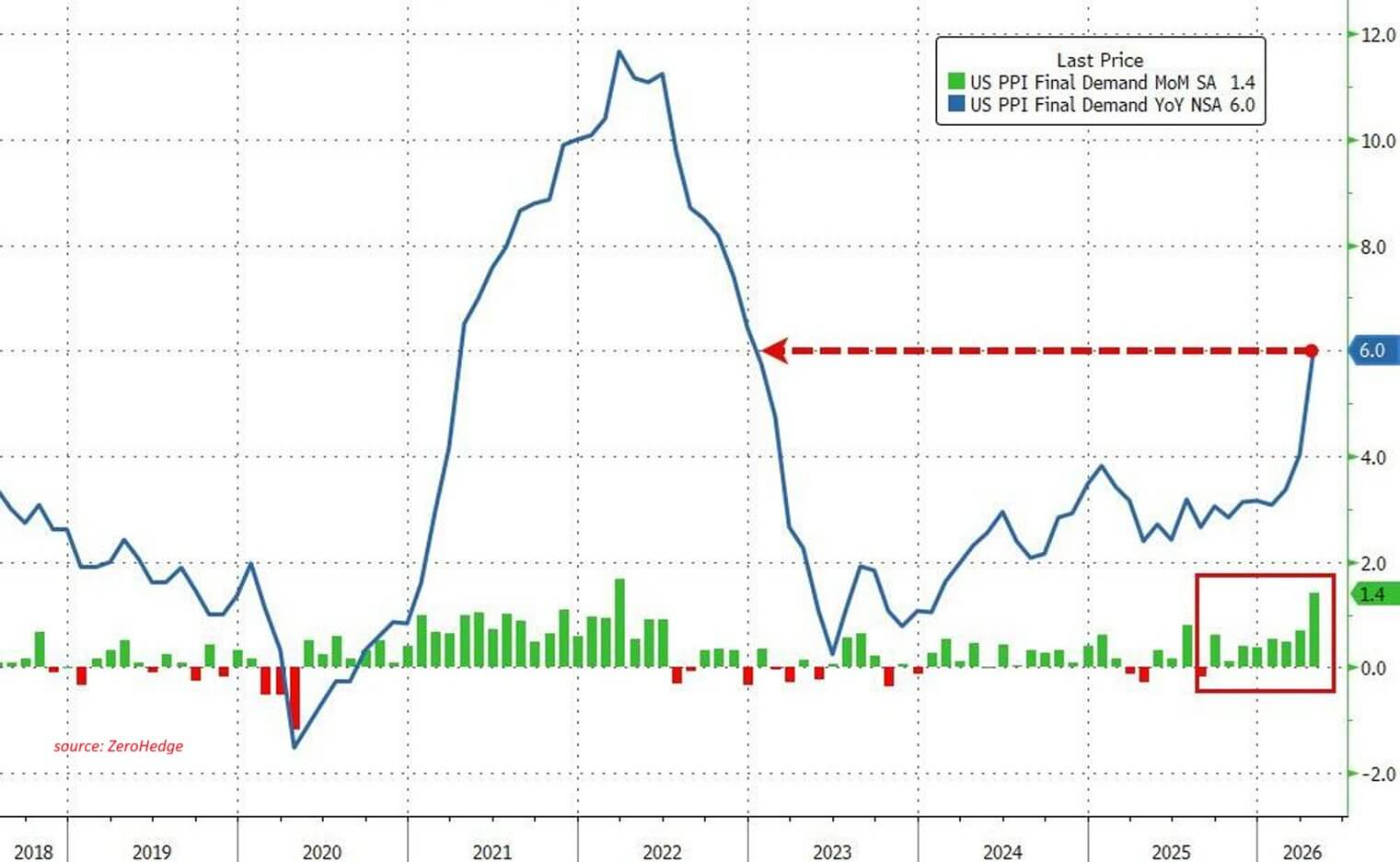
The data reinforced concerns that companies continue to face cost pressures that could ultimately trickle down to consumers.
The market reaction was immediate. U.S. Treasury yields rose, with the 10-year Treasury yield climbing toward 4.4%, while traders dialed back hopes for near-term Fed easing.
This repricing creates a more restrictive environment for speculative assets, as higher yields make products that generate safer returns more attractive.
Bitcoin has historically struggled when real yields rise. Unlike government bonds, coupons are not provided.
Therefore, its attractiveness depends on expectations for price appreciation, financial depreciation hedging, and increased liquidity.
So, as yields rise and inflation remains subdued, investors become less willing to pay the risk without stronger evidence of sustained demand.
That’s why the China summit is at the center of the Bitcoin market this week. The market is off the meeting as inflationary pressures mount, yields rise and traders have already reduced exposure following the CPI announcement.
Using leverage makes it easier to break through the $80,000 rally.
Meanwhile, Bitcoin’s current market position is around $80,000, with both gains and losses potentially widening.
Analysts at Wintermute pointed out that BTC’s recent rise above $80,000 was largely due to derivatives activity. Open interest increased from $48 billion to $58 billion in one month, suggesting that perpetual futures played a large role in the rally.
That doesn’t mean the rally is artificial, but it certainly makes it more vulnerable. If open interest rises quickly, the price may rise as traders add leverage, rather than long-term investors accumulating spot Bitcoin.
In such an environment, a positive headline could accelerate the rally as short stocks are forced to cover. Negative headlines can cause the opposite reaction, causing leveraged longs to exit in a hurry.
Wintermute’s warning that “covering is not certainty” captures the central weakness of the current movement. Short covering can push prices higher, but sustained bull markets typically require continued spot buying.
So far, spot trading volumes have not kept up with the surge in leverage, leaving the market at risk if the squeeze loses momentum.
Technical signals point to similar risks. Bitcoin’s Relative Strength Index is heading into overbought territory, suggesting that the rally could be prolonged in the short term.
Low exchange reserves add further complexity. If demand is stable, prices can rise when supply is constrained, but it can also exacerbate slippage if traders rush to reduce exposure.
When markets are thin, sudden changes in sentiment can cause larger price movements than fundamentals alone would suggest.
Therefore, Bitcoin will be greatly influenced by the tone of the meeting between President Trump and Xi. If there is a constructive outcome, leverage could continue to work in the bulls’ favor. However, in the event of a diplomatic impasse or escalation, the same levers could turn into a mechanism for rapid withdrawal.
(Tag Translation) Bitcoin


