


Bitcoin ($BTC) paused recent gains and traded below $80,000 on Friday, with modest weekly gains, as the stock struggled to break out of a key overhead supply zone. Institutional demand remained strong through Thursday, but rising geopolitical tensions in the Middle East and increased profit-taking activity are limiting further upside, leaving the crypto tycoon vulnerable to a short-term pullback.
Institutional demand is maintained
Bitcoin prices extended their gains in the first half of the week, rising to a three-month high of $82,850 on Wednesday, but encountered strong resistance at a key overhead supply zone. The price increase was supported by solid institutional demand so far this week, as well as improving risk sentiment around a potential US-Iran peace deal.
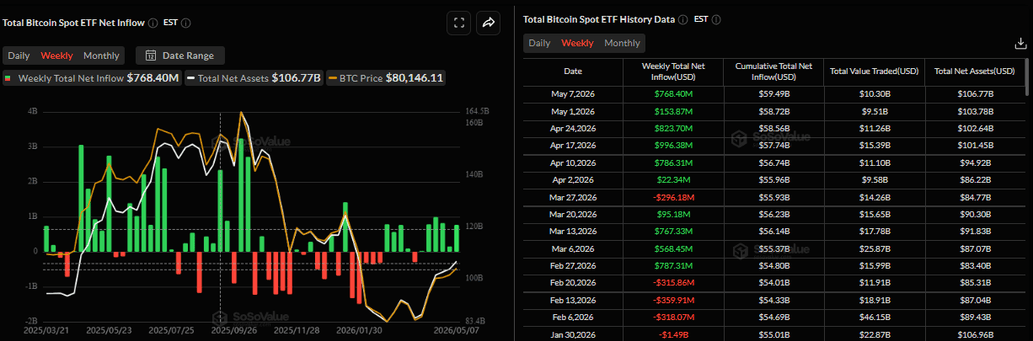
SoSovalue data shows that $BTC Spot exchange-traded funds (ETFs) recorded net inflows of $768.4 million through Thursday. Unless Friday ends with a very large outflow, U.S.-listed Bitcoin ETFs are on track for their sixth consecutive week of inflows, a streak of positive inflows that began in early April.
Trader profit taking causes price to fall
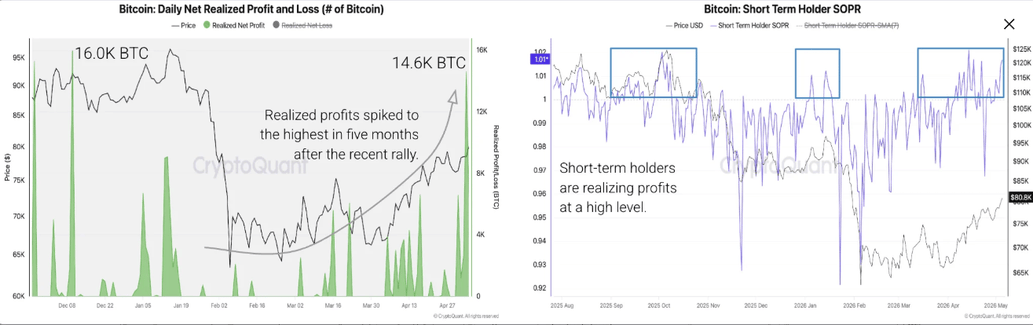
CryptoQuant’s weekly report on Thursday highlighted an acceleration in profit-taking in early May as Bitcoin hit a three-month high.
The graph on the left below shows that realized gains per day jumped to 14,600. $BTC The stock price on Monday was up 27% from April lows, putting holders back in profitable territory and at its highest level since Dec. 10, 2025. Meanwhile, the short-term holders (SOPR) on the bottom right rose to 1.016 and has been in clear profit-taking territory continuously since mid-April, confirming that the recent price rise has encouraged a wide distribution of holders.
“Historically, in bear markets, spikes in realized gains at key resistance levels precede regional price peaks and sustained declines,” the report said.
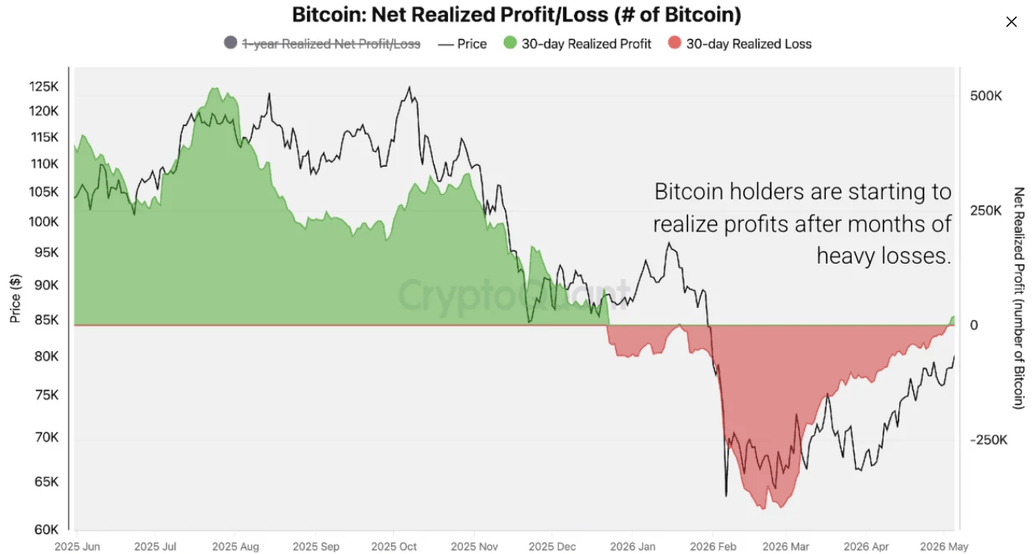
The report further explained that Bitcoin holders are realizing a net profit of +20,000. $BTC On a 30-day rolling basis, this was the first positive reading since December 22, 2025, after a significant net loss of -398,000 in February and March. $BTC.
“20,000 $BTC Net income is still well below 130,000-200,000. $BTC This is a threshold associated with a confirmed bull market regime transition and is comparable to the net profit level seen at the start of the bull market in March 2026, prior to price correction. “This distinction strengthens the classification of bear markets as bull markets, rather than structural regime changes,” CryptoQuant analysts concluded.
Apart from this profit-taking activity, as explained in the previous report, the current $BTC The price hike is primarily driven by persistent futures demand while the spot market remains contracted.
Traders should exercise caution as the current market structure is more speculative than fundamental and mirrors the pattern seen at the beginning of the 2022 bear market.
Uncertainty dampens risk sentiment
Uncertainty remains high in the Middle East as the United States and Iran exchanged fire late Thursday. The Guardian reported that Iran accused the US of violating the cease-fire agreement by targeting two ships in the Strait of Hormuz and attacking civilian areas, amid what the US claimed was a retaliatory attack. President Trump said the ceasefire remained in place despite the airstrikes.
The administration of US President Donald Trump is waiting to respond to Iranian offers to reopen the Strait of Hormuz and end the war. Iranian leaders have not said whether they will accept the terms of the deal, but so far there has been little sign that they would accept concessions on its nuclear program or a moratorium on uranium enrichment.
Risk assets such as Bitcoin corrected in the second half of the week as a new wave of uncertainty dampened risk sentiment. Further escalation or intervention by the US or Iran over the weekend could further weaken risk appetite and lead to further economic adjustment. $BTC.
Technical Outlook: Facing Rejection Near Overhead Supply Zone
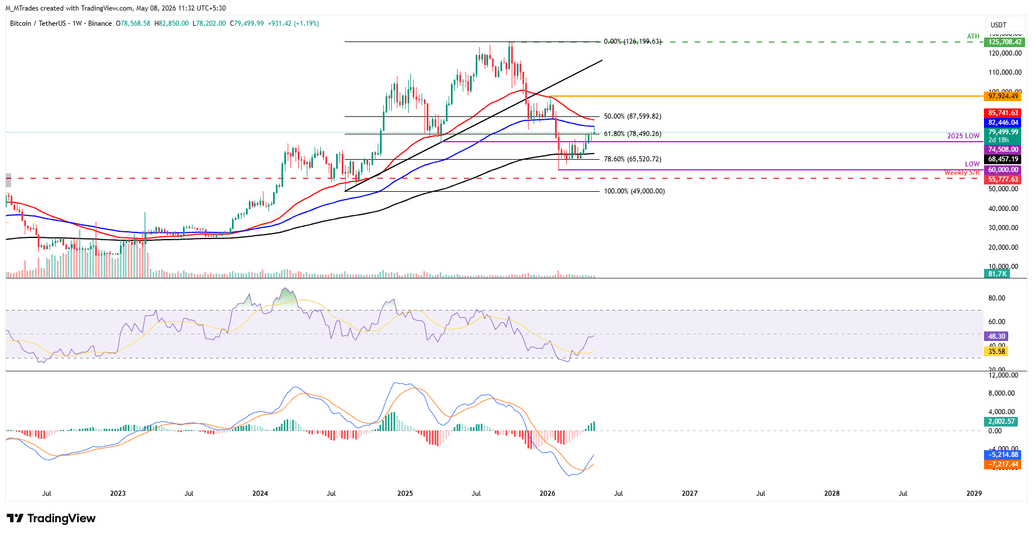
Bitcoin prices rose to a three-month high of $82,850 in midweek, but faced a pullback near the important 100-week exponential moving average (EMA) of $82,446, which acted as overhead supply. Despite the backlash, $BTC As of Friday’s writing, it remains up modestly for the week.
if $BTC If the correction continues, the decline could extend towards the key psychological support of $80,000. A break below this level could extend the pullback towards the 61.8% Fibonacci retracement level of $78,490 (from October’s all-time high of $126,199 to February’s low of $60,000).
Momentum has been mixed but improving, with the Relative Strength Index (RSI) on the weekly chart hovering around a neutral 48, while the Moving Average Convergence Divergence (MACD) remains firmly positive, suggesting bullish pressure is about to pick up again despite recent consolidation.
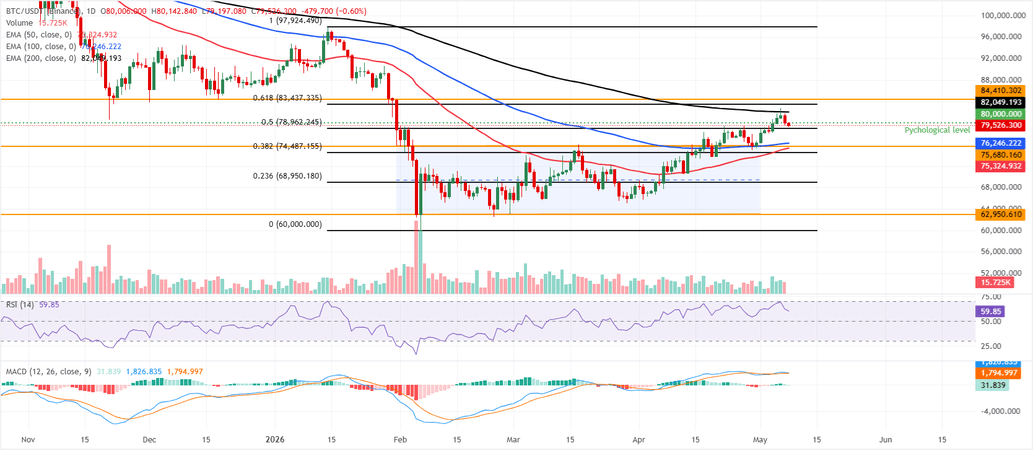
On the daily chart, CryptoKing was rejected at the 200-day EMA of $82,049, which is roughly in line with the 100-week EMA of $82,446 discussed above.
$BTC Price maintains a bullish bias in the short term as it remains above the 50-day and 100-day EMAs centered around $75,300 to $76,300, and comfortably above the 50% retracement at $78,962 (subtracted from January high to February low).
However, CryptoKing is capped by the $80,000 horizontal barrier, with a 200-day EMA of $82,049 and a 61.8% Fibonacci level of $83,437 forming a broad resistance band above it.
Momentum remains constructive, with the Relative Strength Index (RSI) holding near 59 and the Moving Average Convergence Divergence (MACD) line still slightly positive, suggesting that buyers remain in control but follow-through is weakening.
On the downside, the original support is now located at the recycled 50% retracement at $78,962, ahead of a dense demand zone where the 100-day EMA of $76,246 converges with the previous channel top around $75,680 and the 50-day EMA of $75,324.
A break below this band would expose a deeper retracement to the 38.2% Fibonacci level at $74,487, followed by a 23.6% Fibonacci retracement at $68,950. A sustained trade above $80,000 would pave the way for the 200-day EMA at $82,048 and resistance at $84,410, with the January high near $97,924 remaining a broad bullish target.
(The technical analysis in this story was written with the help of AI tools.)


