


What was once thought to be just internet gambling has grown into a huge multi-billion dollar industry. Recent data from early 2026 shows that this growth remains strong.
In 2025, the total trading volume of prediction markets, platforms where people speculate on the outcome of real-life events, exceeded $50 billion.
By the beginning of 2026, they were earning more than $20 billion a month.
According to a joint analysis between Bitget Wallet and Polymarket, one of the platforms, Polymarket, reported a trading volume of $25.7 billion in March 2026 alone.
Economic expansion is not driven by a limited number of high spenders. It’s powered by millions of loyal customers who return frequently to make small transactions.
“Prediction markets are becoming less about capital and more about consistent, repeatable action,” said Alvin Kang, chief operating officer at Biget Wallet. “What we’re seeing is a change in behavior. The market is growing not by large transactions, but by an increase in the number of taps per day.”
Polymarket’s Erden Mirzoan agrees, pointing out that traders are becoming more active and consistent. He believes that reaching new users is just as important as developing the platform itself.
Sports lead, retail traders dominate
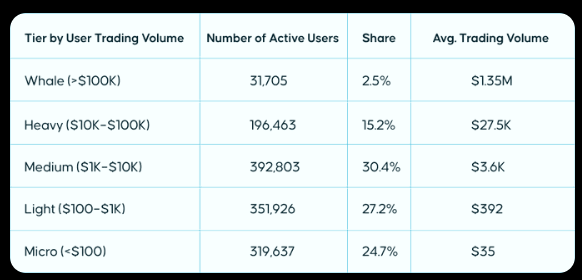
Data from 1.29 million wallets tracked in the first quarter of 2026 confirms this.
Users are logging in more frequently and trading across a wide range of topics, from sports and politics to finance, economics, and cryptocurrencies.
In the first quarter of 2026, sports led all categories with $10.1 billion.
The second largest category was the political market, which saw $5 billion in inflows during the same three-month period.
Approximately 82.8% of users traded less than $10,000 during this period, confirming that the sector’s expansion is built on activity volume rather than individual bet size.
The sector is being forced to expand its underlying infrastructure due to the retail boom.
Source: @BitgetWallet
For operators who want to offer prediction markets under their own brand without starting from scratch, a company called Shift Markets offers a white-label software application.
The program enables several hedging strategies, connects to liquidity sources such as Kalshi and Polymarket, and works with existing platforms.
“Prediction markets are growing so rapidly that trading platforms can no longer ignore them,” said Ian McAfee, CEO of Shift Markets. “Most carriers are already aware of the opportunity, but don’t have a clear path to entry without rebuilding their platform. Our software provides a practical way to do it while maintaining full control over the product and user experience.”
Competition in the prediction market intensifies
At the same time, established brands are losing ground to emerging competitors.
With its mainnet beta debut in November, XO Market is establishing itself as a direct competitor to Kalshi and Polymarket.
Market creation is the main feature.
XO Market allows users to build their own markets and receive a portion of the revenue that market generates, as opposed to traditional platforms that rely on internal staff to choose which events to list.
The platform has already processed over $150 million in trading activity since its introduction.
XO Market has raised $6 million to support its user-generated model and is preparing to launch a feature called XO Vaults. This allows ordinary users to provide liquidity to the market and profit from it. This function has traditionally been performed by specialized trading firms.
As a result of the major changes taking place, the industry is moving from being on the periphery of finance to being more aligned with the core financial infrastructure.
Uncertain regulations and continuing conflicts between federal and state oversight are just two of the challenges that lie ahead.
But with a mix of user-generated markets for players and white-label technology for carriers, prediction markets are more accessible than ever.
Technology may not have as much of an impact as trust on whether that momentum continues—that is, whether the mechanisms for resolving market outcomes can keep up with the rapid expansion in volume and variety of new markets.


