




Bitcoin traders are rebuilding their bets on a move towards $80,000 as geopolitical tensions ease, institutional demand remains solid, and a rally above $70,000 revives appetite for upside exposure after weeks of defensiveness.
At Deribit, owned by Coinbase, the largest crypto options exchange, the $80,000 call has been the biggest open interest strike this week, with about $1.5 billion tied up in contracts that will pay out if Bitcoin rises above that level.
This is also evident on on-chain options platform Derive, where open interest on the $85,000 strike has risen to around $60 million, and $100,000 calls are worth nearly $45 million.
This shift indicates a noticeable change in tone after traders spent a lot of energy buying protection against other bars.
However, Bitcoin has since rebounded from lows around $67,000 earlier in the week to trade above $70,000 as a temporary ceasefire between the US and Iran eased pressure on oil and stabilized broad risk sentiment.
Nevertheless, the market has not completely let down its guard, with downside protection continuing to be bid up over longer maturities and parts of the futures market remaining defensive.
Option traders turn higher
The strongest evidence of improved market sentiment came from traders reconsidering their positions after the ceasefire was announced.
On April 8, Deribit Insights revealed that one of the dominant structures heading into Easter included buying April 24 puts at $61,000 and $62,000 strike prices, indicating investors are still preparing for a deeper washout.
However, after geopolitical headlines improved, these positions were rolled up to $65,000 and $66,000 strikes on a premium neutral basis, reducing nominal downside by more than half.
At the same time, traders were buying April 10 call condors for $74,000 to $80,000 in hopes of short-term upside.
This relocation was also reflected in options. For expirations less than 7 days, the skew transitioned from favoring puts to a flat profile as demand for calls returned. The increased implied volatility leading up to President Trump’s deadline held up even as prices rebounded, allowing long gamma holders to exit their positions with profits tied to both price direction and volatility.

Glassnode said volatility compression deepened further across the curve as near-term stress pricing eased, with front-end implied volatility falling to the low 40s.
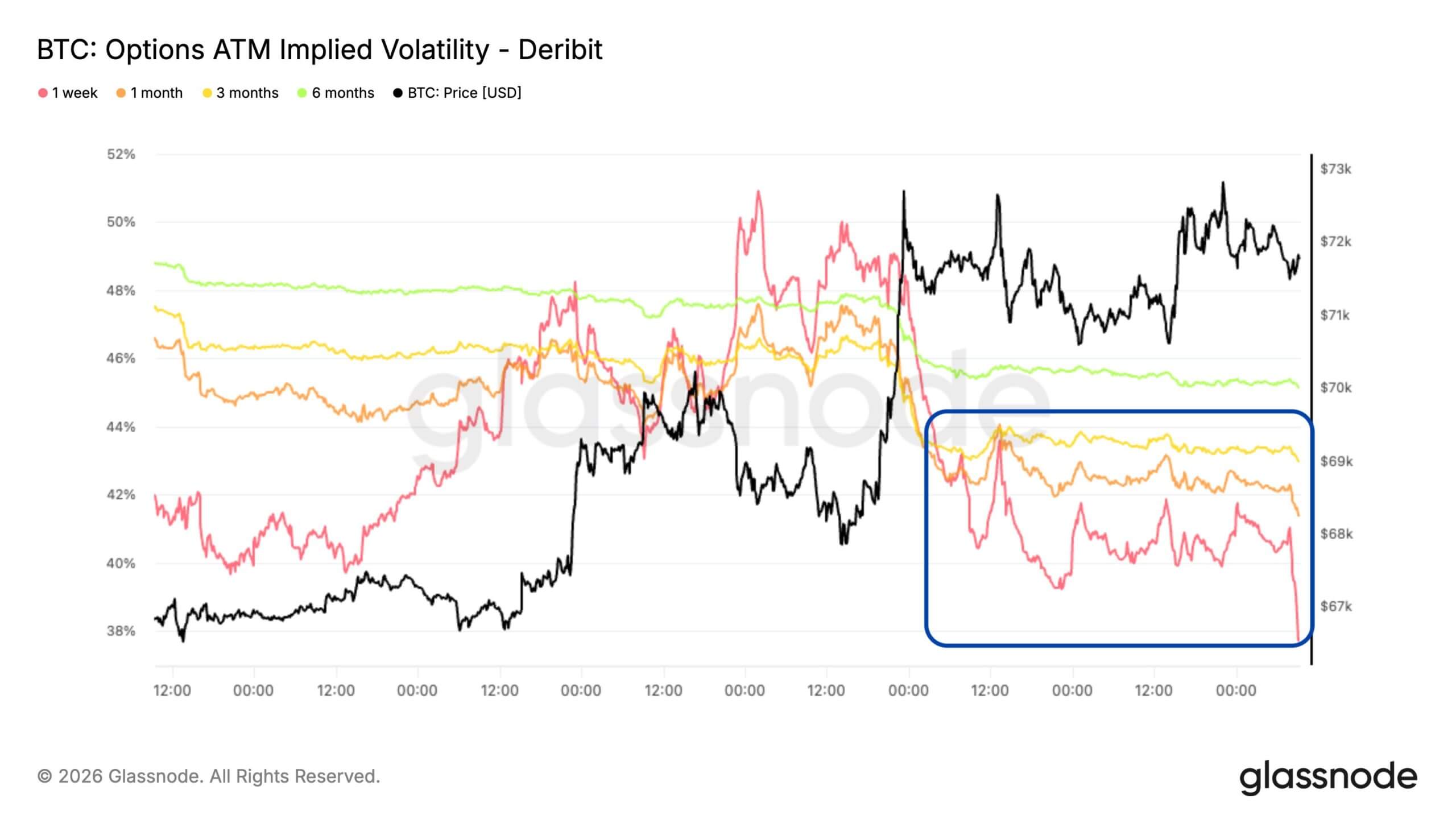
The company said its overall positioning remains light, with the ceasefire reinforcing expectations that the near-term backdrop will be quieter, although cheaper options could attract fresh activity in upcoming macro events.
The easing of the ceasefire eases one pressure.
The macro context helps explain why the crypto market has been willing to move towards more bullish bets.
Market participants noted that Bitcoin’s recent recovery paralleled a move in lower oil prices after a temporary cease-fire between the United States and Iran eased fears of a deeper supply shock in the Middle East. The fall in oil prices alleviated one of the most pressing inflation risks facing global markets and helped stabilize sentiment across risk assets.
The move was significant for Bitcoin, as the market has been trading as a macro-sensitive asset for several weeks. Traders were also focused on crypto-specific indicators, as well as oil, bond yields and Fed expectations.

The pause in geopolitical escalation therefore provided a reason to reduce some of the defensive positions established during the conflict.
However, macro photography is still mixed. According to the latest US Consumer Price Index, the inflation rate was 3.3%, the highest level since May 2024, and the monthly index rose 0.9%, the largest increase since mid-2022.
These numbers continued to weigh on expectations for aggressive monetary easing from the Fed. Markets are currently pricing in a roughly 30% chance of a rate cut of at least a quarter of a percentage point in December.
These developments leave plenty of room for bailouts to pick up once geopolitical pressures ease and oil prices stop adding to the inflation argument.
The Bitcoin options market appears to be trading in that window. The focus on $80,000, $85,000, and even $100,000 reflects the market’s willingness to test higher levels if macro pressures continue to ease. On-chain pricing models help explain why these strikes are gaining traction.
Glassnode’s key reference levels place the average for active investors at $85,000, the cost basis for short-term holders at $81,300, and the true market average at approximately $78,000.
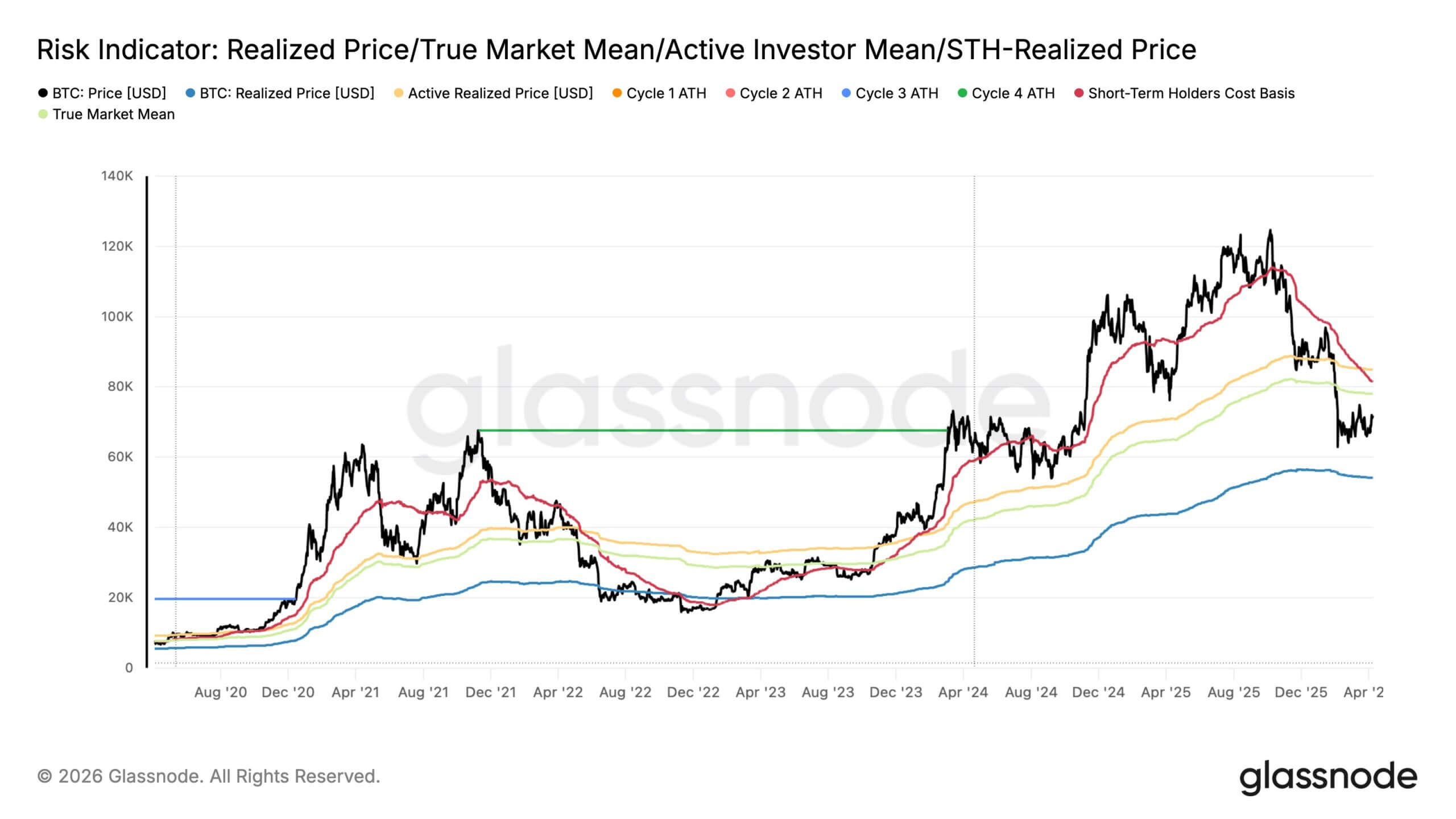
The recent spot price is around $71,800, and these levels form a dense band of indirect resistance, with potential price discovery if buyers continue to push. In contrast, the realized price was much lower at $54,200, demonstrating how much the market remains above its total cost basis even after the latest drawdown.
Essentially, the cluster between $78,000 and $85,000 helps explain why $80,000 is the focus. The company is located in the middle of a zone where some of the overall cost base of the market starts to come together.
Bitcoin on-chain data still shows repair stage
However, the bullish turn in options does not resolve the broader debate over where Bitcoin sits in the cycle.
Joanne Wesson, founder of blockchain analysis firm Alpharaktal, said one of his key signals still points to the risk of another drop before a more sustained rally takes hold.
He highlighted crossovers, where investor prices fall below realized prices for long-term holders, and said this structure has historically emerged during a long accumulation phase rather than at the beginning of a new momentum.
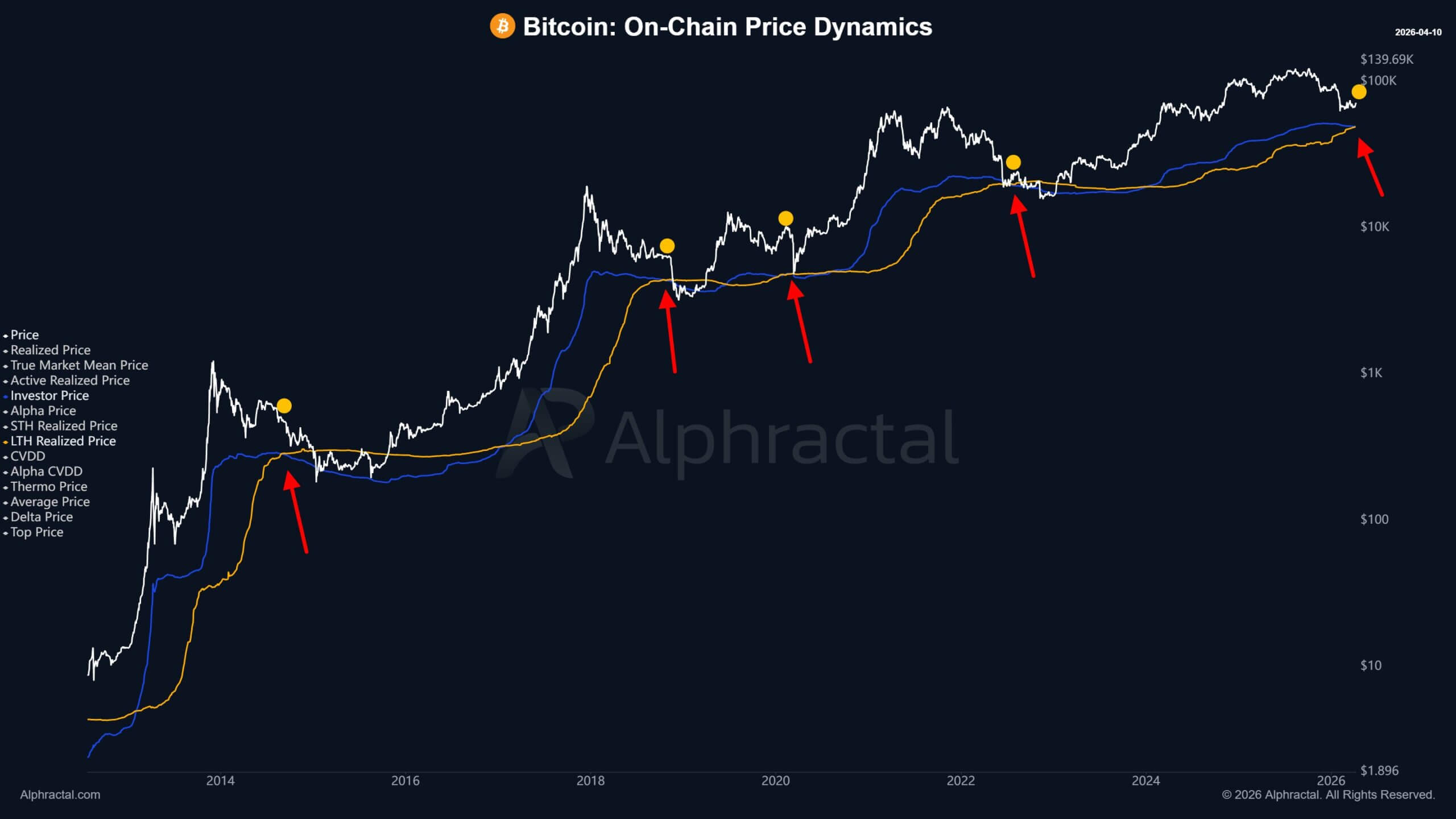
In practice, this means that newer, more active capital has accepted a lower price than the price paid by long-term holders. Control of the market then tends to shift from speculative participants to holders with longer horizons.
This means that while volatility may slow, it will be harder to maintain upside as the rally hits supply from investors looking to exit closer to breakeven.
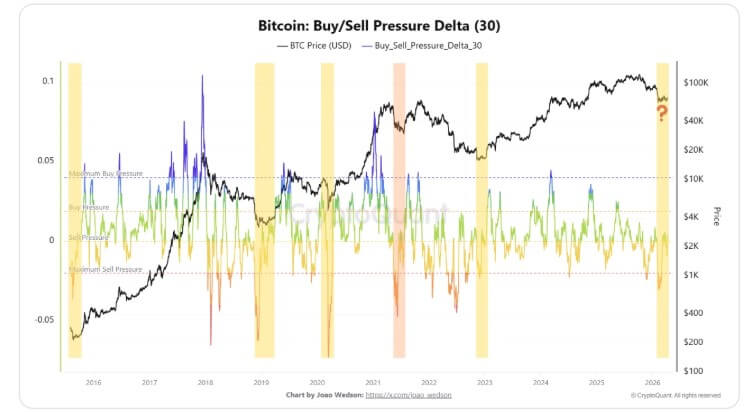
CryptoQuant described the current period in similar terms. According to the company’s data, stress conditions for Bitcoin appear to be easing, but demand has not yet reaffirmed strongly enough to indicate a clean reversal.
The blockchain company said BTC’s buying and selling pressure delta is breaking away from extreme selling levels, a sign that capitulation may be fading, but it has not yet returned to buying pressure territory. Therefore, the market is left in the gap between forced selling and new directional demand.
Additionally, BTC’s derivatives position is still not one-sided. Glassnode said seven-day taker flows have become more balanced but are still skewed negative due to short calls and long puts.
This means that while BTC’s rally continues to attract hedging activity at high levels, explosive strength is still being used to sell on top.
In particular, the gamma position of the top asset shows a similar split. The long gamma between $69,000 and $70,000 provides short-term support near the spot price.
On top of that, there is a large pocket of short gamma overhead. If support fails, the market could quickly move back toward the mid-$60,000s as hedge flows accelerate in the opposite direction.
Can Bitcoin reach $80,000?
If Bitcoin sustainably rises towards $80,000, option positioning alone is likely not enough. The rally will require support from spot flows, especially through ETFs and asset management channels that can absorb long-term supply.
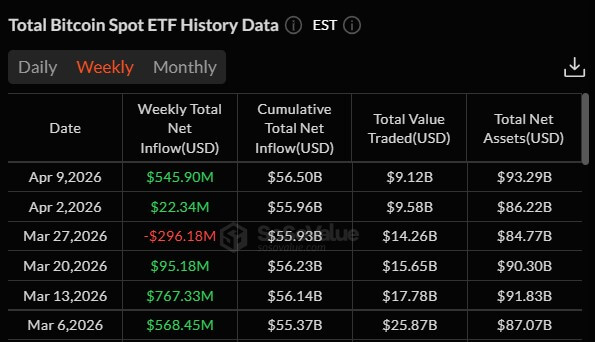
Its support is starting to improve. The U.S. Spot Bitcoin ETF is on track for its largest weekly inflow pace in five weeks, with $545.9 million in inflows over the past week, according to SoSoValue data.
Morgan Stanley’s new Bitcoin ETF has added to its momentum by attracting more than $46 billion in inflows in its first two trading days, and Bloomberg ETF analyst Eric Balciunas predicts the fund could attract more than $5 billion in assets within its first year.
The launch has broader implications because of Morgan Stanley’s influence. The bank’s 16,000 financial advisors oversee approximately $6.2 trillion in assets and have developed a distribution channel that rivals rival.
Therefore, these trends indicate that institutional investors are willing to add BTC exposure again rather than waiting for all geopolitical risks to dissipate first.
Still, that doesn’t mean the path to BTC is clear. Data from CryptoQuant shows that futures positions on Binance, the largest crypto exchange by trading volume, are expanding and bearish bets are increasing.
According to the company, Binance’s open interest increased by approximately $350 million in seven days, the largest increase since March 20, but cumulative net taker volume did not increase with the same momentum.
This divergence may indicate that a significant share of the new leverage is tied to short-term exposure, or at least a more cautious stance than spot moves alone would indicate.
In other words, the market is no longer in a position to collapse anytime soon, but it is also no longer unified behind a breakout.
Notably, cryptocurrency traders in prediction markets echo similar sentiments. Polymarket gives users a 26% chance that Bitcoin will exceed $80,000 this month and a 9% chance that it will reach $85,000. However, more than 30% of bettors still expect the token to return to around $65,000.
For now, the clearest message is that traders are starting to set higher limits. The $80,000 strike is the focus of that view, supported by the recent price rebound, lower macro stress and improved institutional capital flows.
Skew, futures positioning, and lingering hesitancy in on-chain data suggest the market is still looking for evidence. Until that evidence arrives, Bitcoin’s rally is likely to remain first in a recovery trade and then a breakout trade.
(Tag translation) Bitcoin


