

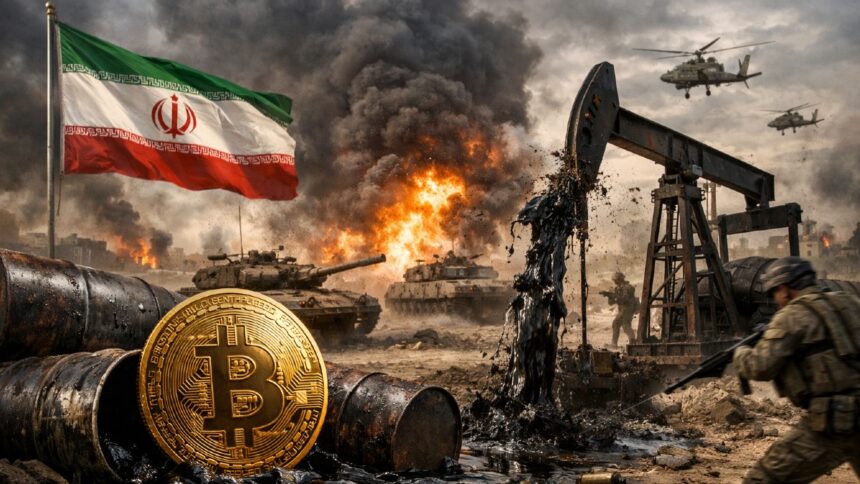
On-chain analytics firm Chainalysis warned on April 10, 2026, that shipping companies that follow Iran’s proposal to pay tolls through the Strait of Hormuz in cryptocurrencies face the risk of international sanctions. The report says the network’s transparency allows regulators to identify counterparties to transactions, even as the Iranian government seeks to circumvent the traditional financial system.
The plan, confirmed by official sources and reported by CriptoNoticias on April 8, contemplates charging $1 per barrel of crude oil. Iran requires these funds to be processed in Bitcoin, stablecoins, and renminbi through intermediaries in the Islamic Revolutionary Guards Corps (IRGC), an organization under U.S. sanctions.
Hamid Hosseini, spokesman for the Iranian Oil Exporters Union, said: This system allows for quick payments to avoid tracking and confiscation.
Explaining the mechanism, Chainalysis points out that the process begins with ship owners contacting Iranian authorities to register vessel and cargo data, before negotiating tolls and receiving permit codes.
Ships can pay with Bitcoin within seconds, ensuring they can’t be tracked or confiscated by sanctions.
Linkage analysis.
The company said in the report that unlike stablecoins such as Tether’s USDT and Circle’s USDC, Bitcoin Technically, it cannot be frozen by a central publisher.
The only real way to disrupt BTC transactions is to force them directly on the parties involved (in this case the carrier or company making the payment), and not through the decentralized network created by Satoshi Nakamoto.
On the other hand, if a wallet linked to the IRGC is identified, stablecoin payments may be frozen by the issuer. Therefore, Chainalysis, despite mentioning Bitcoin, Iran likely to use stablecoins for stability and liquidity.
Stablecoin vulnerabilities
Historically, regimes have used stablecoins. This is because US dollar backing ensures value maintenance and provides the liquidity needed for large-scale use. With the Iranian rial plummeting and Iran’s economy remaining in crisis, the regime’s reliance on stablecoins has gained strategic importance. Bitcoin, on the other hand, experiences constant price fluctuations. BTC has been primarily used by Iranian cybercriminals because it has no issuer and cannot be confiscated or frozen by intermediaries.
Linkage analysis.
However, this chainanalysis analysis presents a logical contradiction from the perspective of sovereign security. The company prioritizes stablecoin price stability and liquidity, but this is based on the following facts. These do not have the guarantee of final resolution that Bitcoin provides against sanctions.
While Bitcoin volatility is a market risk that can be managed through hedging strategies, the use of stablecoins represents a systemic risk of complete expropriation.
For an actor in the greatest financial straits; Assets that are unstable but not seized are technically more viable It is better than stablecoins, whose flows can be unilaterally interrupted by a private issuer.
However, because the proposal is in its early stages, there is no polarizing public debate on the issue. The main controversy centers on the risk of sanctions. This means shipping companies that make payments to sanctioned Iranian companies are violating U.S. law and could face fines and asset freezes.
Chainalysis highlighted that while Bitcoin offers better technical protection against freezes, on-chain traceability still allows flows and counterparties to be identified.
Iran’s proposal is still at the declaration stage and its effective implementation has not yet been confirmed. meanwhile, Chainalysis indicated it will continue to monitor on-chain activity Detect irregular flow.
The case highlights the complexities faced by sanctioned nations seeking to adopt crypto assets, but also highlights the strategic benefits of the Bitcoin network.
By operating as a decentralized global network, Bitcoin provides transaction purposes that do not rely on the approval of banking intermediaries or foreign governments, allowing for the uninterrupted exchange of value.
This resistance to censorship and its apolitical nature They position it as a means of financial sovereignty.This is because, unlike fiat currencies and stablecoins, it cannot be arbitrarily severed by a central authority.
(Translate tag)Bitcoin (BTC)


