


Bitcoin news today is dominated by sudden reversals in market sentiment. After an impressive rally earlier this week that pushed Bitcoin prices towards the $76,000 resistance level, the major cryptocurrency experienced a sharp correction. On Thursday, March 19, 2026, Bitcoin traded at its lowest price, falling below the psychologically important $70,000 level. $69,400 During the European session.
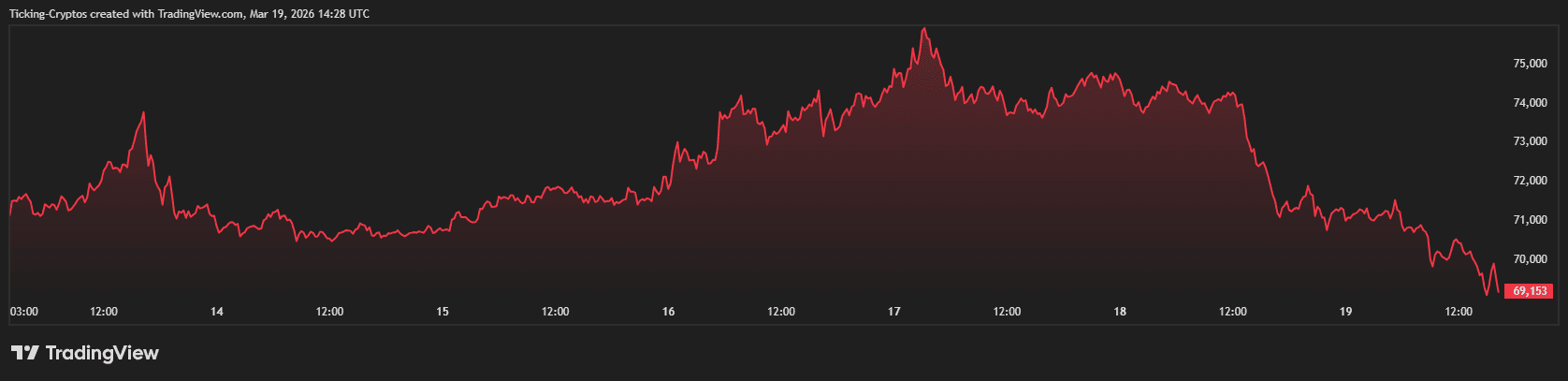
Bitcoin price in USD over the past week
This decline follows a period of strong optimism fueled by institutional ETF inflows and the SEC’s recent commodity classification of 16 digital assets. However, the combination of the US Federal Reserve’s “hawkish hold” and rising geopolitical tensions in the Middle East have forced investors to return to a defensive stance.
Why is Bitcoin crashing?
The main reason for today’s Bitcoin price decline is a “perfect storm” of macroeconomic factors. Specifically, the Federal Reserve’s decision to keep interest rates at a cap. 3.50%~3.75% Coupled with the rise in global oil prices (Brent crude above $114), the range of oil prices rose, the US dollar strengthened, and appetite for “risk-on” assets like cryptocurrencies diminished.
“Hawkish hold” and risk appetite
From a financial point of view, “Hawkish Hold” This happens when a central bank leaves interest rates unchanged but uses rhetoric that suggests interest rates are likely to remain high or even rise for an extended period of time.
This is a significant headwind for Bitcoin. because $BTC is often considered a high-growth speculative asset, and its valuation is highly sensitive to liquidity. Even if the Fed signals that it is not ready to cut rates, the “cost of carry” for holding Bitcoin remains high compared to “safe” yields like U.S. Treasuries.
Federal Reserve Effect: High Interest Rates and Inflation Concerns
The Fed’s March meeting was the main catalyst for the volatility we’re seeing today. bitcoin news. Markets had expected rates to stabilize, but the updated “dot plot” and comments from Chairman Paul Atkins (who took over the SEC and influenced broader policy) suggested that inflation remained a stubborn enemy.
- Inflation forecast: The Fed has raised its 2026 PCE inflation outlook as follows: 2.7%.
- Growth prospects: Growth forecasts for 2026 have been raised to: 2.4%giving the Fed more leeway to keep interest rates high without imminent fear of a recession.
- Market reaction: The probability of an April rate cut has plummeted to almost zero, with some traders currently pricing in a 4% chance of a rate cut. hiking As energy costs continue to rise.
Geopolitical tensions: the oil factor
Beyond the Fed, the escalating conflict in the Middle East is also sending shockwaves through energy markets. Attacks on energy infrastructure have led to soaring oil prices, which have historically led to higher transportation and production costs, further fueling inflation.
In previous cycles, Bitcoin was sometimes touted as “digital gold” or a safe haven. However, recent cryptocurrency news suggests that in times of severe geopolitical stress, $BTC It often moves in lockstep with the Nasdaq 100, which also saw a significant drop today. Investors are now seeking the safety of the US dollar and physical gold over digital assets.
Institutional sentiment: ETF inflows turn into outflows
A key pillar of the recent rally has been consistent demand from US-listed spot Bitcoin ETFs. Seven consecutive days of inflows totaling more than $1.1 billion stopped on Wednesday, according to CoinGlass data.
From a technical perspective, Bitcoin is $76,000 This level is a bearish signal in the short term. Price is currently testing the 100 hourly simple moving average. Analysts have warned that failure to maintain the $69,000 support level could result in a fall towards $69,000. $66,500 The zone that served as a floor in early March.


