

Cryptocurrency exchange Bybit has reaffirmed its commitment to the Middle East and announced the appointment of a new country manager to increase its presence in the Middle East and North Africa (MENA) region amid escalating global conflicts.
Tensions in the Middle East increased after the United States and Israel launched attacks on Iran last month. In response, Iran retaliated against several neighboring countries, including the United Arab Emirates (UAE), where Bybit maintains a major regional presence.
Bybit co-CEO Helen Liu said the company has no plans to scale back its Middle East operations in light of the conflict.
“While some companies are now reevaluating their exposure to the Gulf, we are doing the opposite. We are deepening our presence, investment and commitment to the region,” he said.
“We continue to invest in local talent, regulatory compliance and community partnerships. The UAE’s vision to become the world’s leading digital asset hub will not be undermined by this crisis. If anything, the resilience the country is demonstrating only strengthens why we chose to build here.”
Cryptocurrencies are often used during crises, as citizens seek to preserve their assets amid concerns about the instability of the traditional banking system.
Nobitex, a major Iranian cryptocurrency exchange, experienced a surge in withdrawals immediately after the Tehran attack.
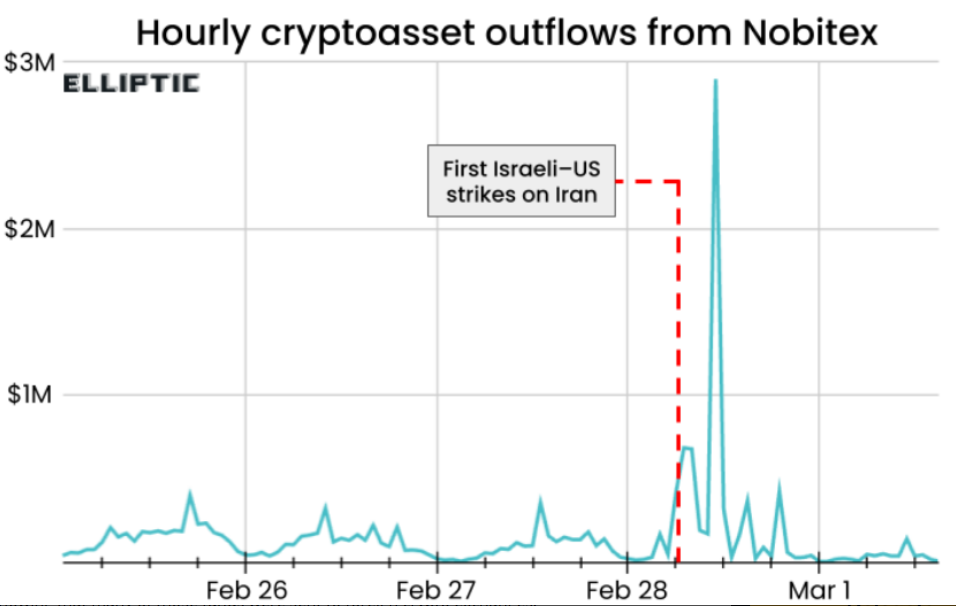
Cryptocurrency outflows to Nobitex spiked within minutes of the Tehran attack. sauce: oval
Bybit appoints new MENA country manager
Derek Dai has been appointed as Bybit’s new country manager for the Middle East and East Africa region, the exchange announced. His role includes overseeing market expansion, regulatory cooperation, institutional partnerships, and localized product development.
Related: UAE central bank says financial system is stable despite missile and drone attacks
Bybit also said it has taken several measures to protect its UAE-based employees, including daily check-ins, real-time safety checks, and relocation and travel support.
Dai said the Middle East is becoming a pivotal region for the future of cryptocurrencies. Over the coming months, Bybit will focus on expanding access to UAE dirhams and building partnerships with banks and payment providers.
“Our priority is to deepen our collaboration with financial centers such as DIFC (Dubai International Financial Center) and DMCC (Dubai Multi Commodity Center),” he said.
Bybit added that it also wants to strengthen “the infrastructure that connects digital assets to everyday financial services and the development of tokenized real-world assets that bridge traditional finance and the digital asset economy.”
Approximately 1,800 cryptocurrency companies operate in the UAE and employ more than 8,600 people. Abu Dhabi, the capital of the UAE, also saw a 67% increase in the number of new licenses issued in the ADGM Financial Free Zone in early 2025 compared to 2024.
magazine: The debate over Bitcoin’s four-year cycle is over: Benjamin Cowen


