

Even if investors read VCI Global’s SEC filings, it may be difficult to understand its dangerous connections to Tether and Solana.
In 2025, amid a kind of information vacuum and other executives’ disappointments, if you have held VCI Global shares since the start of trading with the announcement of the “100 Million OOB Token Digital Asset Financial Transaction”, you will have suffered a 31% loss in less than 4 weeks.
Long-term shareholders have fared even worse. Since the beginning of this year, everyone’s investments have suffered catastrophic losses of 99.9%.
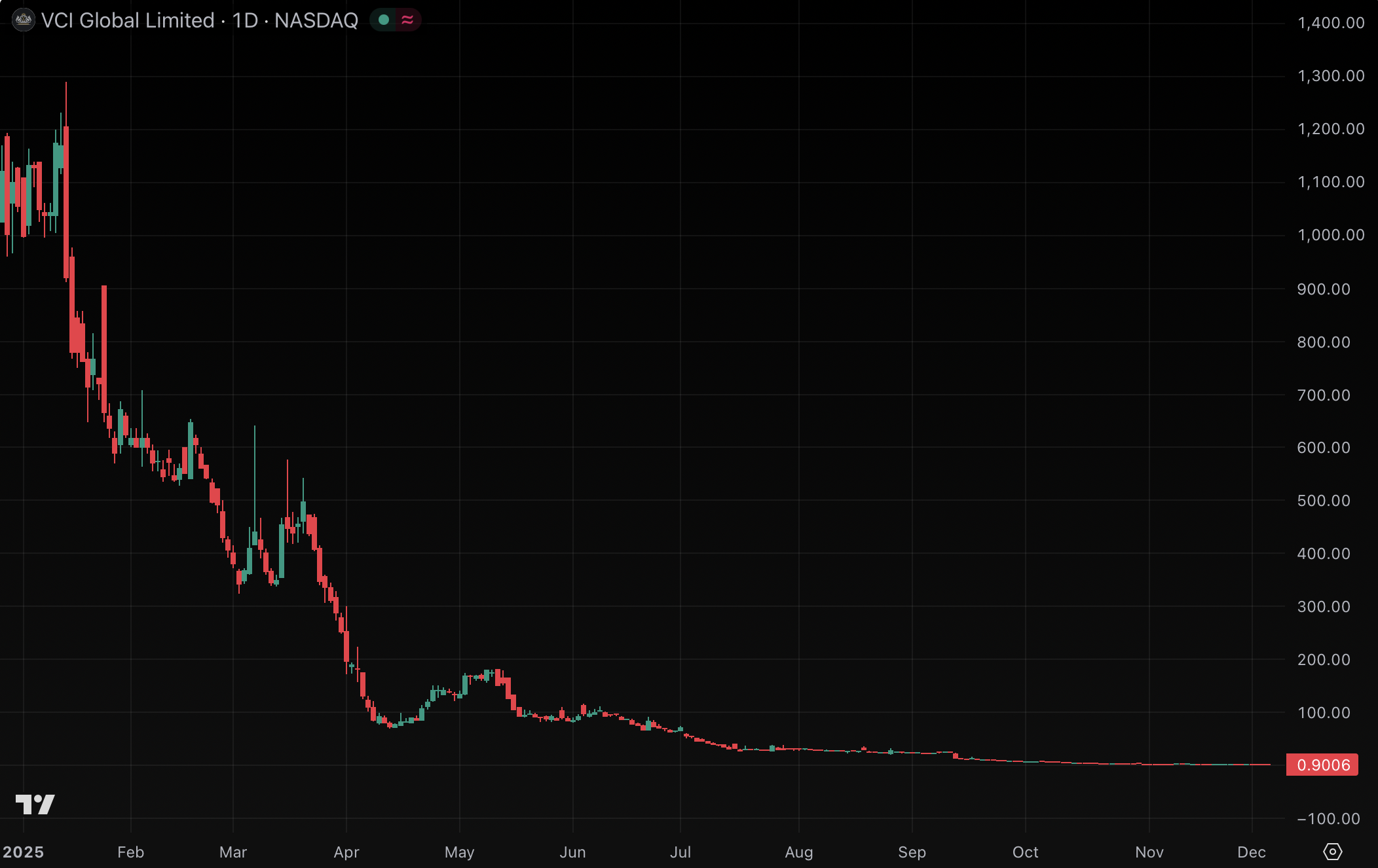
VCI Global charts from the beginning of the year to the present. Source: TradingView
Oobit (OOB) is a tap-to-pay app that uses its own tokens and stablecoins like Tether (USDT) for mobile device payments.
VCI Global is a microcap Nasdaq stock with a market capitalization in the single digits of millions of dollars and a float of less than 24,000 shares.
The company, based in Kuala Lumpur, Malaysia, appears to be having a problem with CEO impersonation fraud, according to a prominent notice on its homepage.
That’s just the beginning of the problem. On November 26, the company claimed to have acquired 4,174,603 additional OOB tokens “from the open market,” but the disclosure did not mention that it acquired the majority of OOB without purchasing it, ignoring market forces due to OOB’s exchange listing.
Specifically, the company already owns 250 million OOB tokens, the price of which was set before the tokens were traded on Kraken or any other major exchange. Buying 4.1 million tokens at $0.24 was an investment of just $1 million.
The company characterized the small acquisition and 1.6% increase as “the early stages of a US$50 million accumulation plan.”
Focusing on what really matters, 98.4% of the company’s OOB holdings were transferred by investors who received 50 million shares of VCI Global stock and pre-funded, immediately exercisable subscription rights.
Tether’s PIPE available OOB at cheap price
These 250 million tokens were priced favorably at $0.20, 73% lower than the headline 48-hour high of $0.73.
The company brazenly claimed that with this transfer of 250 million tokens, it had “paid” the entirety of VCI Global’s $50 million private equity public offering (PIPE) without any actual cash transactions or intermediaries.
On the other side of the transaction, Tether Investment Limited received 39.8% of PIPE shares.
Tether, who spans both sides of the deal, is also OOB’s top investor, along with Solana co-founder Anatoly Yakavenko, who is leading the Series A funding.
In other words, the entity that agrees to price OOB tokens is the same entity that receives the majority of PIPE shares.
Read more: Tether has taken over the White House and is currently demolishing it to build a ballroom
All of this relies on Kraken maintaining OOB for trading
“This structure allows for an effective change of control without triggering 13D,” said Corey Klipsten, a Tether critic who has been involved in lawsuits against the stablecoin giants.
Mr. Klipsten characterized VCI Global’s lack of an SEC Form 13D and other factors as “a potentially material violation of SEC Rule 12b-20.”
Protos does not take an opinion on the allegations and only U.S. securities attorneys can provide advice regarding these documents.
The timing, pricing, and treatment of both parties to the transaction are certainly interesting. Other exchanges such as Kraken and KCEX activated trading pairs for OOB tokens within 48 hours of the November 10th VCI Global trade.
In fact, a significant portion of the trading clearly relies on Kraken’s OOB trading pairs remaining operational.
If Kraken suspends or withdraws its OOB listing within six months, VCI Global “shall have the right to cancel this Agreement” by returning the OOB and canceling the issued VCI Global shares.


