

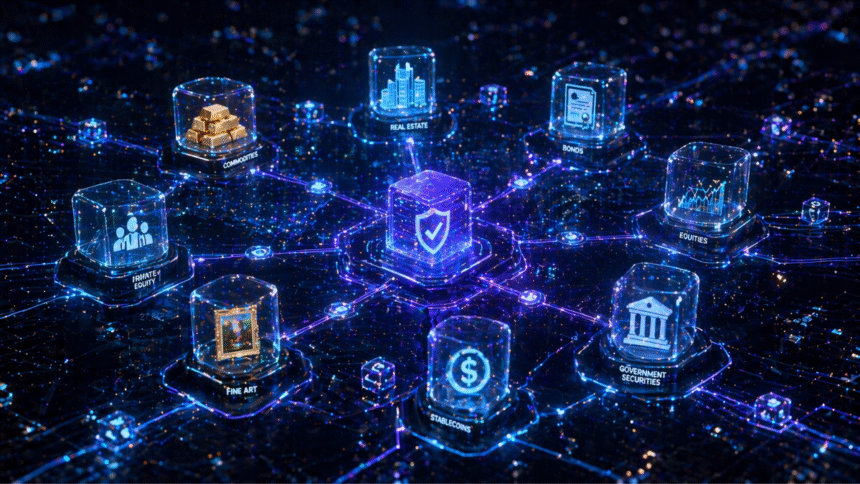
The majority of tokenized assets are simply digital copies, or “receipts” of assets that reside in infrastructure outside of the cryptocurrency accounting network. This is a key finding in Pantera Capital’s recent report on the state of tokenization in Q1 2026.
According to the company’s research director, blockchain today only serves to distribute or display tokenized assets more quickly and visually; They cannot replace traditional infrastructure or introduce the true nature of Bitcoin-inspired technology..
Today, it’s less about reinventing on-chain finance and more about distributing familiar products on new rails. This is similar to the early Internet stage of “newspapers on websites.” Assets are distributed on new rails, but are still largely limited by off-chain processes and infrastructure.
Dunning, director of research at Pantera Capital.
The conclusions regarding the current state of tokenized assets report are supported by the Tokenization Progress Index (TPI), a metric created by Pantera Capital. Measures how close we are to real-world assetsThings like stocks and traditional investment products will move entirely to on-chain infrastructure.
Specifically, the instrument measures three aspects or elements of on-chain “maturity”: issuance and redemption, transferability and settlement, and complexity and feasibility. The index assigns each dimension a score from 1 to 5 to create a composite TPI score.
What does the data show about tokenization maturity?
According to the results of applying the index, which tracks 593 assets (totaling $320.6 billion) across the tokenization market. Only 2.7% of tokenized assets reach “native” level of maturity. 77.6% of tracked assets fall into the “wrapper” category, i.e. wrapped digital tokens, which allow them to operate on a “blockchain” without changing their fundamental legal or financial nature.
Meanwhile, 11.1% consider themselves “hybrid,” meaning they combine traditional and native characteristics.
CoinGecko reports that the market for tokenized real-world assets (RWA, excluding stablecoins) grew 256.7% from $5.42 billion at the beginning of 2025 to $19.32 billion at the end of Q1 2026.
Tokenization: Bitcoin technology applied without sovereignty
What this data shows is that almost every tokenization in the market has a traditional administrator or custodian, such as BlackRock. They will still control who can mint, redeem, and burn tokens.
“Most of what we call ‘tokenization’ today is just traditional paper digitized. It’s a one-to-one replica of traditional finance with receipts on the blockchain.”
asset management company Pantera Capital;
In practice, the current state of tokenization means the following for end users: that he has no real custody or sovereignty over his assets.
Tokenized assets such as bonds, credit, and real estate will continue to be held by banks and companies such as BlackRock and BNY Mellon. Tokens require manual approval from the issuer to be redeemed or used as collateral. Counterparty risks, blocks and freezes and frictions common to traditional finance.
(Tag translation) blockchain


