

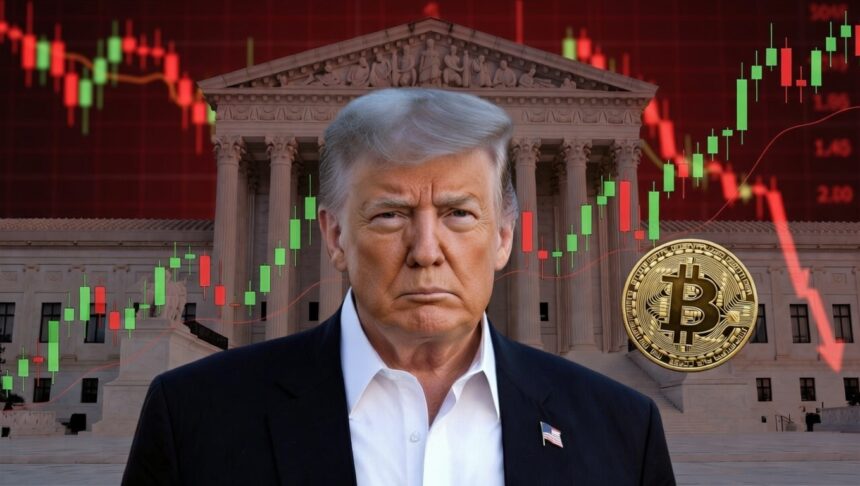
The U.S. Supreme Court on Friday, February 20, struck down tariffs on imports that President Donald Trump overstepped his authority to impose. But the president responded that he would continue to use this tool through other legal channels within his power.
These developments open a new chapter in the trade dispute and renew its impact on financial markets. In that context, Bitcoin author and educator Adam Livingston suggested why tariffs declared illegal could be bullish for Bitcoin (BTC).
According to their analysis, over the past 18 months, Investors were internalizing a ‘tax on political uncertainty’ arising from new trade barriers and the potential for retaliation between nations. “Bitcoin trades as a barometer of global stress,” he said, reflecting changes in macroeconomic risk perceptions.
The expert highlighted that since the tariffs were announced on the so-called “Liberation Day” in April 2025, the price of Bitcoin has fallen from $82,525 to $66,595, which corresponds to a drop of nearly 19%. Meanwhile, the correction from the historic high of USD 126,000 marked in October 2025 is approximately 46%, and this movement can be attributed to a reduction in risk exposure by investors.
Livingston argued that Tariff elimination reduces the likelihood of inflation shocks It derives from sudden commercial measures and contributes to the compression of the market risk premium. In his view, this could favor a revaluation of assets by institutional and macroeconomic capital.
Potential liquidity effects
This decision was also interpreted as an economic liquidity factor. Financial journalist Murtuza J. Merchant said about $150 billion in illegal tariffs would be returned. Could represent an “incidental injection of funds” into the virtual currency market.
“Bitcoin is on the defensive as new capital flows have essentially dried up. This ruling requires money to be returned to the private sector, which is currently facing intense political uncertainty,” Merchant added.
Analysts suggested that some of the funds would be allocated to financial markets. Could act as a catalyst for Bitcoin priceby correcting the liquidity dynamics that have limited recent performance.
However, the market’s immediate reaction was slow. According to Livingston, both the US stock market and cryptocurrencies did not have a strong upward reaction due to expectations of a political response that maintained uncertainty, but it did not take long to arrive within hours.
After hearing the court’s decision, President Trump criticized the ruling, saying it favored other countries over the United States. As he emphasized, this will allow us to maintain established tariffs while adding new tariffs to strengthen the country. Under that paper, announced a new 10% tariff on all world imports..
“Welcome to modern America, where the rule of law triumphs and empires find loopholes faster than you can update your stock app,” Livingston commented.
President Trump maintains trade pressure despite ruling
The author argued that the market emphasizes predictability and that a succession of decisions and countermeasures is important. maintain an environment conducive to economic anxiety;. In his opinion, this environment is creating a dual dynamic for Bitcoin.
According to the educator, uncertainty and limited liquidity could negatively impact prices in the short term due to being treated as a risky asset. However, in the long term, these events strengthen the narrative of Bitcoin as an alternative to monetary systems subject to political decisions.
In the short term Bitcoin suffers from the disruption, but in the long term it clearly benefits from it as it signals the need for an exit. Bitcoin sits on the sidelines, quietly gathering followers in this environment as the empire repeats another season of economic policy live from its panic room.
However, if the tariff cannot move forward due to a court decision, the author We see a bullish market reaction as possible.. However, other analysts believe this scenario could increase uncertainty about how the government will support the budget deficit.
“If the courts ultimately require the Treasury to return a significant portion of previously collected customs revenues, the resulting deficit will have to be financed by increased issuance,” said Dan Silk, global head of short-term and liquidity at Janus Henderson.
In this sense, Volatility is expected in the market It depends on how this scenario plays out. All eyes will be on how the courts will respond, and on the trade war that President Trump is promoting, with no end in sight.
This situation occurs in a year when Bitcoin is expected to be bearish according to historical patterns. As reported by CriptoNoticias, digital currencies always reach the end of their uptrend the year after a halving, the most recent of which was in 2024.
(Tag Translation) Bitcoin (BTC)


