



Vitalik Buterin said that Ethereum’s new “fast confirmation rule” could give users strong guarantees that blocks will not be reversed after a single slot, or about 12 seconds, and that this change would significantly reduce one of the network’s biggest real-world frictions in exchanges, bridges, and layer 2 systems.
The proposal, which was publicly explained by Ethereum Foundation researcher Julian Ma and supported by X’s Buterin, aims to narrow the gap between Ethereum’s strong security model and the slow confirmation times that are shaping the user experience across the ecosystem. In Buterin’s words, this mechanism “gives us a firm guarantee that Ethereum will not revert after one slot (12 seconds). The security prerequisites are (i) majority honesty, and (ii) maximum network latency of less than 3 seconds. Therefore, although it falls short of economic finality, it is very powerful for many use cases.”
New Ethereum rules for faster confirmations
That distinction is important. Ethereum finality remains the strongest payment guarantee on the chain, but it comes with significantly higher latency. Ma said the Fast Confirmation Rule (FCR) reduces the deposit time from Ethereum mainnet to L2 and centralized exchanges to about 13 seconds, which he described as “an 80-98% reduction for most L2 and exchanges.”
For users, the immediate impact is speed. For infrastructure providers, the bigger issue is efficiency. Ma argued that mainnet confirmation slowness forces exchanges, bridges, and rollups to operate with delays and uncertainties, especially when processing deposits and synchronizing market activity across chains. “Bridging funds from Ethereum to L2 or centralized exchanges is slow; using a legitimate bridge will force users to wait several minutes,” he wrote. “The new Fast Confirmation Rule (FCR) solves that. It reduces Ethereum L1 to L2 or exchange deposit times to around 13 seconds.”
He said the rules are expected to become “the new industry standard for L2 and exchanges” and could begin rolling out in the coming months without a hard fork. It’s a notable design choice. Rather than introducing consensus changes that require network-wide coordination, FCR can be activated by clients when they implement it, and once support begins, nodes can automatically execute the rules.
Marr’s explanation frames FCR as a middle ground between today’s heuristics and Ethereum’s formal final stage. Currently, most exchanges, L2s, and solvers do not wait for finality. Instead, it relies on block depth rules, or “k-deep”, essentially waiting for a transaction to be buried under enough subsequent blocks. FCR takes a different route and counts authorizations rather than blocks. According to Ma, this makes it structurally faster while also providing a provable security model that k-deep doesn’t have.
The trade-off is clear. Fast confirmation blocks are not finalized, and their guarantees depend on stricter assumptions than finality. FCR assumes a synchronous network. In practice, this means that the certificate will arrive within about 8 seconds, assuming the adversary does not control more than 25% of the staked ETH. In contrast, Finality is designed to be asynchronous and persist up to a 33% adversarial threshold.
Still, Ma argued that the system will gradually deteriorate as the situation worsens. “If your network is slow, FCR has a built-in fallback mode. Instead of quickly confirming blocks within 13 seconds, it may take a little longer,” he wrote. “As soon as a sufficient number of certificates are delivered, the block will be quickly confirmed. In the worst case, the FCR will revert to finality.”
That fallback becomes the center of the pitch. This mechanism does not pretend that reorganization risk has disappeared. We claim to significantly reduce latency while maintaining definitive guarantees when our assumptions hold. Ma also emphasized that if these assumptions hold true, the quickly confirmed block “will definitely be finalized.”
At the time of writing, ETH was trading at $2,319.
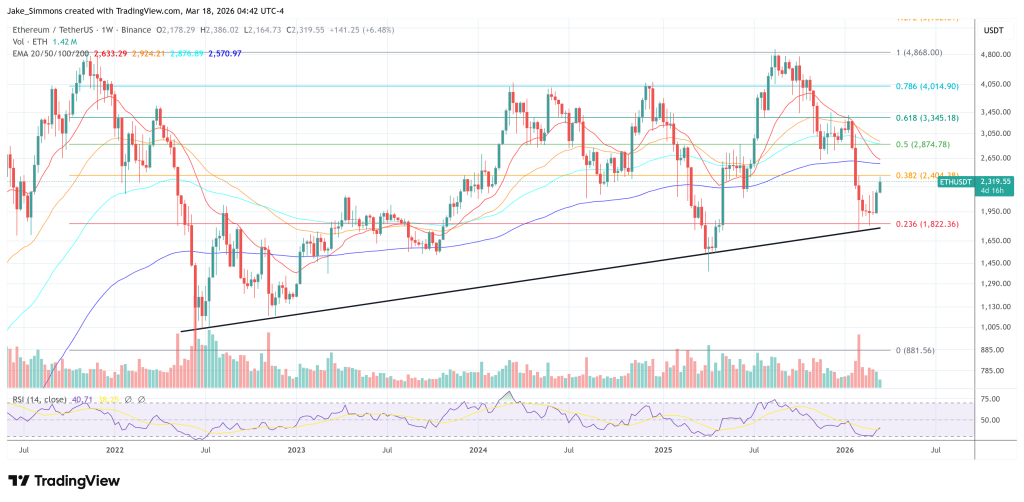
Featured image created by DALL.E, Charts from TradingView.com
editing process for is focused on providing thoroughly researched, accurate, and unbiased content. We adhere to strict sourcing standards, and each page is carefully reviewed by our team of top technology experts and experienced editors. This process ensures the integrity, relevance, and value of your content to your readers.


