

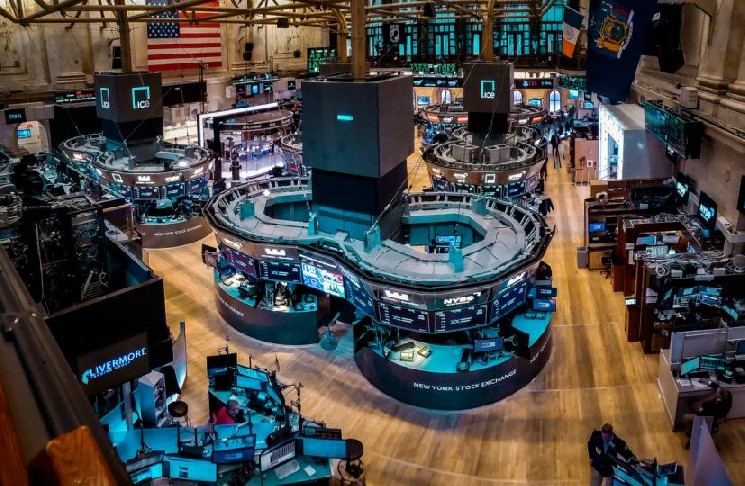
If the final bell has long been a business model, 24/7 trading is an attempt to break it. As the NYSE, Nasdaq, CME, and Cboe race to introduce 24-hour trading, the question is who will gain and who could potentially lose.
Matty Greenspan, CEO and founder of Quantum Economics, told CoinDesk: “The biggest losers in 24/7 stock trading will not be the traders. They will make huge profits. It will be the intermediaries who have been making money for years when traders cannot trade.”
Greenspan, who is also a market analyst, argued that when the market reopens after what he calls a major event, “a small number of firms initially determine the prices at which trades can be made. In many cases, they explicitly use prices that trigger stop losses for their customers, closing them out at a loss and essentially benefiting the brokers who are trading against the customers.”
Asked if brokers would be coordinating with each other on pricing during market closures, Mr. Greenspan bluntly asserted, “Yes, it’s completely rigged.”
“They essentially have control over the price, and it often takes hours to develop a strategy,” he said. “You can often cut your losses on the hunt. When big news happens over the weekend, the house tends to free up pricing at the opening bell.”
His comments come as several major U.S. exchanges are considering offering 24-hour trading services. The NYSE said it is seeking SEC approval for 24/7 trading. Nasdaq announced a similar plan in December. CME plans to launch 24-hour crypto futures trading in 2026, pending approval, and Cboe recently expanded its U.S. index options to 24/7 trading.
“Plausible Denial”
While Mr. Greenspan’s comments may be seen as a rebuke, it’s not hard to see why such behavior stands out in the after-hours market. Once regular trading hours end at 4:00 pm ET, less liquidity is likely to affect prices.
“After the 4 p.m. closing bell, there’s no liquidity at all,” said Joe Dente, a floor broker at the New York Stock Exchange. “Spreads are going to widen further as people go home and there is no liquidity.”
He said wide spreads and thin order books create an environment where price movements can be exaggerated compared to regular trading.
Academic research also supports the view that extended trading sessions are structurally different from core market hours. A widely cited joint study by the University of California, Berkeley and the University of Rochester found that after-hours price discovery is “much less efficient,” citing reduced volume and thin liquidity that limit the speed at which information is reflected in prices.
When asked if manipulation was already occurring during these hours, Dente said, “It’s possible,” but also noted that “the event of 24-hour trading could potentially manipulate things,” referring to a situation already seen in after-hours markets.
On the other hand, Greenspan said, these alleged acts of manipulation are “not strictly erratic, so they[brokers who may be participating in such practices]tend to maintain plausible deniability.”
This is where the line between actual manipulation and proof that such an act took place begins to blur.
A widely cited study of SSRN’s opening price manipulation shows how brokers can influence prices during pre-open auctions by placing and canceling large orders, temporarily moving stock prices away from their underlying value before broader liquidity returns.
The study found that such manipulation can result in distorted opening prices that are later corrected once the market begins trading in earnest, leaving investors who bought at inflated prices with losses. Because these distortions occur before normal trading volumes return, the resulting price movements may be indistinguishable from normal market volatility.
Another broker familiar with overnight trading practices, who requested anonymity because he was not authorized to speak publicly, said thin overnight liquidity can make it easier for coordinated strategies to influence the prices of less widely traded stocks.
And this is not just anecdotal evidence.
In late 2025, the SEC settled charges related to a multi-year spoofing scheme involving deceptive orders used to move the price of lightly traded securities. The regulator also fined Velox Clearing $1.3 million for failing to detect “stratification” and “spoofing” of volatile stocks.
Meanwhile, the U.S. Financial Industry Regulatory Authority (FINRA) found in its 2026 Annual Regulatory Oversight Report that the firms “fail to maintain reasonably designed supervisory systems and controls, including identifying and reporting potential manipulative activity that occurs during after-hours trading.”
A win for retail?
While it’s difficult to pinpoint how widespread these accusations are, one thing is certain: Once trading becomes 24/7, traders, especially retail traders, will ultimately win.
In today’s electronic markets, traders who react fastest to market news have a structural advantage.
“Whoever has the fastest computer and the best programmer always has an advantage,” Dente said, noting that algorithms can react to news or instructions in “nanoseconds.” For individual investors, it will be difficult to keep up with that speed, he added. “How will humans catch up to that?”
And for small investors, with markets closed, it becomes even more difficult to react to such events, leaving individuals and small traders at a significant disadvantage.
Pranav Ramesh, head of quantitative options research at Nasdaq and co-founder of Lead Poet, said a thin market could amplify these risks.
“Broker adjustments often manifest as industry-wide adjustments to routing and enforcement practices, especially when a large portion of retail flow is outsourced to a small number of wholesalers,” he said. “Scrutiny can be more difficult outside of normal business hours as markets are thinner and investors have fewer direct reference points to benchmark the quality of execution,” Ramesh said in his personal capacity.
Sources familiar with the broker’s routing and liquidity practices told CoinDesk that pricing power in thin sessions is real, especially when significant news is announced while markets are closed. Historically, it has been precisely the inability of retail traders to participate that has made it easier to adjust routing, spreads and execution practices when the gap widens, those sources said.
This is exactly what 24-hour trading would solve for traders, Greenspan said, adding that a 24/7 market would blunt the dominance of fintech companies by completely eliminating the weekend gap.
The recent Middle East conflict is a perfect example of how this opens up more trading opportunities when markets remain closed. HyperLiquid, a decentralized exchange that trades on the blockchain 24/7, has seen increased interest from traders betting on traditional financial assets such as oil and gold on weekends when traditional exchanges are closed.
The platform’s weekly derivatives trading volume exceeded $50 billion, generated $1.6 million in revenue in 24 hours, and became so popular that it exceeded the revenue of the entire Bitcoin blockchain. The platform also recently added perpetual S&P 500 contracts.
Needless to say, if major exchanges are able to trade 24 hours a day, 365 days a year, they are likely to benefit from trading fees.
It remains to be seen whether 24-hour trading will ultimately reduce brokers’ influence over pricing. What is clear is that exchanges and investors stand to profit from a market that will never close.
“Traders can react in real time without being at the mercy of an intermediary, a broker,” Greenspan said.
Read more: CME’s 24/7 Crypto Trading Move May End Bitcoin’s Weekend Drop


