

Taiwan should reconsider adopting Bitcoin as a reserve asset to avoid the risk of global turmoil and war, according to a researcher at the Bitcoin Policy Institute.
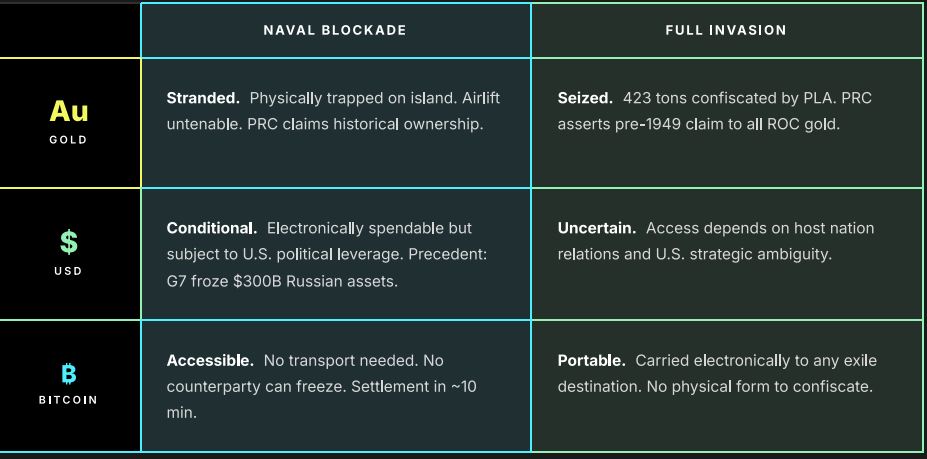
Jacob Langenkamp said in a report on Tuesday that if China pursues military unification with Taiwan through a blockade or full-scale invasion, Bitcoin (BTC) would be the only reserve asset that would be fully accessible and usable in either scenario.
“Specifically to Taiwan, Bitcoin provides geopolitical resilience. In a Chinese blockade or invasion, gold would be stranded or seized and US dollar reserves would face potential constraints, but Bitcoin would remain fully accessible without physical transportation,” he added.
Nation-states are starting to consider the idea of launching strategic Bitcoin reserves, seen as a bullish signal for Bitcoin.
Last year, Taiwan’s central bank sought to investigate the establishment of a national Bitcoin reserve. However, the bank ruled out the deal in December, citing volatility, liquidity and custody concerns, instead identifying the US dollar as a safer alternative.
US currency depreciation is a risk for Taiwan: Langenkampf
Langenkamp said Taiwan is highly exposed to the risk of a weaker U.S. dollar because at least 80% of its central bank reserves, as well as most of its trade, are made up of U.S. dollar-denominated assets.
He said rising U.S. debt, Federal Reserve monetary expansion, a possible AI market downturn and declining semiconductor revenues could also accelerate the dollar’s decline.
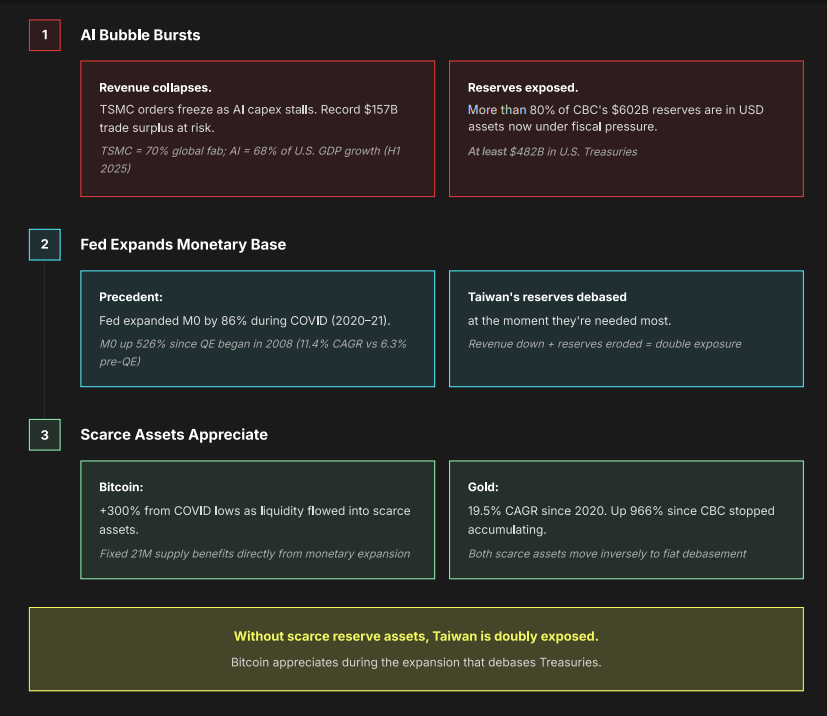
“Bitcoin, when combined with gold, can provide a hedge against USD depreciation. This could provide a new opportunity for CBC to adopt reserve assets ahead of its peers and benefit Taiwanese from subsequent price appreciation,” Langenkamp added.
“It can provide geopolitical insurance against a scenario that hopefully doesn’t materialize. It can open up new ways of trade with less friction. Bitcoin can provide Taiwan with greater financial resilience.”
Related: No plans to add satellites to US Bitcoin reserves yet
Langenkamp also argued that the CBC’s concerns about Bitcoin’s liquidity and volatility are valid, but that both issues will fade as Bitcoin matures and is adopted by countries.
“The CBC’s concerns are valid, but can be addressed with the institution’s expertise in custody, liquidity and volatility,” he added.
Taiwan holds at least 210 Bitcoins
Despite ruling out Bitcoin reserves for now, the CBC has pledged to further test the technology in its digital asset sandbox using cryptos the country already owns.
Last year, Taiwanese lawmaker Ko Chu-chun revealed on X that the country’s Ministry of Justice was keeping 210 bitcoins (worth $14 million) seized during a criminal investigation.
BitBo does not include Taiwan in its ranking of reserves. The publicly disclosed holdings make the country the seventh-largest domestic Bitcoin holder, behind El Salvador and ahead of Finland.
magazine: A Beginner’s Guide to Surviving the Crypto Winter


