

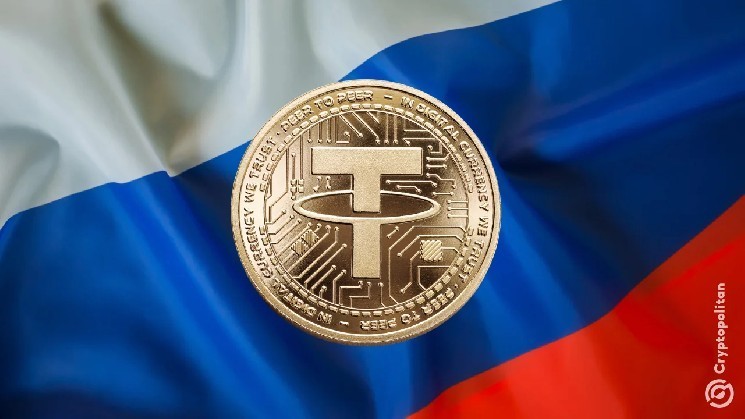
Tether, the issuer of the leading dollar-pegged stablecoin USDT, has registered a trademark for its tokenization platform Hadron in Russia.
The move comes as Moscow prepares to introduce a comprehensive regulatory framework for cryptocurrencies, including stablecoins and tokenized assets.
Tether and Hadron trademarks registered with Russian Patent Office
The company behind Tether, the world’s largest and most popular stablecoin, has successfully registered a trademark for its real world assets (RWA) tokenization platform “Hadron” in the Russian Federation, local media said on Saturday.
RIA Novosti News Agency discovered this while reviewing recent filings with Russia’s patent office, the Federal Intellectual Property Office, commonly known as Rospatent.
According to information in the agency’s electronic database, Tether filed its application in October 2025 and Rospatent approved it in January 2026.
The company has acquired exclusive rights to the registered trademark, which has three small hexagons inside a distorted hexagon, until October 3, 2035.
It can be used not only to provide blockchain-based financial services, but also to conduct consulting in the cryptocurrency field, cryptocurrency transactions based on blockchain technology, transfers and exchanges, processing coin payments, etc.
Tether Limited issues multiple stablecoins that are pegged to the value of various real assets, fiat currencies, and even commodities such as the US dollar, euro, and gold, the report notes.
The largest of these is USDT, which currently ranks third among crypto assets and first among stablecoins in the world, with a market capitalization of approximately $187 billion as of January.
RIA Novosti recalled that Hadron was launched in November 2024. The platform allows for the tokenization of various RWAs, from stocks and bonds to bonus points and more.
Tether trademark registration stays ahead of Russian regulations
Russia intends to properly regulate the expanding cryptocurrency space in the first half of 2026, after Moscow’s financial authorities gradually softened its stance on digital currencies and assets such as Bitcoin during 2025.
As reported by Cryptopolitan, last year marked a turning point for Russia’s cryptocurrency policy. This change was facilitated by international regulations surrounding the Ukraine war, which severely restricted Russia’s access to global fiat channels, including international remittances.
In March, the Central Bank of Russia (CBR) proposed a special “experimental” legal regime for cross-border cryptocurrency payments and limited investments. And in May, it allowed the offering of crypto derivatives to “qualified” investors.
Then, towards the end of December, the financial authorities announced the outline of a plan to comprehensively regulate the market. The new concept envisions the recognition of cryptocurrencies and stablecoins as financial assets, increasing access for investors.
Meanwhile, Russia’s ruble-pegged coin A7A5 has become the fastest-growing stablecoin in the past 12 months despite being subject to Western sanctions, according to on-chain data.
It was launched in January 2025, and its circulating supply increased by about $90 billion last year. It is issued on Tron and Ethereum and accounts for almost half of the non-dollar sector of the growing global stablecoin market.
In addition to cryptocurrency transactions, the new bill, which is expected to be adopted by Russian lawmakers by July 1 at the latest, will also update the rules for digital financial assets (DFA) as defined in Russia.
The latter category includes a number of tokenized products, such as securities and digital rights, and is regulated by a dedicated DFA law that came into force in 2021.
Unlike cryptocurrencies, these are currently only issued on private rather than public blockchains, but the CBR plans to change this to allow Russian companies to attract foreign capital by allowing the circulation of Russian DFAs on open networks.


