


On Tuesday, March 17th, the S&P 500 financial stocks got off to a bad start, forming their first death cross since October 2023.
What this means is that the stock’s short-term moving average (MA) has fallen below its long-term trend line, indicating weakening momentum and increasing downside risk.
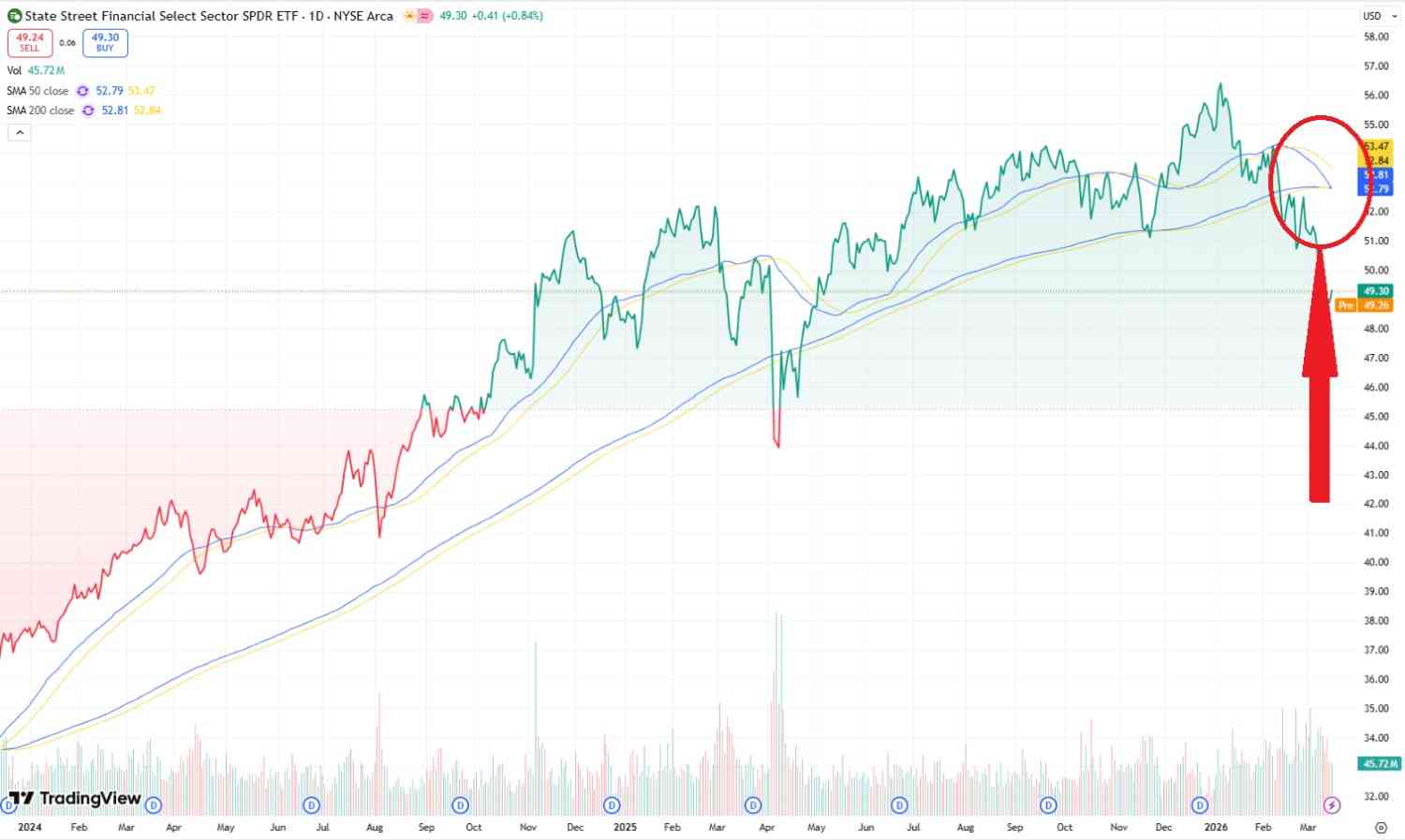
Although death crosses are often seen as confirmation of an already weakening trend rather than a precise timing tool, past examples highlight their potential importance.
As mentioned above, this pattern was last seen in November 2023, when the financial industry was emerging from the secular downturn that began in 2022 as the Federal Reserve aggressively raised interest rates to combat inflation. What followed was stress in the banking sector in 2023 due to local bank failures.
Another similar situation in which the 50-day average remained above 200 days for more than a year occurred in April 2022. The sector then plummeted 18%, bottoming out about six months later.
Are financial stocks underperforming?
Financial stocks have significantly underperformed the broader market, with their relative strength against the S&P 500 index declining to levels last seen during the coronavirus-era recovery in late 2020. This weakness therefore suggests that the struggles extend well beyond the recent volatility.
Understandably, this situation has raised concerns that the business cycle may be changing. The most obvious pressures currently appear to be private credit market exposure and the potential macro impact of rising oil prices.
Additionally, the Global Sachs research also found that hedge funds began increasing their selling across banks, insurance companies, fintech companies and trading companies in the week ending March 13, as first reported. Reuters.
The report said hedge funds were “aggressively shorting” financial stocks last week, and the sector was a net short across international markets. Of course, market performance reflects pressure. But analysts also think the rise in short interest in financial stocks may reflect broader hedging activity rather than outright bearishness on banks themselves.
Featured image via Shutterstock


