

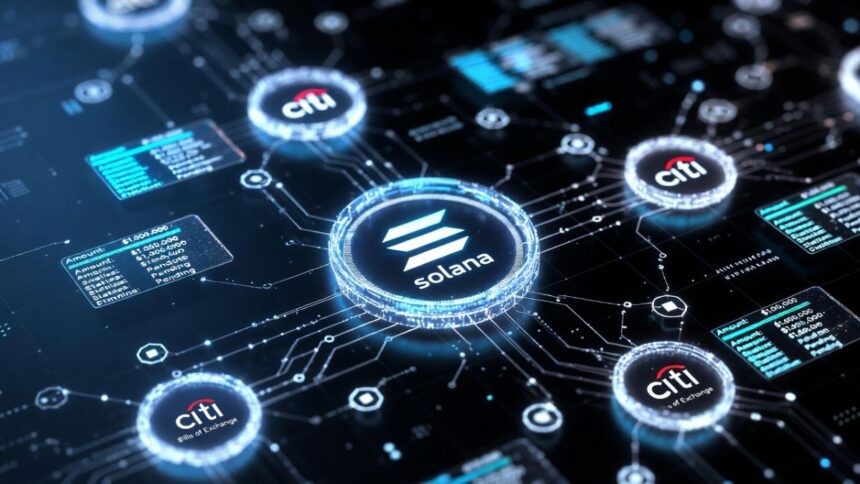
Citi, the third largest bank in the United States, conducted an internal proof of concept to tokenize bills of exchange using the Solana network.
The experiment consisted of recreating the complete lifecycle of these financial instruments, from issuance and financing to distribution and final settlement in a controlled environment.
This initiative aims to determine the feasibility of migrating traditional business operations to digital asset infrastructure to improve operational efficiency for banks engaged in a wide range of activities, including asset management, securities brokerage, treasury services, and corporate banking.
Citi, which manages about $2.4 trillion worth of assets, said in a Feb. 5 report that the technical exercise was conducted on a private version of the network and did not involve any actual customer or third-party capital participation.
For simulation purposes, fictitious profiles were created to play the roles of buyers, sellers, and investment banks. It uses synthetic data designed to closely mimic the behavior of real commerce.
Under the scheme, each Solana bill of exchange (a commercial document that serves as a written payment order) will be represented by a unique digital asset that is equivalent in technical nature to a non-fungible token (NFT), the bank commented. As explained in Criptopedia, the education section of CriptoNoticias: It is a type of cryptographic token that represents a unique, non-repeatable asset stored on the network..
The operation of the system begins when a provider enters bill of exchange data into a banking platform, which generates a digital token containing details of amount, counterparty, and execution time. Buyers then use electronic signatures to verify terms, making assets digitally native within a legally binding network.
Bond market automation and efficiency
The implementation of smart contracts in this type of operation aims to ensure that the business logic is executed automatically, thereby eliminating the need for manual intervention in debt resolution.
Depending on the design of the test, ownership of the asset moves with the token, and the system directs refunds to owners holding the digital asset upon expiration. Although this method reduces processing time to a few minutes, practical application will depend on companies’ ability to integrate these networks with traditional banking structures and comply with current regulations in various jurisdictions.
Citi has indicated that the next steps in this exploration process are: Decide how to connect these digital assets to the bank’s internal accounting system.
For now, the exercise remains a laboratory test that aims to quantify the reduction in operational errors in an environment where settlement of short-term trade finance products is not dependent on bank business hours or external verification processes.
(Tag translation) Altcoin


