

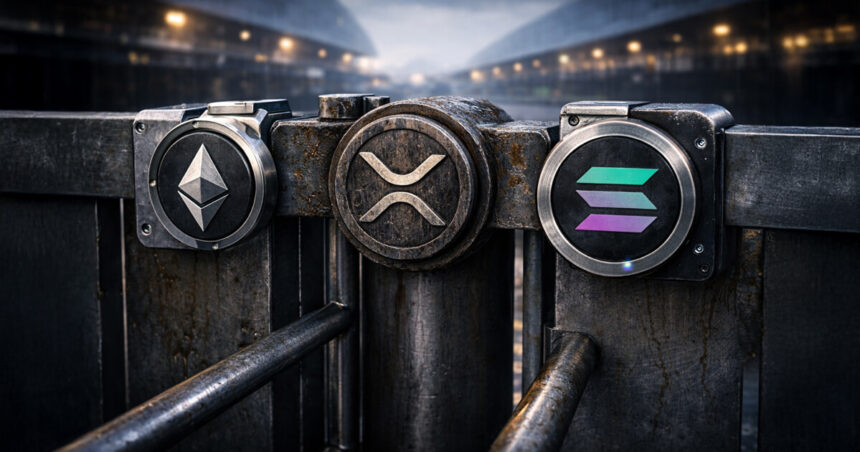
Ripple enables staking of Ethereum and Solana within its institutional custody business and has expanded beyond custody to include asset servicing capabilities that large investors consider standard.
This new feature, delivered through a partnership with staking infrastructure provider Figment, allows Ripple Custody clients to offer staking on major proof-of-stake networks without setting up validator infrastructure.
The service provides operational simplification with institutional controls for banks, custodians, and regulated asset managers who want staking yield but do not want to keep their staking operations outside their governance boundaries.
The move also highlights the structural differences between XRP and the proof-of-stake assets that financial institutions commonly hold alongside XRP. Ethereum and Solana can generate protocol rewards. XRP is not possible, at least not today.
That gap is important for custody clients who benchmark cryptocurrency services against well-known concepts such as securities lending returns and cash yields.
Figment’s role in institutional-grade staking
Ripple’s selection of Figment shows that institutions are prioritizing separation of duties, operational assurance, and auditable frameworks when requesting staking.
According to Figment, Ripple chose the company for its track record of serving more than 1,000 institutional customers, its non-custodial architecture, and its focus on regulated participants.
This architecture is actually important because many institutional investors prefer that custody and validator operations remain separate functions. They want clear boundaries around who manages assets, who operates infrastructure, and how risk is monitored.
Staking also involves a type of operational risk that traditional custody customers are quick to recognize. Slash-related outcomes can be difficult to explain if validator performance requirements introduce failure modes and governance and control standards are unclear.
For regulated companies, the question is often not so much “Can I get paid?” but “Can I get paid in a way that stands up to the scrutiny of compliance reviews and audits?”
Figment also highlights trust signals built for institutional due diligence, including full certification under the Node Operator Risk Standard (NORS), which audits node operators across security, resiliency, and governance.
These categories align closely with the due diligence checklists that typically shape procurement decisions in regulated finance.
Ripple’s integration aims to turn staking into a custody feature that behaves more like a workflow than an infrastructure project.
This positioning is consistent with the evolution of the storage market. Institutions are increasingly working to reduce multivendor sprawl. They want to bundle their services under a managed operating model with reporting and accountability.
XRP does not offer protocol staking and XRPL staking discussions are not at the deployment stage
The addition of Ethereum and Solana staking also highlights what XRP does not offer: protocol-level staking rewards.
This omission becomes clear at the custody layer. Platforms that only offer XRP can store assets, support transfers, and provide reporting, but cannot offer regular on-chain revenue programs through XRP’s native mechanisms.
In an environment where staking yield is treated as the baseline expected value of proof-of-stake assets, the custody menu can feel incomplete.
Meanwhile, the Ripple ecosystem is exploring what XRP Ledger (XRPL) staking will look like, but those discussions are more than superficial, pointing to economic constraints.
RippleX developers outlined two requirements for a native staking design on XRPL: a sustainable reward source and a fair distribution mechanism.
In particular, XRPL’s long-standing approach is to burn transaction fees rather than redistribute them. Validator trust is earned through performance, not monetary bets.
This means that staking will require an economic redesign rather than a simple upgrade to turn on rewards.
The XRPL development pipeline also has process signals. The ledger’s known modifications tracker currently shows no staking-related modifications in development or voting.
That doesn’t preclude future work. However, it confirms that staking is not in an active deployment phase for XRPL.
For facility protection customers, that distinction is real. Ethereum and Solana yields exist now, are measurable today, and are operational today. On the other hand, there remains an unresolved economic debate regarding XRP native staking.
Despite financial institutions rotating risks, XRP inflows are strong anyway
Recent weekly data shows that investment products linked to XRP are seeing stronger weekly inflows than products linked to Ethereum and Solana, and expansion of custody products is underway.
CoinShares reported that $63.1 million was raised in XRP-led investment products last week. During the same period, Solana’s product raised $8.2 million and Ethereum’s product raised $5.3 million.
However, negative sentiment persisted for Bitcoin-focused products, which saw $264 million in outflows over the week.
These numbers indicate active reallocation, with investors trading and reshaping their exposure in response to price movements, rather than simple waves of accumulation.
Flow data highlights a point that custody buyers often encounter right away.
While tokens can attract institutional allocation through investment products, they still lack the service features that the commission increasingly expects from proof-of-stake assets.
Basically, the demand for XRP and the maturity of the XRP product are separate issues.
Given this, Ripple’s response is to separate roles within the organization. XRP continues to be positioned as the company’s preferred rail connecting asset, with Ethereum and Solana offering yield within its custody boundaries.
Ripple continues to center XRP through institutional DeFi roadmap
Ripple has made it clear that adding staking to other networks is not intended to diminish the importance of XRP in its strategy.
Instead, the company’s recent “Institutional DeFi” roadmap positions XRPL as a high-performance chain for tokenized finance, with compliance tools and programmability designed for regulated use cases.
Ripple explains the role of XRP ranging from reserve requirements, transaction fees (burning XRP), autobridges in foreign exchange and lending flows.
The roadmap also highlights on-chain privacy, permissioned markets, and institutional financing as features scheduled to be introduced in the coming months.
This framework positions XRP as infrastructure rather than an income-generating asset.
It also supports a multi-asset custody approach, allowing institutions to earn revenue on Ethereum and Solana and use XRPL rails within a controlled custody workflow.
In this model, yield is a feature that helps bring institutions into custody boundaries. XRPL is positioned as an environment where Ripple wants more on-chain activity to occur under compliance-first constraints.
And XRP will be presented as a connecting asset for bridging, collateral flows, and fees.
(Tag Translation)Crypto


