

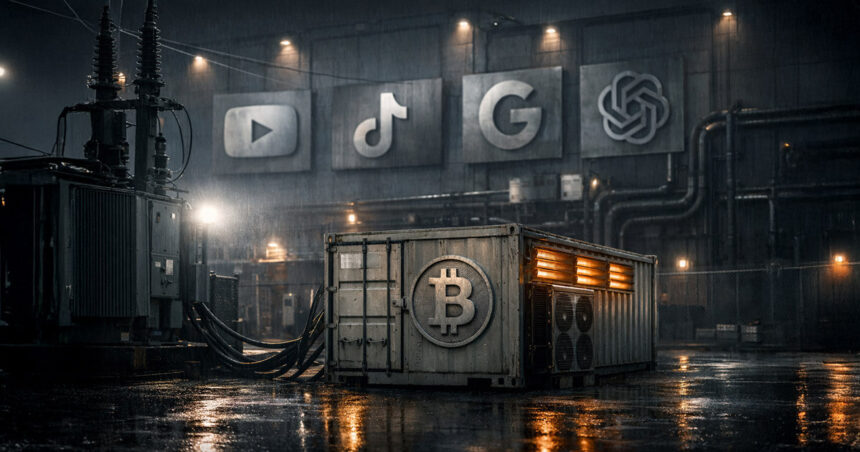
Bitcoin mining will consume approximately 171 TWh in 2025, representing 16% of total data center energy usage.
All traditional data centers around the world consumed between 448 and 1,050 TWh in 2025, but estimates vary depending on analyst data. Gartner puts it at 448 TWh, while Socomec and the IEA cite a range of 600 to 1050 TWh.
Gartner forecasts suggest this will reach 980 TWh by 2030, while IEA data also suggests we will break the 1,000 TWh mark this year, if we haven’t already.
AI-centric facilities are officially estimated to consume 82-536 TWh in 2025, accounting for 11-40% of total data center energy usage. The breadth of this scope is determined by the speed of AI adoption and the difficulty of tracking accurate usage data.
Therefore, traditional data centers, including cloud computing, enterprise applications, streaming, and social media, will definitely account for more than 388 TWh in 2025.
| Indicators for 2025 | Range (TWh) | Average usage (TWh) | Precautions |
|---|---|---|---|
| All data centers (excluding BTC) | 448~1,050 | 800 | Conservative working average for analysis |
| Data center centered on AI (calculated from total) | 88–536 | 350 | midway point |
| Traditional/Non-AI Data Center (Derivative) | 388–712 | 450 | Total minus AI (800 − 350) |
| Bitcoin mining (electricity usage) | 138–204 | 171 | The range is from the Cambridge estimate (~138) to the Digiconomist annual estimate (~204). |
Gartner says:
“In 2025, AI-optimized servers will account for 21% of a center’s total power usage, and are projected to account for 44% by 2030. By 2030, they will account for 64% of a data center’s increasing power demand.”
Socomek said:
“In 2025, data centers are expected to consume approximately 536 TWh of electricity, representing approximately 2% of global electricity consumption. As the power requirements of AI computing continue to rise, this number could double to 1,065 TWh by 2030.”
This analysis uses an average of 1,000 TWh for all data centers in 2026 to account for the large scale deployment of new infrastructure. However, this could be We underestimate AI usage by the same amount of energy that Bitcoin consumes in a year.
Still, I believe this is the fairest division given the lack of formal agreement on exact energy usage and division.
| Prediction indicators for 2026 | Percentage of total | Implied power (TWh) | Precautions |
|---|---|---|---|
| All data centers (e.g. BTCl) | 100% | 1,000 | Projected global data center power usage |
| AI data center | 40% | 400 | AI’s share is predicted to be 40% of the total |
| Traditional workload | 60% | 600 | Remaining percentage of total |
| Bitcoin mining (context) | – | 150 | Comparative benchmark considering reduced difficulty |
According to these estimates, Bitcoin is far below AI, video streaming, and social media in terms of energy usage.
How many people in the “Buttcoin” community get offended by this fact when they watch videos on YouTube or post on Reddit about how fraudulent Bitcoin is?

Energy mix of Bitcoin and traditional data centers
According to the Cambridge Digital Mining Industry Report 2025, the digital infrastructure energy landscape shows Bitcoin’s sustainable energy (renewables and nuclear) share of 52.4%, compared to the broader data center industry average of 42%.
AI data centers are expected to consume 40% of total data center electricity by 2026, up from 14% in 2024. Traditional workloads account for the remaining 45% of the global data center footprint of 1,000 TWh, with Bitcoin accounting for the remainder.
Bitcoin miners face a constraint scenario in 2026 as AI companies drive up prices in search of a stable power supply.

The network difficulty reached 148.2 trillion at the end of 2025, but decreased slightly at the beginning of 2026 as the hashrate decreased due to the fall in Bitcoin price.
The race for low-cost power could push Bitcoin consumption to at least 142 TWh by late 2026, if efficiency gains offset increases in hashrate. In a constrained scenario where AI infrastructure outpaces mining operations, consumption could fall to 100-140 TWh by 2030.
According to Cambridge Judge Business School, Bitcoin’s renewable energy mix currently stands at 43%, with hydropower accounting for 23.12%, wind power 13.98%, and solar power 4.98% of the total energy profile.
Nuclear power accounts for 9.8-10%, and sustainable energy totals 52.4%.
Natural gas replaced coal as the primary source of fossil fuels, accounting for 38.2% compared to 8.9% for coal, down from 36.6% in 2022.
Changes in fossil fuel composition represent a shift towards lower emission sources. The overall sustainable energy percentage exceeds both the global grid average of 40% and the data center industry standard of 42%.
However, Bitcoin’s environmental impact per user is measured at approximately 2,768 kg CO2e per user per year, based on 30 million users worldwide. However, unlike social media, energy usage does not increase as the number of users increases.
This is 57 times larger than TikTok’s 48.5 kg per user and 46 times larger than the average social media user’s footprint of 60 kg, but the scale is different.
| scenario | BTC user | Total footprint (CO₂e mountains/year) | Footprint per user (kg CO₂e/user/year) | comparison memo |
|---|---|---|---|---|
| baseline | 30,000,000 | 83.04 | 2,768.00 | ≈577 × tiktok (48.5 kg); ≈46 × 60 kg “average social” benchmark |
| Social media equivalent energy per user | 1,384,000,000 | 83.04 | 60.00 | This is the number of BTC users required if the total footprint stays the same. |
| Number of users at TikTok scale | 1.5 billion | 83.04 | 55.36 | At TikTok scale, BTC per user can be up to 55 kg |
Data center growth in 2026
According to Deloitte Technology Predictions 2026, AI infrastructure investments will reach $400-450 billion in 2026 capital expenditures worldwide, with more than half of that allocated to processors, including GPUs, TPUs, and custom ASICs.
OpenAI announced a total investment of $500 billion for the Stargate Initiative, which exceeds the inflation-adjusted $280 billion for the Apollo space program.
Google will allocate $75 billion to AI infrastructure in 2025, including the $4.75 billion acquisition of Intersect Power for data centers co-located with clean energy development.
Inference workloads will now consume 66% of AI computing power in 2026, up from 33% in 2023, with training accounting for the remaining 33%.
This reversal reflects the deployment phase of AI models, where continuous query processing dominates energy consumption, rather than one-time training events.
ChatGPT processed up to 200 million requests daily at 0.3 Wh per query for GPT-4o, for a total of approximately 60 MWh per day. Previous model versions consumed up to 2.9 Wh per query before optimization.
The prediction for GPT-5 shows 18.35 Wh per 1,000 token responses, which represents an 8.6x increase in consumption per query for GPT-4o.
According to an analysis by Windows Central and PatentPC, GPT-5 could consume up to 45 GWh per day, equivalent to the electricity needs of 1.5 million U.S. homes, when processing 2.5 billion daily requests.
Traditional data centers, including social media platforms, streaming services, cloud computing, enterprise applications, SaaS, e-commerce, and financial services, are expected to consume 400 TWh in 2026.
The available data does not separate social media and streaming consumption from broader traditional data center categories. These platforms are estimated to represent 15-30% of traditional workloads.
| category | sustainable energy mix | growth rate |
|---|---|---|
| AI data center | 42% | Up to 40% per year |
| traditional data center | 42% | Approximately 9% per year |
| bitcoin mining | 52.4% | constraints due to competition |
| Total number of data centers | average 42% | 2.5 times from 2024 |
Meta reported a 2025 data center power usage efficiency (PUE) of 1.09. This represents an industry-leading efficiency compared to the company average of 1.5 to 1.6.
The company has reduced 16.4 million tonnes of CO2e since 2021 through efficiency improvements and sourcing renewable energy.
TikTok’s parent company ByteDance reported that the company’s total annual emissions are approximately 50 million tons of CO2e. Emissions per user were calculated to be 48.49 kg CO2e based on third-party analysis of usage patterns.
Streaming energy usage
As of 2019 data, Netflix consumes 451,000 MWh per year, which is enough to power 37,000 homes.
In terms of streaming energy, viewing devices account for 72% of emissions, data transmission 23%, and data centers 5%. The streaming energy per hour measured in 2019 was 0.077 kWh, but the current consumption is lower, as efficiency has improved by approximately 20% each year since 2010.
The International Energy Agency says:
“Contrary to many recent misleading media reports, streaming video’s impact on the climate remains relatively modest, especially compared to other activities and sectors.”
The Shift Project claimed in 2019 that the consumption per hour of Netflix streaming was 6.1kWh, but this was revised to approximately 0.8kWh in 2020.
This was a seven- to eight-fold exaggeration, and continued to spread despite corrections.
The Carbon Trust’s current estimates place streaming emissions in Europe’s electricity grid at around 55g CO2e per hour. The IEA’s 2020 analysis calculates 36g CO2e per hour, with variations reflecting different grid carbon intensities and efficiency improvements over time.
Unlike streaming and social media, Bitcoin benefits the energy grid
Bitcoin mining facilities can curtail demand within seconds, allowing them to participate in demand response programs and consume renewable energy that would otherwise be curtailed.
Based on Duke University modeling, flexible loads like Bitcoin mining could add 76GW of grid capacity, representing about 10% of peak demand, CPower Energy said.
ERCOT, Texas integrated Bitcoin miners as flexible loads after 2021 power outages, averting construction of an estimated $18 billion gas speaker plant.
AI and traditional data centers require continuous, reliable power to provide their services, which limits their ability to provide grid balancing services.
Data center occupancy is expected to reach 85% in 2023 and exceed 95% by late 2026, minimizing demand response flexibility.
According to MIT News, water consumption for AI servers in the United States is projected to be between 731 million and 1.125 billion cubic meters per year by 2030.
Bitcoin’s air-cooled ASIC system achieves minimal water consumption compared to water-cooled data center infrastructure.
Thanks to advances in ASIC technology, the top-of-the-line 2026 model achieves 9.5 to 12 Joules per terahash (J/TH), while traditional 2020 to 2023 models operate at 25 to 30+ J/TH.
The Antminer U3S23H delivers 1,160 TH/s at 9.5 J/TH, and the S21 XP Hydro delivers 473 TH/s at 12 J/TH.
These 50-70% efficiency gains are made possible by moving from 7nm to 5nm and 3nm chip architectures. The total consumption of the network is either stable or increases due to the Jevons paradox, where increased efficiency allows more mining activity at lower cost.
This pattern repeats in all three sectors.
While AI inference efficiency improved 10x from the initial GPT-4 estimate to GPT-4o, total AI consumption is projected to increase 7x from 60 TWh in 2024 to 420 TWh in 2026.
Although the energy intensity of streaming data centers has decreased by 20% annually since 2010, the total streaming time and absolute consumption continues to increase.
Efficiency gains reduce cost per unit and often allow consumption increases to exceed efficiency savings.
Goldman Sachs predicts that by 2030, 60% of increased data center electricity demand will be met by fossil fuels, adding approximately 220 million tons of CO2 to global emissions.
Natural gas will serve as a “bridging fuel” during the transition period from 2026 to 2028 while renewable energy and nuclear projects are under construction.
Tech giants such as Amazon, Microsoft, Meta and Google have signed up more than 50 gigawatts of renewable capacity, equivalent to Sweden’s total power generation capacity. Development schedules result in delivery delays of 2-5 years.
Microsoft’s $10 billion Brookfield renewable energy contract will provide 10.5 GW of capacity starting in 2026, equivalent to the output of 10 nuclear power plants.
The NextEra partnership with Google will restart Iowa’s Duane Arnold nuclear power plant in 2027. Meta partnered with Oklo to develop a small modular nuclear reactor to power data centers in Pike County.
Meta’s Louisiana data center is a $10 billion investment and will connect more than 1,500 MW of new renewable energy to the grid.
The world’s critical power capacity in data centers is expected to reach 55 GW in 2023 and 82-96 GW by 2026, nearly doubling the infrastructure in three years.
Regional distribution shows that the United States and China will account for approximately 80% of the world’s data center power growth by 2030. The US is expected to add 240 TWh, an increase of 130% from 2024, and China is expected to add 175 TWh, an increase of 170% from 2024.
Ireland currently allocates 21% of its national electricity to data centres, which is expected to reach 32% by 2026 if current growth continues.
Grid connection schedules in many regions are two to five years long, which, combined with transformer and substation supply chain bottlenecks, is constraining expansion rates.
Local power supply capacity is nearing its limits in some markets, while cooling water availability is a challenge in drought-prone regions such as Arizona, Nevada, and Texas.
Energy usage across cryptocurrencies
Ethereum’s transition to proof-of-stake on September 15, 2022 reduced energy consumption by 99.988% from 23 TWh to 0.0026 TWh per year.
According to Ethereum.org, the network currently consumes 0.0015% of Bitcoin’s energy while processing more transactions than Bitcoin.
Carbon emissions decreased by 99.992% from 11,016,000 tons to 870 tons CO2e per year. This shows that blockchain technology does not inherently require high energy consumption.
Bitcoin’s proof-of-work security model represents a design choice rather than a technical limitation.
The Bitcoin community argues that proof-of-work provides better security guarantees through energy consumption, and proof-of-stake provides security through economic incentives and staked capital.
Both models offer valid approaches with different trade-offs between energy consumption and security mechanisms.
Total global data center consumption in 2026 is 1,000 TWh, representing 3.5% of the projected global electricity consumption of 29,000 TWh.
Bitcoin’s 150-171 TWh is equivalent to 0.6% of the world’s electricity, comparable to the annual consumption of Poland, and the 180-200 TWh of global aviation.
The data center sector is expected to grow from 460 TWh in 2022 to 1,000 TWh in 2026, representing a 2.5x increase primarily due to the expansion of AI infrastructure.
By 2030, total data center consumption is expected to be between 1,000 and 1,900 TWh in the US alone.
In a conservative scenario assuming continued efficiency improvements of 20% per year, total consumption could be reduced to 200-400 TWh. In aggressive cases with accelerating AI adoption and increasing model complexity, this could exceed 2,500 TWh worldwide.
Bitcoin consumption scenarios in 2030 range from 100-140 TWh in a constrained scenario where AI bids lower-cost power than miners, to 150-200 TWh in a baseline scenario of slow growth.
If Bitcoin price increases allow mining at higher electricity prices, consumption could reach 200-300 TWh.
The Lightning Network’s off-chain transaction capabilities enable 100-1000x transaction throughput with minimal energy increase. Network consumption primarily serves to maintain security rather than processing individual transactions.
Renewable energy integration schedule shows company commitment is outpacing realization
Renewable power generation is expected to grow by 22% annually through 2030, and is targeted to account for 40-45% of data center electricity demand growth. This is not enough to meet the entire new demand.
The long-term vision beyond 2030 includes reducing supply to 40-50% from solar and wind power, 10-20% battery storage from renewable energy sources, nuclear power to provide 20-30% of base load, and natural gas to 10-20% for backup and peaking.
Bitcoin’s ability to consume reduced renewable energy provides immediate grid benefits that new construction renewable projects cannot realize during their 2-5 year construction schedules.
Mining facilities can avoid wasting up to 40% of renewable energy by consuming electricity during periods of low demand. This enables renewable projects even in locations without transmission infrastructure.
This “first resort buyer” role makes projects financially viable during the grid construction phase, including hydroelectric facilities in Siberia and Iceland, geothermal power plants in Iceland and El Salvador, and solar power facilities in Texas, among others.
Distinguishing between interruptible and continuous electricity demand has implications for grid management and renewable energy integration capacity.
Bitcoin’s flexible load characteristics can increase the penetration of renewable energy into the power grid by absorbing excess generation and suppressing peak demand periods.
Data centers that require continuous operations require fossil fuel backup capacity or baseload nuclear power generation. Battery storage technology is not yet able to economically support multi-day backups of facilities that consume hundreds of megawatts.
Data centers will consume more energy than Bitcoin
Data center power distribution finds that servers and computing equipment consume 40-60% of a facility’s power demand.
Cooling system utilization ranges from 7% to 40%, reaching 7% in hyperscale facilities and 30% or more in less efficient enterprise data centers. Storage systems account for approximately 5%, networking equipment 5%, and power distribution and other systems 5-10%.
Hyperscale operators such as Google, Meta, and Amazon have achieved PUE ratios closer to 1.1, while the enterprise average is closer to 1.5-1.6.
Why does Bitcoin attract so much hate?
The attention-consumption gap shows that Bitcoin receives approximately 3-4 times more significant media coverage per TWh consumed compared to traditional data centers.
AI receives approximately twice the coverage intensity per TWh.
By 2028, demand growth will outpace renewable energy deployment, so the near-term emissions trajectory will get worse before it gets better.
During this transition period, the majority of new data center capacity will be powered by natural gas, with renewable energy and nuclear projects expected to come online between 2027 and 2030.
The temporary mismatch between the urgency of climate change, which requires immediate action, and the infrastructure realities, which require a 5-10 year transition period, has created a gap that is currently being filled by fossil fuel generation.
Bitcoin is not “free” from environmental trade-offs. This is an always-on security system that converts electricity into hardness, an expensive cost to rewrite history. It’s a design choice and deserves scrutiny.
But scrutiny needs to be proportionate to reality.
By the numbers, Bitcoin is far behind the power demands of data centers and the ever-increasing AI that are the real growth engines of the modern internet.
These facilities are growing beyond 1,000 TWh footprints with an uncertain mix of gas, renewables, and nuclear power. This is because reliability is more important than ideality when dealing with billions of real-time requests.
If the criticism is “be careful with power,” the spotlight cannot stay on mining while AI inference, streaming, and social platforms quietly scale up in the same grid.
And Bitcoin is more than just an “always-on” load. Miners can cut back in seconds and buy energy that would otherwise be wasted, showing up as demand response, helping to fund renewable energy in places that the grid can’t yet fully absorb. That doesn’t eliminate emissions, but it changes the way we look at comparisons.
A flexible load that can be turned off is not the same as a continuous service that cannot be turned off.
The fairest way to talk about Bitcoin’s energy is the same way we talk about any digital system: its total consumption, energy mix, flexibility, and the return it provides to society.
Applying this criterion consistently yields conclusions that are unpleasant to Bitcoin’s most vocal critics. The network is not an outlier, it is the easiest target.
(Tag translation) Bitcoin


