

Mastercard’s planned $1.8 billion acquisition of stablecoin infrastructure company BVNK reinforces the view on Wall Street that stablecoins are moving from niche crypto tools to the core of global payments.
Analysts say the agreement signals a shift in how traditional financial networks view blockchain-based money transfers. “Stablecoins are essential to the future of payments,” Mizuho analyst Dan Dolev said, adding that the acquisition is proof that the digital dollar is becoming integrated into mainstream financial infrastructure.
Mastercard announced Tuesday that it will acquire BVNK, a London-based company that allows companies to send, receive, store and exchange stablecoins in more than 130 countries, for $1.8 billion. Analysts estimate that the company processed over $30 billion in stablecoin payments in 2025.
For investors, the move helps answer deep questions about Mastercard’s crypto strategy.
“BVNK is the clear answer,” said TD Cowen analysts, who rate the company as a buy with a price target of $671, adding that the deal will connect on-chain payment rails to Mastercard’s existing network. The company said the acquisition proves that stablecoins can act as a complementary infrastructure layer to card networks, rather than a direct competitor.
This difference is central to the investment case. Previous concerns that stablecoins could bypass traditional payment companies have been replaced by a different view: they could instead improve the way funds move behind the scenes.
Cantor Fitzgerald, which has an “overweight” rating on the stock and a $650 price target, said the acquisition will prepare Mastercard for the coming “wave of stablecoin adoption” as demand for faster and cheaper cross-border payments grows, especially among financial institutions and fintech companies.
This “wave” of demand has become evident in recent months as many traditional financial giants scramble to adopt stablecoins as payment rails. Even Bitcoin purists like Jack Dorsey, who would have dreamed of a world where payments were made via the Bitcoin blockchain, have reluctantly given in to customer demands for stablecoins.
These use cases are already taking shape.
Stablecoins are increasingly being used for business-to-business payments, global payrolls, and money transfers that can take days to settle using traditional systems. In contrast, blockchain-based money transfers can move funds within minutes and operate 24 hours a day.
BVNK’s platform adds its capabilities directly to the Mastercard ecosystem, enabling 24/7 payments and reducing dependence on intermediaries for cross-border transactions.
long term bet
While Mastercard’s financial gain from the acquisition may be small, the credit card giant has its eyes on bigger profits.
Financially, the acquisition is not expected to have a significant short-term impact. BVNK will have approximately $40 million in revenue as of late 2024, and its contribution to Mastercard’s revenue is likely to be modest.
Rather, the partnership allows Mastercard to make a long-term bet to become a frontrunner in a rapidly evolving industry that is revolutionizing the way money moves.
Stablecoin trading volume has already reached an estimated $350 billion annually and is expected to increase as regulatory clarity improves and more institutions enter the market.
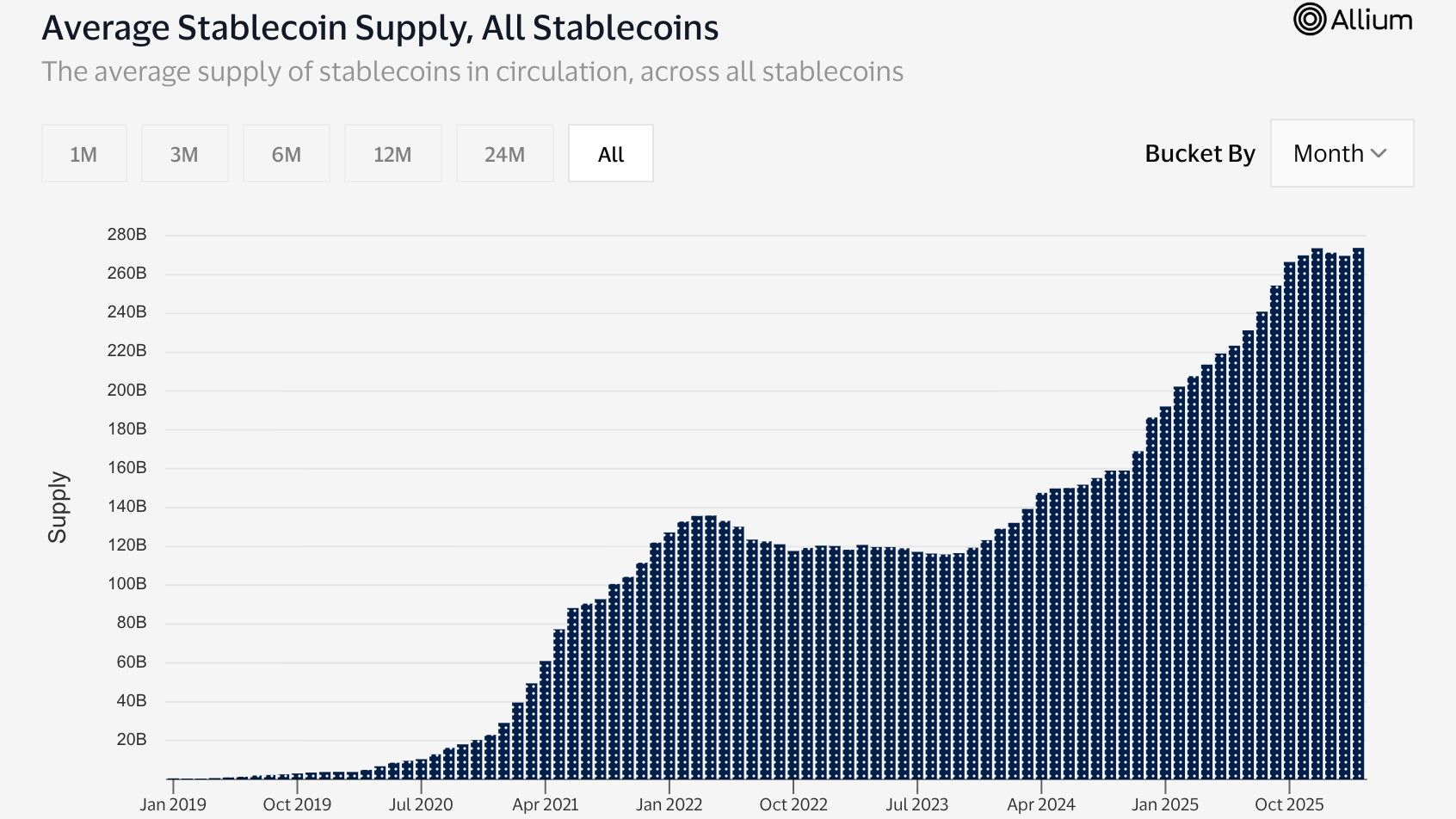
Stable coin supply after 2019 (Visa/Allium)
For a payments giant like Mastercard, the move into stablecoin infrastructure is more than just an experiment in cryptocurrency rails, said Harvey Lee, founder of Tokenization Insight.
“Card networks are the payment methods most exposed to stablecoin disruption,” he wrote in a note Tuesday.
Meanwhile, Oppenheimer analysts, who have an outperform rating and a $683 price target, said the partnership expands Mastercard’s ability to support end-to-end digital asset flows, including exchanges between fiat currencies and stablecoins. This also aligns with the company’s broader push towards interoperability between traditional finance and blockchain networks.
“We see Mastercard’s acquisition of BVNK as further affirmation of the stablecoin market for cross-border commerce, rather than B2C payments, where card payments are well-established,” said William Blair analysts led by Andrew Jeffrey. The bank has an Outperform rating on the stock.
More great deals coming up?
Stablecoins threaten to bypass traditional card-based payment systems by enabling faster, cheaper, always-on money transfers. This pressure is forcing incumbents to adapt quickly through acquisition rather than internal development.
Prior to Mastercard’s BVNK deal, payments giant Stripe acquired stablecoin infrastructure and issuer startup Bridge for $1.1 billion last year. Global Morgan Stanley was one of the lead investors in crypto infrastructure provider Zerohash’s $104 million funding round last year.
The ultimate goal behind these transactions is to embed stablecoins into existing payment flows, enable large-scale conversion between fiat currencies and digital dollars, and extend card products into a 24/7 programmable payment system.
“It’s about rewiring the way money moves on the network,” Tokenization Insight’s Lee said.
BVNK is at a critical juncture in that transition. It handles the movement of stablecoins between blockchains, wallets, and traditional accounts, making it an essential bridge between crypto and fiat systems. In fact, both Mastercard and Coinbase were in talks to acquire BVNK last year at a valuation of up to $2.5 billion, so this deal signals that BVNK will play a key role in the future growth of stablecoins. Coinbase withdrew from takeover talks last year and was acquired by Mastercard at a valuation of $1.8 billion.
If the momentum of stablecoin growth and this transaction are anything to go by, it is a testament to how quickly stablecoins have moved from the fringes to the center of financial infrastructure, and could open the door for further deals in this space.
Shares of MasterCard and peer Visa traded nearly flat on Tuesday.
Read more: Stablecoin market reaches $312 billion as banks and card networks adopt on-chain dollars


