




Bitcoin, once promoted by some investors as a hedge against geopolitical turmoil, is behaving more like a liquidity-sensitive risk asset amid rising energy prices and widespread macro stress.
This comes as tensions between the US and Iran deepen, shocks ripple through oil, the dollar and broader financial conditions, landing on a cryptocurrency market that is already showing signs of fatigue.
This has restarted discussions about a much steeper downside path than the market had hoped for just a few weeks ago.
Why this is important: This shows how Bitcoin changes its behavior under stress. Rather than calling for defensive moves amid geopolitical risks, they are reacting to tight financial conditions, rising oil prices, and a strong dollar. This will change investors’ attitudes toward macro shocks and increase the likelihood of even larger drawdowns if liquidity continues to shrink.

Oil shock causes first wave of price revisions
The market’s recent price movements accelerated after President Donald Trump’s April 1 comments dampened hopes for short-term easing in the Middle East.
The administration has pushed investors back onto the defensive by offering no clear timeline for an end to hostilities and suggesting that U.S. military operations could escalate in the next few weeks.
The initial reaction was felt across stocks, but a deeper signal came from energy.
U.S. stocks fell during the day, offsetting losses by the close, with the S&P 500 down 0.23% and the Dow Jones Industrial Average down 0.39%. The decline was steeper in Asia, with South Korea’s KOSPI down 4.2% and MSCI Emerging Asia down 2.3%.
Oil moved even more decisively. West Texas Intermediate crude rose 11.41% to $111.54 per barrel, the biggest absolute gain since 2020, while Brent crude rose 7.78% to $109.03, according to data from Oilprices.com.
The move follows the U.S. and Israeli offensive that began on February 28 and Iran’s effective blockade of the Strait of Hormuz, a chokepoint through which about one-fifth of the world’s oil and liquefied natural gas flows flow.
These developments have a significant impact on the crypto market, as the sustained rise in oil prices directly impacts inflation expectations, tightens financial conditions, and reduces the market’s tolerance for speculation.
With the dollar index up 0.48%, Treasury market spreads widening 27%, and the VIX index climbing toward 25, the overall macro picture is turning against risk assets that rely on abundant liquidity and stable investor appetite.

Bitcoin has already entered a weakening shock
Iran’s escalation may have accelerated the recent decline, but it did not create market vulnerability. Bitcoin was already losing support before the geopolitical backdrop worsened.
CryptoQuant data shows that despite previous support from corporate buyers such as spot exchange-traded funds and strategies, selling pressure continues to outweigh institutional accumulation. The company’s 30-day apparent demand growth is -63,000 BTC, indicating that new demand is not strong enough to absorb supply.
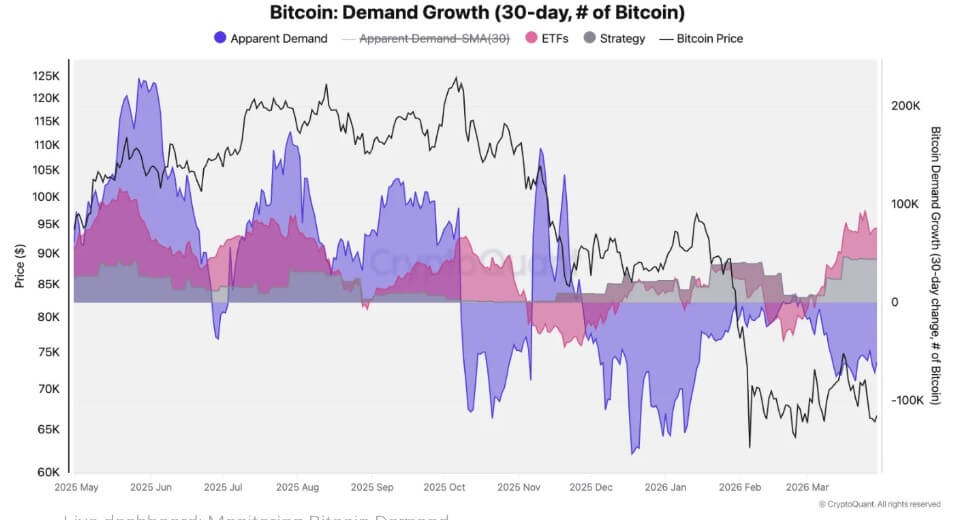
The same pattern can be seen in larger holders. Whale wallets holding between 1,000 and 10,000 BTC have gone from accumulation to one of the most rapid distribution phases of the cycle. The one-year change in whale holdings is from an increase of about 200,000 BTC at its peak in 2024 to a decrease of 188,000 BTC.
Mid-sized holders also withdrew. Wallets holding between 100 and 1,000 BTC are often considered an important layer of market support, but their holdings have only increased by 429,000 BTC in the current market cycle, compared to around 1 million BTC in late 2025.
This weakness is particularly evident in the United States. The Coinbase premium, a common measure of U.S. spot demand, remains negative despite Bitcoin falling into the $65,000 to $70,000 range. This suggests that US buyers, both retail and institutional, are not returning in sufficient numbers to stabilize the market.
Essentially, these numbers help explain a market that was already beginning to lose its resilience before news of the war intensified.

Turning a Weakly Leveraged Market into a Vulnerable Market
On the other hand, Bitcoin’s current weak spot demand has become more dangerous if leverage is making the market work too much.
In calm markets, such positioning helps maintain price levels. However, in times of macroshocks, contracts that would otherwise have been accelerated are more likely to be terminated, either through election or forced liquidation, thus creating a vulnerability.
In this way, orderly weakness becomes a cascade. Prices fall, leveraged longs are forced out, more selling ensues, and the market begins to move more towards positioning than conviction.
Bitunix analysts said: crypto slate Bitcoin remains in a passive pricing regime, with resistance near $69,400 still unresolved and downside liquidity continuing to build around $65,500. In a more hostile macro environment, that lower band could trigger a broader wave of liquidations.
Options markets are sending a similarly cautious message. According to data from Greeks.live, 28,000 BTC contracts expire on April 3rd, with a put-call ratio of 0.54, a maximum pain point of $68,000, and a notional value of $1.8 billion.
According to the company,
“Bitcoin performed poorly in both price and market sentiment in the first quarter of this year, and also underperformed in the first week of the second quarter. Restoring confidence may require time and capital support. All indicators currently point to bearish market conditions.”
Why $10,000 is still a tail risk
Bitunics describes the current environment as a triple constraint regime shaped by rising inflation expectations, policy limitations, and growing geopolitical risks.
This framework helps explain why cryptocurrencies are reacting so sharply, as liquidity is less cushioned when oil prices remain high. At the same time, market confidence will not easily recover if war risks continue to rise, speculative positions become harder to protect as the dollar strengthens, and volatility increases across asset classes.
Against this background, the more plausible case for BTC still shows low levels.
In a benign scenario, where the conflict remains contained but inflation remains high, an unwinding of leveraged futures could send Bitcoin down from around $70,000 to $50,000, within the range of roughly a 25% to 30% correction.
On the other hand, if ETF outflows accelerate, spot demand remains weak, and dollar financial conditions tighten, a more severe bearish line will emerge. In this situation, Bitcoin could fall to the $20,000 to $30,000 range, wiping out 60% to 70% of its value from recent levels.
| scenario | price range | what makes it tick | market effect | probability framework |
|---|---|---|---|---|
| relief bounce | $71,500 to $81,200 | Geopolitical tensions ease, oil prices retreat, and broad risk sentiment improves. | As liquidation pressure subsides, Bitcoin recovers towards resistance. | It’s possible, but it depends on macro stabilization. |
| Moderate downside | Approximately $50,000 | Conflicts remain contained, but inflation remains high and leveraged futures positions are being unwound. | Approximately a 25% to 30% correction from the recent $70,000 area. | A plausible downside case. |
| medium-term bear case | $20,000 to $30,000 | ETF outflows are accelerating, spot demand remains weak, and US dollar financial conditions continue to tighten. | Bitcoin has entered an even deeper contraction, wiping out 60% to 70% from recent levels. | More severe, but still within historical drawdown patterns. |
| tail risk black swan | Approximately $10,000 | A prolonged closure of the Strait of Hormuz and a broader regional war will send oil prices soaring from $150 to $200 per barrel, causing a global liquidity collapse. | Bitcoin has suffered extreme declines as speculative funds exit the market. | Tail risk rather than base case. |
The move to $10,000 is beyond that as a result of a black swan. This would likely require a long-term closure of the Strait of Hormuz, or a widespread regional war that would push oil prices between $150 and $200 per barrel, prompting a significant tightening of global liquidity and pushing stock prices down by more than 30%.
Under these circumstances, speculative capital across cryptocurrencies would shrink dramatically, exposing Bitcoin to an 80% drawdown similar to what was seen in earlier cycle washouts.
For now, what is immediately clear is that Bitcoin does not serve as a safe haven in the midst of war. Rather, it trades like a highly sensitive risk asset, with its direction still dependent on liquidity, leverage, and the market’s willingness to absorb macro shocks.
(Tag translation) Bitcoin


