

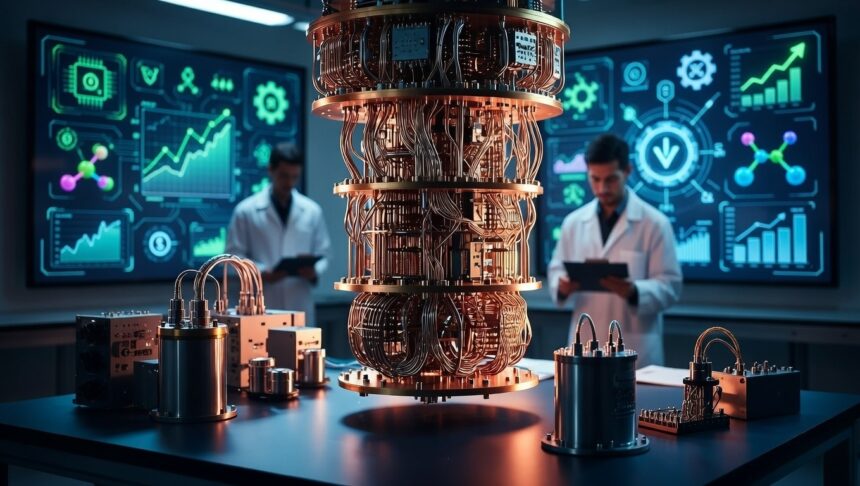
Arthur D. Little Company (ADL), the world’s first and oldest management consulting firm, has released the latest version of its 2022 “Blue Shift” report on the state of quantum computing. There, he concludes that despite recent technological advances and billions of dollars in public and private investment, mass commercialization of this technology still faces significant obstacles.
Three years ago, the industry was betting that it could build useful machines simply by increasing the number of physical qubits. According to a new ADL report published by Quantum Zeitgeist on March 21st, the bet is as follows. turned out to be insufficient.
The focus shifted to more demanding goals. Fault-tolerant quantum computing (FTQC), a machine that can correct its own errors in real time without making modifications that cause more problems than they solve.
A historical problem is that the error correction process More errors occurred than resolved. Crossing that threshold is technically known as “break even”has been a major concern in this field.
So a new analysis by Arthur D. Little, a consulting firm founded in Boston (USA) in 1886 by MIT chemist Arthur Dehon Little, focuses precisely on assessing whether the advances of the “past 12 to 18 months” have allowed us to approach or even surpass it.
Recent quantum milestones highlighted by the ADL team
Recent advances noted by ADL suggest that the obstacles cited by the consulting firm are being overcome. According to researchers, companies such as Quantinuum, Google, and IBM; Error correction and stability of logical qubits.
As reported by CriptoNoticias, in February 2026, error correction was performed effectively and efficiently for the first time by Quantinuum’s Helios processor. The system solves more faults than it creates. One of the researchers said the result was something physicists “could only dream of.”
Meanwhile, Google announced its 105-qubit Willow chip in 2024, demonstrating that it is possible to increase the size of modified qubits. Can reduce overall error ratewhich is a reversal of the previous logic that more qubits means more noise.
Similarly, ADL’s research highlights that Google implemented a technology called “magical state cultivation” in December 2025. This allows them to perform certain kinds of logical operations that are considered essential to achieving exponential acceleration of quantum algorithms.
IBM unveiled its Nighthawk processor late last year with the goal of improving connectivity between qubits using existing, affordable technology.
What is still missing from ADL consulting companies?
However, ADL emphasizes that none of these advances mean commercially useful quantum computers are anywhere near. For the FTQC machine to be applicable to a wide range of problems, the report estimates that: At least 100 logical qubits are required, and the most valuable applications require thousands of logical qubits.
Building reliable logical qubits requires hundreds to thousands of physical qubits, depending on the technology, according to accepted industry standards. The gap between current systems and their thresholds remains large.
An intermediate path that ADL sees as more direct is hybrid computing. In other words, A system that combines a quantum processor and a classical supercomputerdelegate the most efficient tasks to each architecture.
In June 2025, an ADL report said that IBM and Japan’s RIKEN combined quantum processors and classical supercomputers to simulate how electrons behave within molecular structures. A type of calculation that is useful for developing new materials and medicines.
The experiment used up to 77 physical qubits and a record 10,570 quantum gates, the fundamental computing operations of a quantum machine. According to the ADL report, this hybrid model – in which quantum machines solve the most efficient part of the problem and supercomputers handle the rest – represents the most realistic horizon for useful applications in the short term.
The report mentions chemistry and materials simulation as the most promising areas, but does not specify other specific applications.
When will the real threat come? A debate that divides opinions among analysts
The ADL report does not set a specific deadline for the arrival of quantum computers that could potentially compromise cryptographic systems such as Bitcoin, Ethereum, and other technologies. This warning is in contrast to ecosystems such as: Estimates vary widely.
In this regard, Cathie Wood’s financial firm ARK Invest, in collaboration with custodian Unchained, released a report in March 2026 that concluded, in the most likely scenario, consistent with the consensus of companies such as Google, IBM, Microsoft, and NIST: It will take 10 to 20 years Before there are quantum computers that can threaten Bitcoin cryptography.
ARK suggests understanding threats as a five-step process rather than a single catastrophic event. The current stage corresponds to machines that are present but do not present a threat.. According to ARK, a key step where quantum computers could break the elliptic curve cryptography that protects Bitcoin keys will arrive within the next 10 or 20 years.
However, this prediction is not universal. Charles Edwards, CEO of Capriol, believes that Bitcoin is: Should be protected by 2028the period is significantly shorter. Ethereum co-founder Vitalik Buterin speculates that a threat to the digital transaction signature system that secures both Bitcoin and Ethereum could also materialize in 2028.
At the other end of the spectrum is Blockstream co-founder Adam Back. We share ARK’s vision and view risk as: “10 or 20 years” ahead.
The tension between these positions accurately reflects the central warning of the ADL report. So the real risks are not just technical. That’s the difficulty of coordinating exactly when to act in a field where milestone announcements come every month, deadlines get compressed with every new study, and where consensus about urgency doesn’t yet exist.
(Tag translation) Bitcoin (BTC)


