


The Bank of England’s proposed cap on stablecoin holdings is facing growing opposition from across the crypto industry. British founders, global CEOs and politicians have warned that the restrictions could make it impossible for them to pay their bills, hinder business growth and lead to an exodus of talent overseas.
The proposals, introduced in a consultation paper in November 2025, would impose temporary limits on holdings of systemic stablecoins denominated in pounds at £20,000 per individual and £10 million per company. No other major jurisdiction has proposed comparable caps.
Why the Bank of England wants a cap
The central bank designed this limit as an interim safeguard against deposit flight. Officials fear that if a large-scale Sterling stablecoin were issued without restrictions, customers could quickly move their savings from traditional bank accounts into digital tokens.
This change could disrupt the availability of loans and credit in an economy where banks supply about 85% of consumer borrowing.
The proposals would also require system stablecoin issuers to hold 40% of their reserves in non-remunerative Bank of England accounts, most of which earn interest on short-term government bond holdings, a condition that could significantly reduce the issuer’s income.
Stand With Crypto’s UK Director Adriana Ennab outlined the bank’s rationale at the recent BeInCrypto Expert Council.
Adriana said: “The Bank of England is considering caps of £20,000 for individuals and £10 million for businesses during the transition period to protect financial stability and prevent large-scale capital outflows.”
Why do founders say things don’t work out?
Stand With Crypto held roundtable discussions with builders across the UK over several months. The feedback was consistent. Cross-border payments, supply chain transactions and payroll processing will all quickly plateau, particularly for mid-sized businesses whose turnover is well above £10m but still below corporate standards.
“They told us their business was impossible. There are caps on payments, there are caps on transfers, and for many companies, £10m is simply not enough. Some founders said they had already set up on the Isle of Man, and others said if they were to start today they would set up elsewhere,” Adriana explained.
Questions about legal enforceability add another layer. Self-custodial wallets operate outside of a centralized platform, making it technically difficult for regulators to monitor or enforce holding limits.
At the BeInCrypto Expert Council, Ennab likened this approach to a structural misunderstanding of the technology itself.

UK Bitcoin Policy Director Freddie New raised another concern. Stablecoin reserves typically hold government debt, effectively making the issuer a large buyer of UK gold coins.
He pointed to the United States, where Tether has become one of the largest holders of U.S. government debt, surpassing some sovereign nations.
Limiting the growth of stablecoins could reduce demand for sovereign debt at a time when governments need buyers.
“It’s very difficult to convince the Bank of England that it’s not necessarily a bad thing for buyers of government bonds to be guaranteed,” Freddie New told the board.
BeInCrypto Expert Council on UK Cryptocurrency Competition
Repulsion to the world
Criticism extends far beyond Britain’s founders. Coinbase CEO Brian Armstrong said the cap was a “disincentive to innovation” that could hinder Britain’s global competitiveness.
The rules for stablecoins in the UK are being finalized and are at risk of preventing the UK from being globally competitive in the digital economy.
For example, the Bank of England has proposed capping the holdings of stablecoins by individuals and businesses.
Britain has a long history… pic.twitter.com/afn0gLinld
— Brian Armstrong (@brian_armstrong) February 24, 2026
Similarly, Nigel Farage described the proposals as a “poison pill” for the UK financial sector. Elsewhere, Aave founder Stani Krechov warned that the combination of caps and reserve requirements would make the UK the least attractive jurisdiction for stablecoin issuers.
The Bank of England’s systemic stablecoin plans set caps of £20,000 per individual and £10 million per company, effectively choking the market before it can grow.
Issuers will be forced to hold 40% of their reserves at the central bank without compensation and maintain a yield of just 60%…
— Stani.eth (@StaniKulechov) November 12, 2025
Stand With Crypto’s own research found that as the US stablecoin market grew to $300 billion, bank deposits also increased.
The data suggests that stablecoins are acting as an additional store of value rather than a replacement for traditional deposits, undermining the Bank of England’s core legitimacy.
Political pressure is also increasing. Stand With Crypto’s petition against the cap had gathered 84,276 signatures by the March 3 deadline.
The House of Lords launched its own investigation into stablecoins in late January, writing to all signatories and requesting evidence.
Farage’s Reform Party has pledged to cut capital gains tax on cryptocurrencies to 10% across the board, putting pressure on the ruling Labor Party to take action in the election.
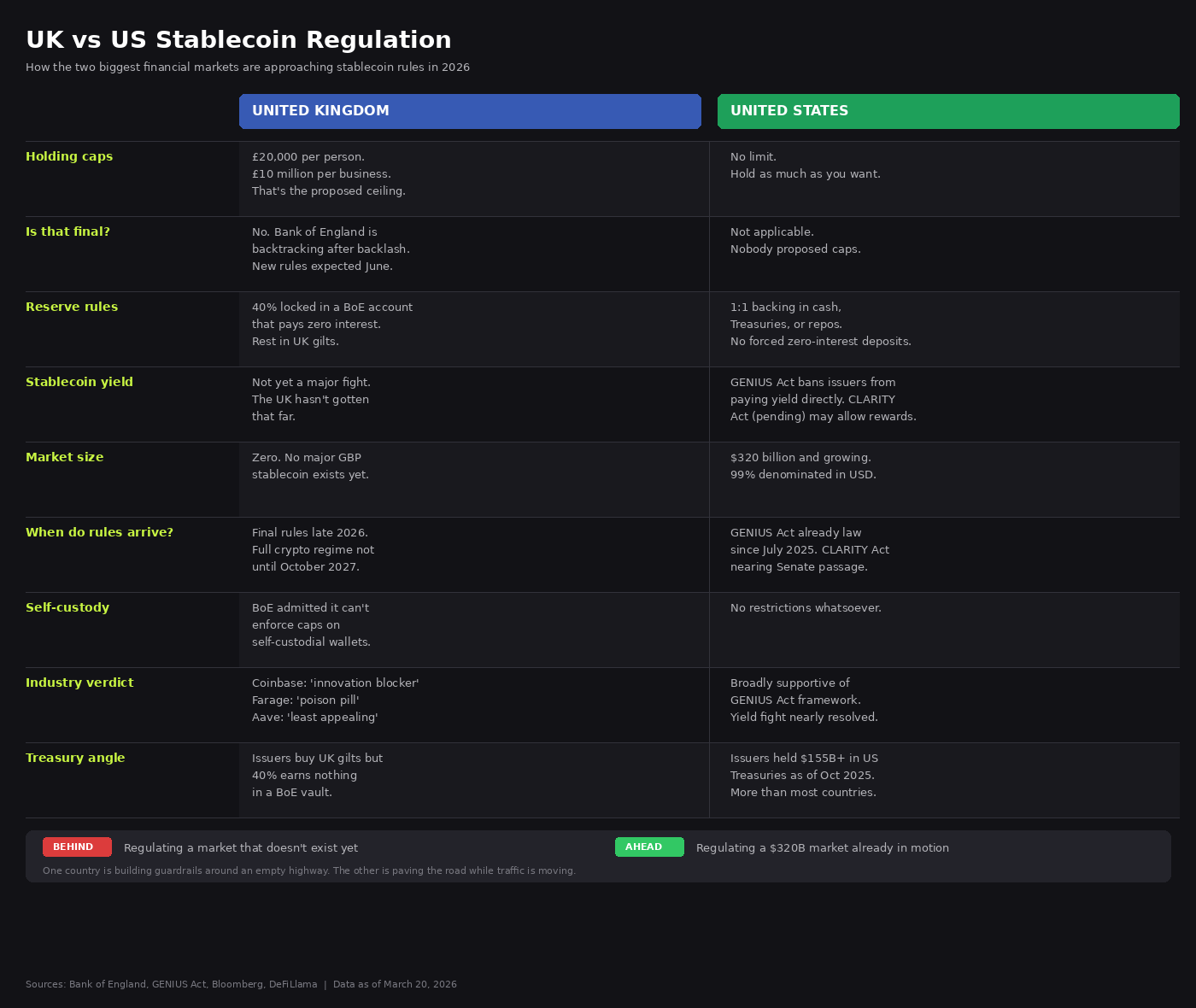
Comparison of UK and US stablecoin regulations showing holding limits, reserve requirements and market size, source: BeInCrypto
what happens next
Sarah Breeden, deputy governor of the Bank of England, told the House of Lords in March that the Bank of England was “genuinely open to other ways” of managing risk.
He acknowledged the technical difficulties in enforcing the cap and questioned whether it would be cost-effective to create a monitoring system for temporary restrictions.
The Bank of England has signaled a major step back on controversial stablecoin holding limits.
Deputy Governor Sarah Breeden told the House of Lords today that the BoE is “genuinely open” to alternative risk management tools following intense industry opposition. #BoE… pic.twitter.com/e8Os9erxsi
— Conor Kenny (@conorfkenny) March 12, 2026
The latest draft regulations were released in June, and the final regulations are expected by the end of the year. The UK’s wider crypto asset regime is scheduled until October 2027.
With the EU pushing forward with its 28th regime to streamline cross-border business registration, and the US already implementing the GENIUS Act and pushing towards passing the CLARITY Act, UK founders say the window for competitive policymaking is rapidly closing.
Talent exists. The question is whether regulations will be in place in time to keep them on land.
The post UK stablecoin cap could “make it unviable” for businesses, says expert The post appeared first on BeInCrypto.


