

Offchain Labs co-founder Edward Felten said in his EthCC 2026 keynote that Ethereum’s Layer 2 network needs “responsive pricing” to scale to billions of users and still reduce price fluctuations due to congestion.
Ethereum’s EIP-1559 upgrade was launched in August 2021 as part of the London hard fork. We have reformed the Ethereum fees market by changing gas fee limits and introducing the ability to burn a portion of transaction fees and permanently remove them from circulation.
Felten said gas price fluctuations are a key mechanism to protect the network from being overwhelmed during periods of high demand, even though they cause the kind of rate fluctuations that mainstream users tend to reject.
“[Responsive pricing]allows us to see more traffic at lower gas prices without overloading our infrastructure.”
The price of volatile gases has long been a barrier to mass adoption, especially for users accustomed to fixed or predictable transaction costs in traditional financial systems.
This issue is important because scaling Ethereum is no longer just about adding throughput. It is increasingly important that Layer 2 networks can price congestion honestly enough to protect the infrastructure under high demand while making transaction costs predictable enough for mainstream-style apps. Arbitrum’s rollout of dynamic pricing is now one of the first live tests of that tradeoff.
Arbitrum One is the first L2 with responsive pricing
Arbitrum One adopted dynamic pricing in January. The magazine describes the model as “the direction of the Arbitrum platform in making pricing more predictable in response to demand by adjusting prices to match actual network bottlenecks.”
Related: Gavin Wood’s Biggest Hope: Free Crypto Trading and Web3 Technology Worldwide
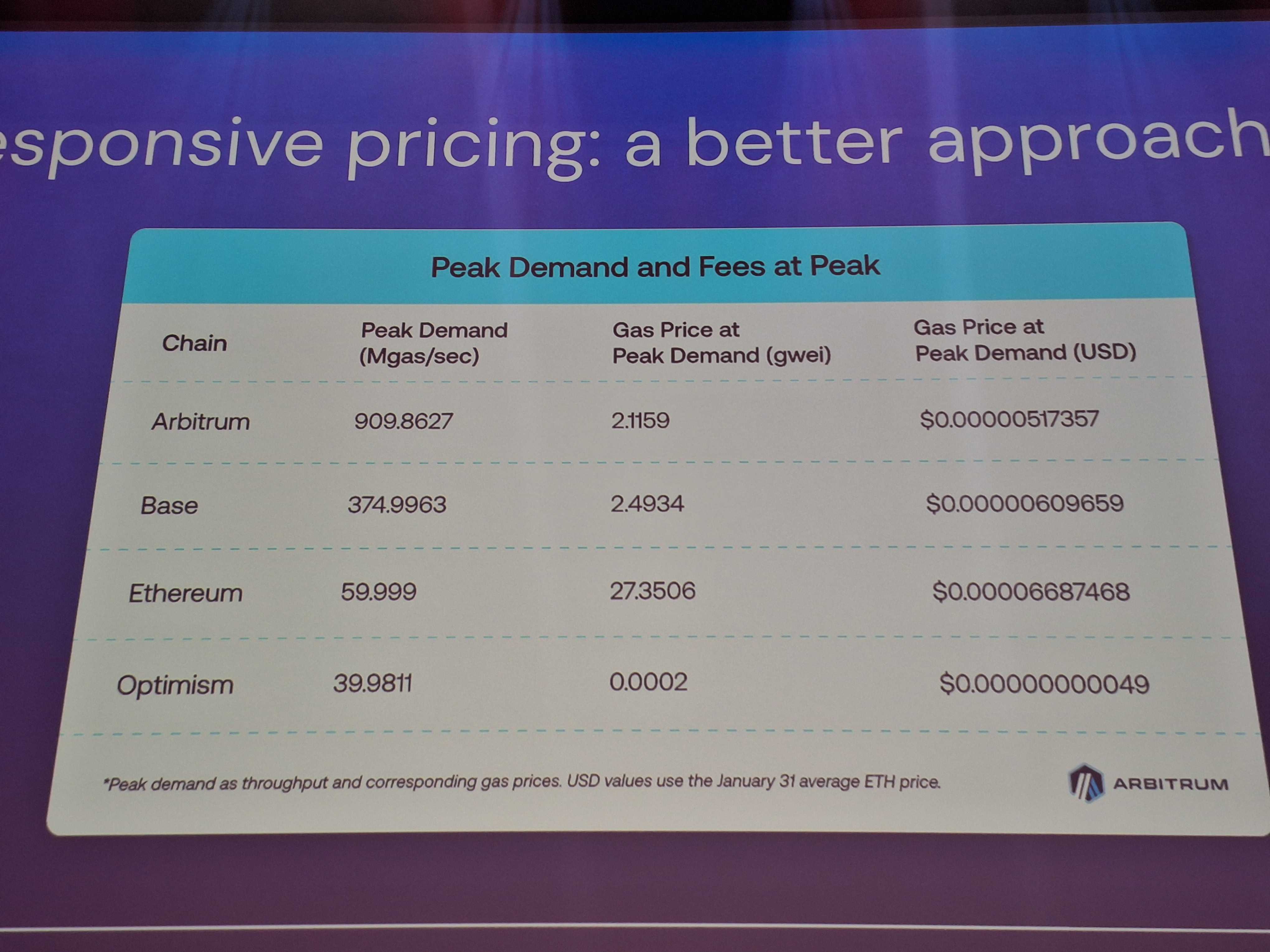
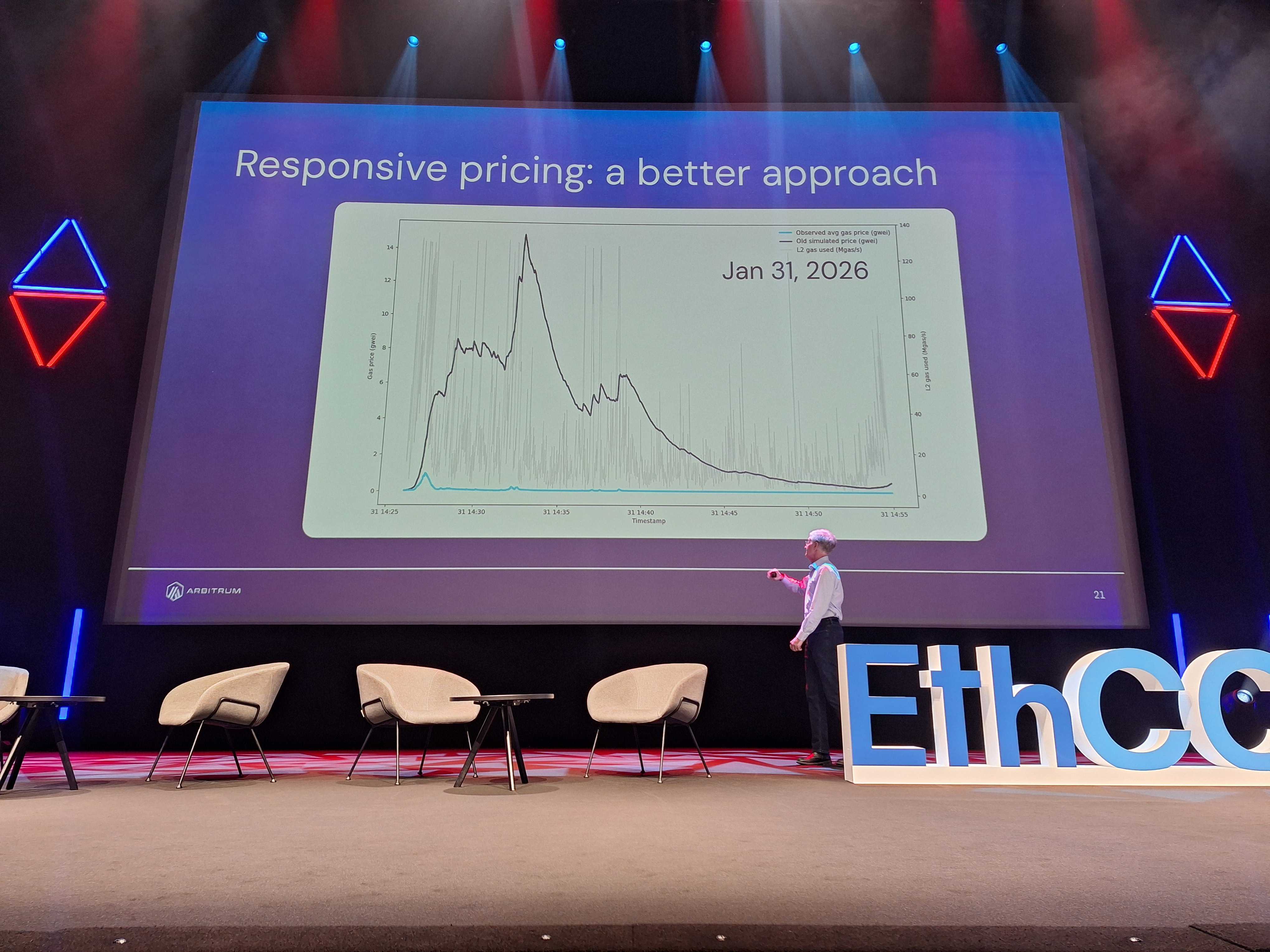
Felten shared multiple graphs showing how Arbitrum’s gas prices remain lower than those of the Base network and other L2s that rely on EIP-1559 during peak network volumes.
According to L2beat data, Arbitrum One is the largest L2 with a total TVL of $15.2 billion, while Coinbase’s base chain ranks second with $10.9 billion. L2 has grown 4.6% over the past year, securing more than $39.7 billion in cumulative TVL.
Responsive pricing may be more scalable and have more underlying cost transparency, but its biggest drawback is that it’s less predictable than EIP-1559, said Julian Kors, senior developer and founder of execution workspace startup Pulsar Spaces.
The debate is not about which model is better, but rather whether the network optimizes for “predictability and purity of mechanism design, or efficiency and real-time cost adjustment. EIP-1559 does the former very well. Responsive pricing leans towards the latter,” he told Cointelegraph.
Related: Ethereum Foundation accelerates 70,000 ETH staking plan after BitMine sale
Responsive pricing is a step forward, but gas models need to be replaced
Jérôme de Tichet, president of Ethereum France and EthCC, told Cointelegraph that responsive pricing could improve the user experience by allowing fees to more accurately reflect actual network demand.
Cyprian Grau, project leader for the Gasless Ethereum L2 Status Network, agreed, calling the new pricing model a “real improvement in pricing accuracy.” However, the model still relies on a “fee market,” so users could still face variable fees and gas spikes during busy periods, he told Cointelegraph.
“The structural problem persists. As L1 and L2 scaling improves and competition increases, L2 gas prices will trend toward zero. With responsive pricing, the decline will be smoother, but you are still building a revenue model based on depreciating assets.”
Grau added that responsive pricing is “the most advanced version of the gas model,” but said the gas model needs to be replaced. “As L2 scales to billions of users, users will never think about gas and the economics of the network will not depend on billing,” he added.
The pricing model discussion comes as some in the Ethereum ecosystem are already rethinking their original rollup-centric scaling theory. Vitalik Buterin argued in February that some of the assumptions of Layer 2 no longer hold true and that future scaling must rely more on mainnet and native rollups.
The L2 network was created to scale Ethereum and offload some of the transaction load from the mainnet. However, Ethereum is currently rethinking its L2-centric approach, as these networks are siphoning significant economic value from the mainnet.
magazine: Ethereum’s Fusaka Fork explained for beginners — What exactly is PeerDAS?


