

The first few months of 2026 forced the Ethereum community into a kind of introspection. It went beyond price and technical upgrades to the question of what the network was actually going to be.
Even before this year, there was a perception among builders and executives that Ethereum was on the verge of a new phase of growth, this time driven by institutions and technology rather than crypto-native users. As some have argued, neobanks will quietly enroll millions of people by removing the complexity of wallets and gas fees. In this framework, Ethereum does not need to acquire users directly. It sits underneath the interface and powers a new financial stack that superficially bears no resemblance to cryptocurrencies.
It was a continuation of the long-standing assumption that Ethereum’s success comes from intangibility.
This vision has been shaped in part by years of upgrades aimed at improving the user experience and reducing costs. Changes such as “proto-dunksharding” introduced in the Dencun upgrade have significantly lowered Layer 2 network charges by increasing data downloads for transactions, while continued improvements to the base layer have made transactions more efficient.
On the other hand, the price of Ether in the network ($ETH) tokens have been dictated by market forces, these upgrades move Ethereum closer to a model where users can interact with applications without needing to understand the underlying infrastructure.
But that narrative began to change a few weeks into this year, with a refocus on the core roadmap.
L2 discussion
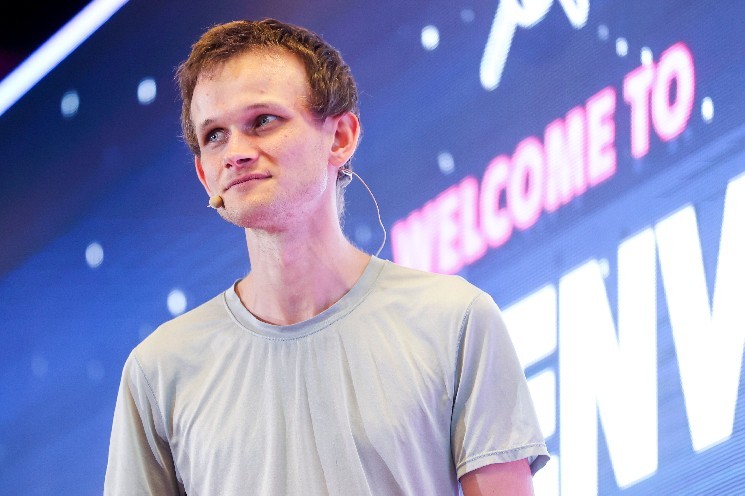
Earlier this year, network co-founder Vitalik Buterin gave a sharp reality check to the broader ecosystem: “You’re not scaling Ethereum.”
The comment broke up a conversation that had previously been largely celebratory about the rollup. These types of networks, also known as Layer 2 (L2) networks, process transactions from Ethereum and bundle them back into the main chain, making them faster and cheaper. Layer 2 networks have exploded in recent years, transaction fees have fallen and activity has expanded. But the more serious question was whether any of this amounted to consistent scaling.
Buterin’s argument went beyond a general critique of progress. In his view, many of today’s Layer 2 designs are moving away from Ethereum’s core model, relying on centralized components and siled environments that don’t fully inherit the guarantees of the base chain. The concern was not that L2 existed, but that in its current form it might not be able to provide the kind of scaling that Ethereum was trying to achieve.
His criticism highlighted growing anxiety.
L2-to-L2 fragmentation, inconsistent security assumptions, and reliance on centralized components were starting to look like structural risks rather than temporary trade-offs. In attempting to expand outward, Ethereum risked losing the very properties that made it valuable in the first place: strong security, decentralization, and its role as a shared, neutral payments layer where applications and liquidity can seamlessly interoperate.
The L2 team did not resist enough to readjust. Some acknowledge the criticism and lean toward a future where Rollup does not simply function as a cheap Ethereum, but differentiates itself through specializations such as privacy, consumer-facing apps, and its own execution environment. Others defended their role more forcefully, arguing that high-throughput environments remain essential.
Meanwhile, Ethereum’s base layer is making incremental progress on its own. Recent upgrades, such as the Fusaka hard fork in December, have increased the data capacity and efficiency of the main network, allowing it to process more transactions while reducing costs. The surge in transactions has recently come under scrutiny, with some calling it an “address poisoning” scam.
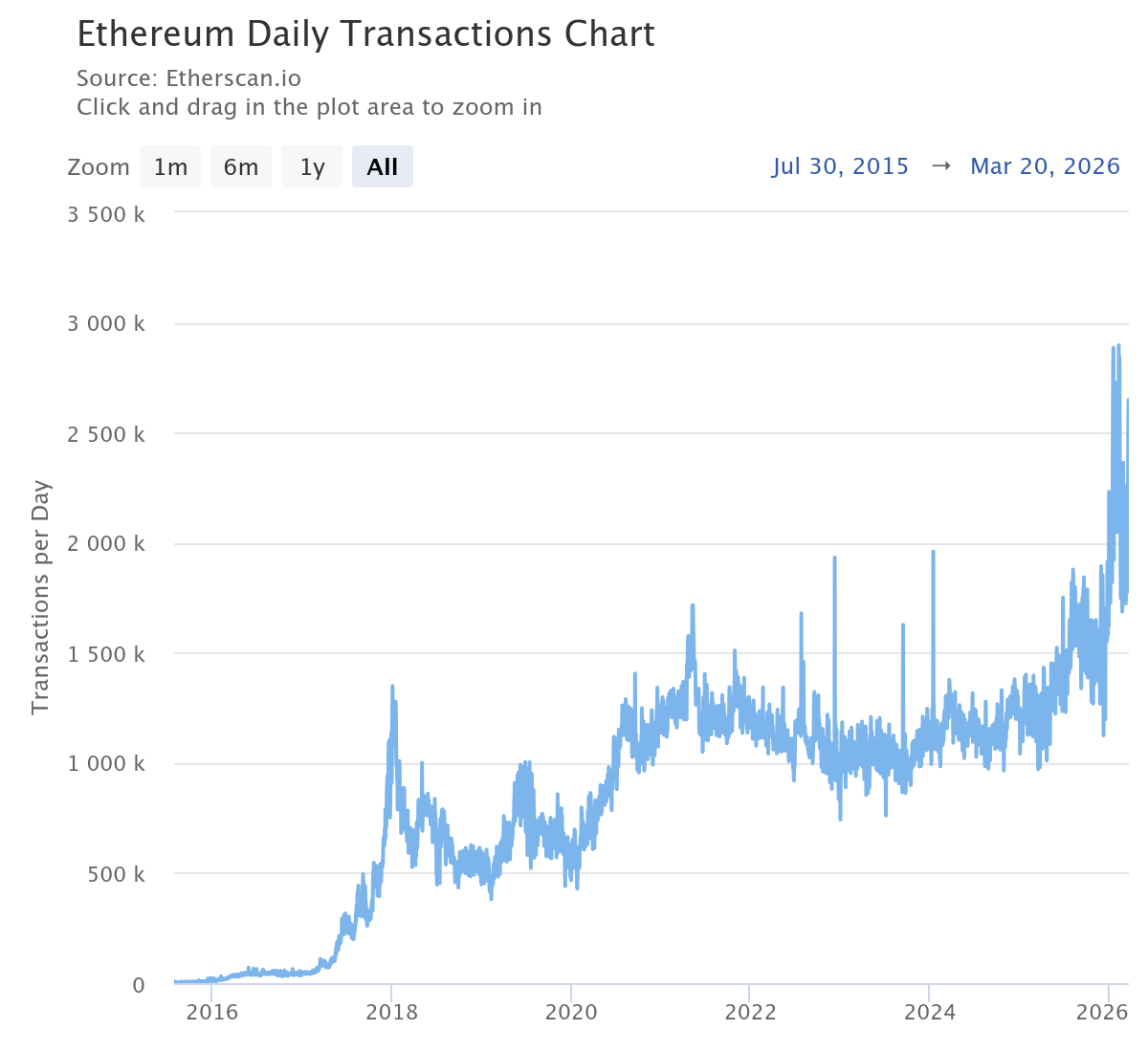
Ethereum daily transaction surge (Etherscan.io)
What this tense episode has meant for Ethereum is that the path forward requires a delicate balance between structural upgrades to the base layer and a new breed of specialized rollups that can grow the ecosystem without compromising fundamental security.
According to 21shares, this could also lead to integration between Layer 2 networks. “The coming year is likely to see Ethereum L2 integration, meaning a leaner and more resilient layer. $ETHThe company stated in its research report:
quantum threat
At the same time, another issue that has been discussed for a long time but is less urgent has suddenly moved up the priority list: quantum computing.
The Ethereum Foundation signaled a change in attitude, promoting initiatives such as “LeanVM” and post-quantum signature schemes. What was once treated as a distant, almost academic concern is now becoming part of short-term planning.
This influence was difficult to ignore. Networks are no longer just built for the next cycle, but for threats that can fundamentally break the assumptions of encryption. The foundation has signaled that it takes that risk seriously and has established a dedicated research effort specifically focused on post-quantum security.
Vitalik Buterin also outlined a roadmap to protect blockchain from long-term risks posed by quantum computers.
internal shuffle
If scaling exposed the cracks in Ethereum’s status quo, quantum risks cast a shadow over its future, and the network appeared to be taking this threat seriously.
And the change came from within.
The resignation of Tomasz Stanczak as co-executive director of the Ethereum Foundation is more than just a change in leadership. At a time when networks are facing technical, strategic, and philosophical reassessments all at once, even subtle changes at the top can signal a broader recalibration.
This move was also surprising.
The foundation isn’t known for sudden changes, and Stanczak only joined the role about a year ago following the long tenure of Aya Miyaguchi. In an ecosystem that tends to value continuity, this rapid turnover suggests a deeper internal realignment is underway as the foundation reevaluates its priorities amid growing demand for Ethereum’s potential role in new frontiers such as scaling, security, and artificial intelligence (AI).
“Trust layer”
And AI, a topic that can no longer be ignored not just for crypto but for every industry, has started to shape a different way of thinking about networks.
Buterin outlined how Ethereum can play a fundamental role in the future of artificial intelligence. This vision extends beyond payments and DeFi to a world where Ethereum acts as a coordination layer for decentralized AI systems, enabling verifiable outputs, data sharing with minimal trust, and economic activity between machines.
That momentum didn’t emerge overnight.
Early last year, the Foundation launched a dedicated Decentralized AI Research Unit (dAI) to investigate how networks can support autonomous agents and the machine-to-machine economy. What felt experimental at the time has accelerated into something more planned by 2026, with foundations increasingly framing Ethereum as a potential “layer of trust” for AI, a system for validating outputs, coordinating agents, and anchoring a rapidly evolving ecosystem that has so far been largely controlled by centralized players.
All of these are ambitious scope expansions that place Ethereum at the intersection of two of today’s most important technologies.
But overall, the first three months of this year suggest that Ethereum can no longer afford to tackle these issues alone. Rather, they are converging.
What is emerging is that the network is being pulled in multiple directions, each with its own sense of urgency, making the balancing act difficult to ignore. And unlike previous cycles, where the narrative could change as quickly as the price, the issues now feel deeper and more focused on structure than momentum.
These tensions are unlikely to be resolved anytime soon and will continue to shape Ethereum’s trajectory over the coming months.
For now, however, the focus remains on expanding the base layer, an effort that is expected to accelerate with the Gramsterdam upgrade scheduled for this year. This upgrade is likely to be a litmus test of the network’s ability to solve problems that will successfully move Ethereum into a robust, quantum-secure “layer of trust” that can anchor the world’s AI economy.
Read more: Ethereum’s “gramsterdam” upgrade aims to fix MEV fairness


