


Ethereum Developers has drafted the EIP-7917 proposal to resolve the uncertainty of existing proposal elections.
Ethereum’s EIP-7917 proposal
Ethereum developers Lyn Oshitani (@linoscope) and Justin Drake (@justindrake) have co-drawn the EIP-7917 proposal (deterministic proponent Lookahead) aimed at fully solving the issue of uncertainty in existing proposal elections.
I’m excited to share EIP-7917 with Me & @drakefjustin! This introduces the introduction of deterministic proponents to the beacon chain. This is a natural simplification that eliminates the unpredictability of the proposer, which is essential for advance tracking protocols. https://t.co/jtlbxnchdv
Details In🧵
– Lin Oshitani (@linoscope) March 26, 2025
Note that in the current Ethereum consensus, the system selects the validator as the block proposal for slots from the entire set of active voters via a random sampling algorithm based on random numbers (e.g. Randao) and effective balance (effective balance). Although there is pre-access to the Randao Seed, the effective balance of validators may fluctuate within the epoch, making it difficult to fully predict the next epoch’s proposal.
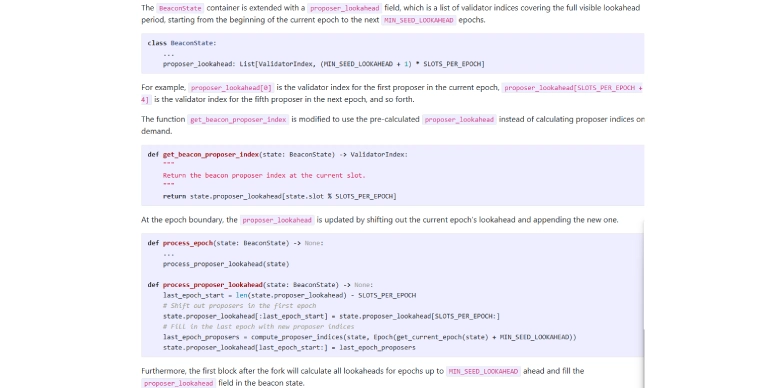
Excerpt from EIP 7917
EIP-7917 resolves the uncertainty of the proposal arrangement caused by dynamic changes in the effective balance of enablement in existing designs by pre-calculating and storing the deterministic proposer list at the start of each epoch. This not only improves system security and prevents validator operations, but also simplifies the implementation of on-chain protocols while maintaining backward compatibility and scalability.
The duo outlined the rationale that considers alternatives that they believe can be used to calculate the proposer’s appearance at the start of epoch n+min_seed_lookahead, as the alternative approach is to cache effective balances at the start of epoch N.
Also Read: Standard Chartered Bank Official: Ethereum Facing a “Midlife Crisis”


