

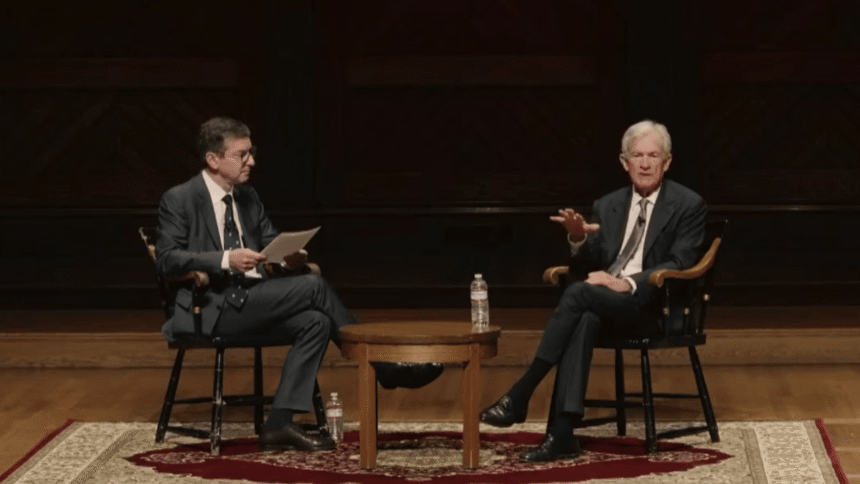
Federal Reserve President Jerome Powell said at a conference at Harvard University on March 30, 2026, that the United States’ fiscal problems are not yet at its current debt level, but at its trajectory.
“Debt levels are not unsustainable, but the trajectory is not,” he said in response to a question. About the growing federal debt. “The federal debt is growing significantly faster than the economy, and the ratio is rising. Over the long term, that’s the definition of unsustainable.”
The following graph is US federal debt, year by year. The amount now stands at $38.51 trillion, and it has reached this level for other reasons that brought about the current situation, such as funding wars and alleviating various economic crises. It could be a structural problem (though Powell downplays it).
Regarding the federal debt, the Congressional Budget Office projects that large and growing public deficits will cause debt increases from 2026 to 2036. “Federal debt held by the public sector will rise from 101% of GDP this year to 120% of GDP in 2036, exceeding the previous high of 106% of GDP in 1946, just after the end of World War II,” the agency said.
The statement was one of Powell’s strongest messages during the meeting, which also addressed inflation, interest rates, the Middle East crisis, financial regulation, jobs and artificial intelligence.
Regarding debt, he left a clear warning. “It’s important to get back to the primary balance. “If we don’t do something soon, it’s not going to work.” But he stressed that this is not a problem for his agency to solve. “Of course, this is not the Fed’s job. I limit myself to these high-level issues.”
“Inflation will reach 2%”
Regarding financial issues, Chairman Powell said that the Federal Open Market Committee (FOMC): stay committed By bringing inflation back to 2%. “We’ll get there,” he declared. “The FOMC remains committed to returning inflation to 2% on a sustained basis.”
As he explained, toward the end of 2024, the Fed felt it had “almost” achieved that goal, even though “nearly 100% of economists” were predicting a recession after a rapid rate hike in 2022.
“We didn’t have anything like that,” he said. On the contrary, he argued that 2023 and 2024 will be strong years, with economic growth at 2.5%, inflation at “2 or something” and a labor market near full employment. “I call it a soft landing. We achieved that,” he said.
However, the latest US inflation data shows the Consumer Price Index (CPI) is up 2.5% year-on-year.
Chairman Powell noted that the process of eliminating inflation has once again become complicated. He said the import tariffs set by President Donald Trump are putting pressure on prices (as tariff costs are passed on to end consumers) and escalation in the Middle East could impact energy.
“Tariff inflation is visible and we believe it is really just a one-time price increase,” he said. He estimated that this factor is “driving up inflation by half to all of it.” This, coupled with current geopolitical events (such as the Iran war and resulting rise in oil prices), “will definitely have an impact on gasoline prices,” he said.
Powell also defended discussions within the Fed during a time of great uncertainty. He acknowledged there have been recent disagreements over the direction of interest rates, but said he doesn’t think it complicates his job.
“When you’re faced with really difficult issues, it helps to listen to all sides.” For Powell, calling for unanimity when there are “downside risks to the labor market” and “upside risks to inflation” would be “largely misleading.”
FED: politically independent but aggressively regulated
Mr. Powell on financial regulation. Clearly distinguishing the independence of the FED From a more collaborative role in supervision, to monetary policy as well.
“The Fed needs to be completely politically independent” on interest rates and inflation, he said. However, when it comes to regulation, he explained that the current legal framework gives a specific role to the deputy governor in charge of supervision, making the central bank governor “another voter” on many of these issues.
Facing the risk of a new financial crisis, he said: Although today’s systems are more robust than they were before 2008, they are not without threats..
“We want a resilient financial system and we already have it,” he said. Still, he added, “nobody in this industry gives you the green light” because there are always risks to monitor. Private credit is showing signs of being an industry on the verge of full expansion, as reported by CriptoNoticias, Powell said, adding that the Fed is following it “very carefully” and so far “there doesn’t seem to be any element of a broader systemic event.”
Mr. Powell, the “textbook” that did not move the market
Like many other times, Powell avoided speaking off script.. He did not offer dangerous definitions or sharp judgments on the most sensitive issues, but rather acted within the bounds of political correctness and carefully prepared responses that avoided opening new fronts of controversy.
Despite making strong statements about the trajectory of U.S. debt; The overall tone of his intervention was cautious. No extensive diagnostics, no long-term warnings, no short-term destructive symptoms.
This moderate profile was also reflected in the market reaction.. There were high hopes that Chairman Powell might reveal some clues that could change the direction of financial assets, but ultimately that didn’t happen.
BitcoinOn the other hand, it remains relatively stable, 66,000 without recording any sudden movements during or after the meeting.
(Tag Translate) Central Bank


