

China resumed large-scale military operations near Taiwan on March 15, dispatching 26 aircraft and seven naval vessels toward the island, its largest use of force in recent weeks.
The activity comes after an unprecedented two-week suspension of Chinese flights near Taiwan’s Air Defense Identification Zone (ADIZ). Analysts are currently reassessing the economic risks of the Taiwan conflict and its impact on digital assets.
Why Taiwan faces $10 trillion in global risks
Taiwan is located at the center of the global semiconductor supply chain. The island produces more than 60% of the world’s chips and 90% of the most advanced processors used in artificial intelligence (AI), data centers, and smartphones.
Taiwan Semiconductor Manufacturing Company (TSMC) alone supplies products to companies such as Apple, NVIDIA, AMD, and Qualcomm.
Earlier this year, Bloomberg Economics modeled five potential scenarios for the Taiwan conflict. In the worst case scenario, an all-out war between the United States and China over the island could result in global losses of about $10.6 trillion.
This number would represent about 10% of global gross domestic product (GDP) and would dwarf the damage caused by the 2008 financial crisis and the coronavirus pandemic combined.
Even a blockade scenario that does not result in full-scale war could reduce global GDP by an estimated 2.8% in the first year. If Taiwan’s chip production ceases, supply chains across electronics, automobiles and industrial equipment will immediately face shortages.
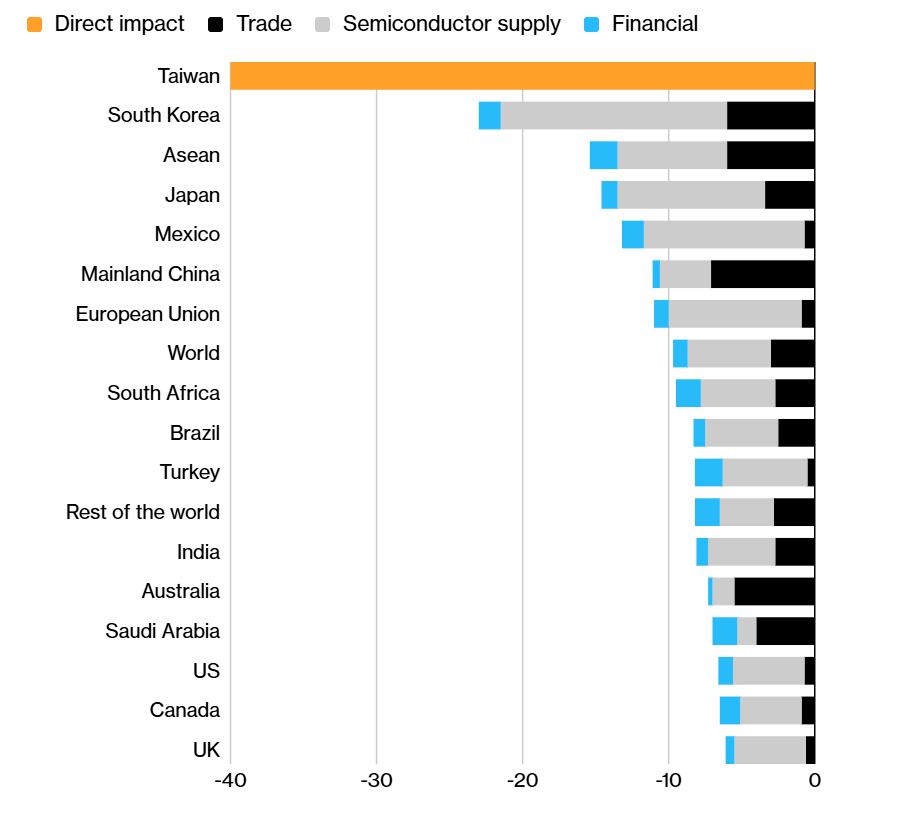
Bloomberg Economics graph of the impact of the Taiwan conflict on GDP. Source: Bloomberg
China is the world’s second largest economy and a manufacturing center. Post-conflict sanctions and trade restrictions will further disrupt global production and exacerbate economic damage.
The timing of recent military activities further heightens tensions. The resumption of service comes amid already heightened global risks due to the conflict between the United States and Iran and instability across the Middle East.
Taiwan’s Defense Minister Wellington Koo warned against reading too much into short-term fluctuations in China’s air activity.
Asked about the suspension, Taiwanese Defense Minister Wellington Koo said, “We can’t rely on a single indicator, such as the absence of aircraft,” referring to the continued presence of Chinese naval vessels, which he said “still surround us every day.” https://t.co/z19UmfOrMn
— Jonathan Cheng (@JChengWSJ) March 17, 2026
But he stressed that naval vessels continue to circle the island every day.
Bitcoin outperforms amid rising geopolitical stress
While traditional markets have struggled with the dual weight of Middle East and Asia-Pacific tensions, Bitcoin ($BTC) shows remarkable strength.
The market capitalization of the Pioneer cryptocurrency has risen about 7% since the Iran conflict escalated on February 28, outpacing the S&P 500, Nasdaq 100, gold, and silver over the same period.
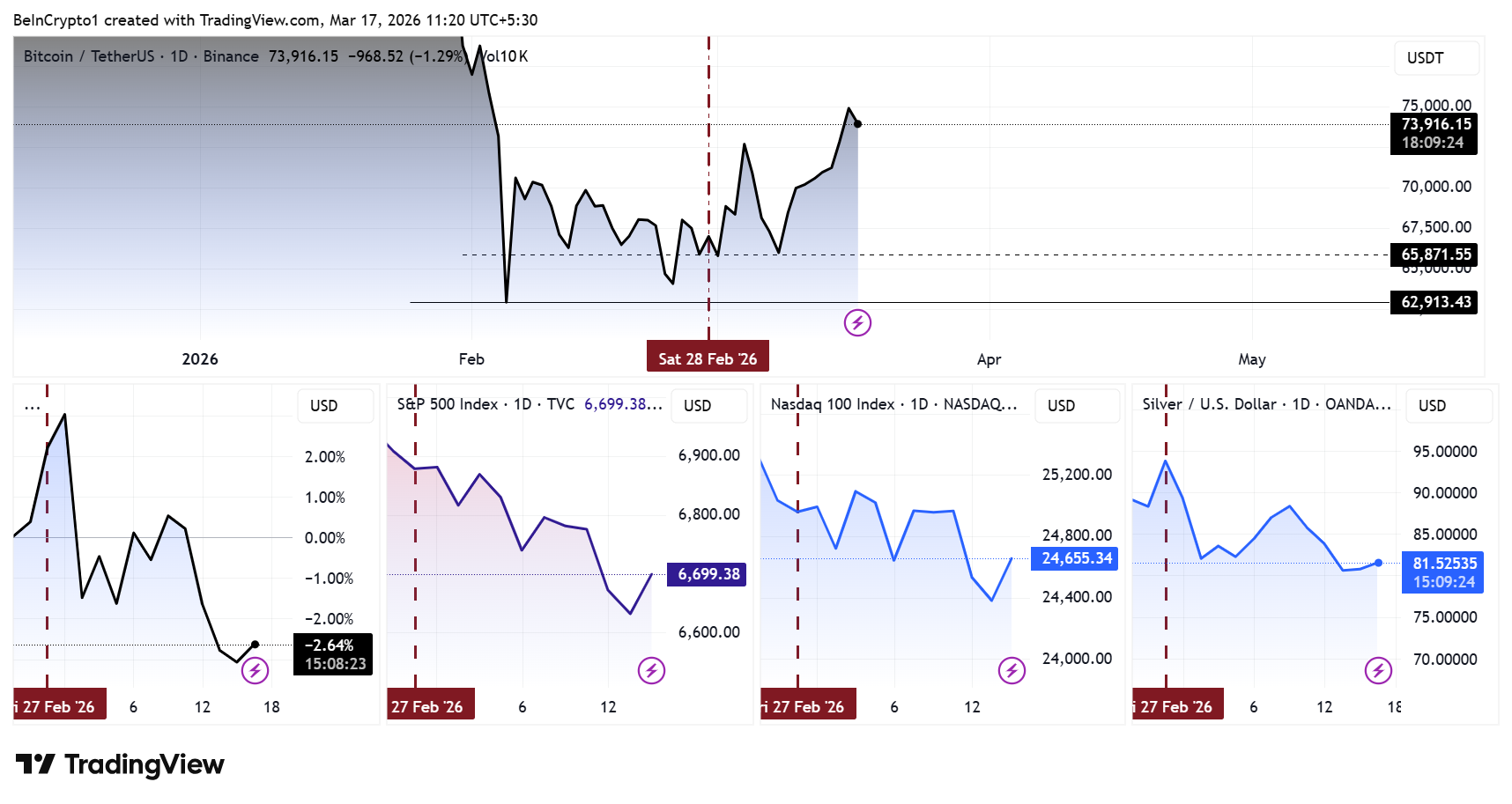 $BTC, gold, $SPXNASDAQ, and Silver Price Performance”>
$BTCmoney, $SPXNASDAQ, and silver price performance. Source: TradingView
$BTC At the time of writing, it was trading at $73,916, nearing a six-week high after rebounding about 25% from February’s low of $60,000.
Bernstein analyst Gautam Chughani pointed to Bitcoin’s structural properties as a key factor in its resilience.
“It probably takes a physical collision to realize that Bitcoin remains the most portable (cross-border) digital asset with no counterparty risk and remains a liquid asset,” wrote Holger Tsashapits, quoting Gautam Chughani.
Bernstein pointed out that about 60% of Bitcoin’s supply has not been transferred in over a year. moreover $BTC While money flows into ETFs, corporate bonds, and long-term wallets, short-term selling pressure may be less important in times of stress.
The U.S. Spot Bitcoin ETF recorded total inflows of more than $2.1 billion for the third week in a row, nearly reversing year-to-date outflows.
Kiyosaki warns of historic bubble, predicts $750,000 $BTC
However, not all voices frame the macro environment as a slow build. Author and investor Robert Kiyosaki has warned that the global economy is approaching what he calls the biggest bubble in history.
“When the bubble bursts, I predict that gold will reach $35,000 an ounce a year from now…I predict that Bitcoin will reach $750,000 an ounce a year after the crash,” Kiyosaki wrote.
Kiyosaki also predicted that Ethereum (ETH) would reach $95,000 within a year of the crash. He did not specify the trigger, but said the timing was close.
These predictions lack consensus support. However, increased military pressure around Taiwan, continued conflict in the Middle East, and continued macro vulnerabilities have combined to amplify the debate over Bitcoin’s role in times of systemic stress.
Will China’s Taiwan threat put $10.6 trillion at risk and be the next catalyst for Bitcoin’s rise? The post appeared first on BeInCrypto.


