

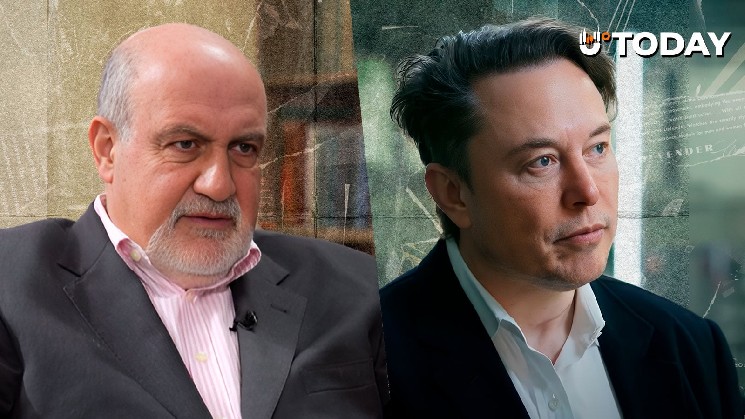
Financial service X Money will enter early access in April this year, as confirmed by Elon Musk. The announcement sparked a strong reaction, but the most interesting reaction came from a fresh tweet from Nassim Taleb, author of Black Swan and aka the “philosopher of risk.”
Taleb publicly supported Musk’s project and predictably contrasted it with BTC. For him, this launch is not just a social feature of X (formerly Twitter), but the realization of the concept of a private currency.
Based on the ideas he has promoted in his previous statements and books, he explains in some practical ways why he contrasts X Money with Bitcoin.
Why “Black Swan” author says X Money is “smarter” than Bitcoin
The first is competition, not monopoly. Taleb believes that states should not be the sole issuers of currencies, and that private companies such as X should issue their own payment instruments and compete with each other. In the end, the winner will be the one whose funds prove more stable and convenient for trading.
The second is functionality and speculativeness. Taleb described X Money as “smarter than Bitcoin.” He has frequently criticized Bitcoin, which he believes has failed as a currency due to its volatility, which makes it difficult to fix the price of goods. If X Money were linked to banking infrastructure and fiat currencies, it would be suitable for everyday purchases.
Finally, there is infrastructure resiliency. Unlike the crypto market, which Taleb has repeatedly described as fragile, Musk’s project relies on an existing base of hundreds of millions of X users and legal status, and is reportedly licensed in more than 40 US states.
This is much smarter than Bitcoin. Private currencies need to compete with each other. https://t.co/cf2IxeXQ39?from=article-links
— Nassim Nicholas Taleb (@nntaleb) March 11, 2026
What will happen in April? Although no confirmed features have been announced, various rumors point to direct peer-to-peer transfers within social networks, virtual and physical Visa cards for payments, and a promised yield of up to 6% per year on account balances.


