

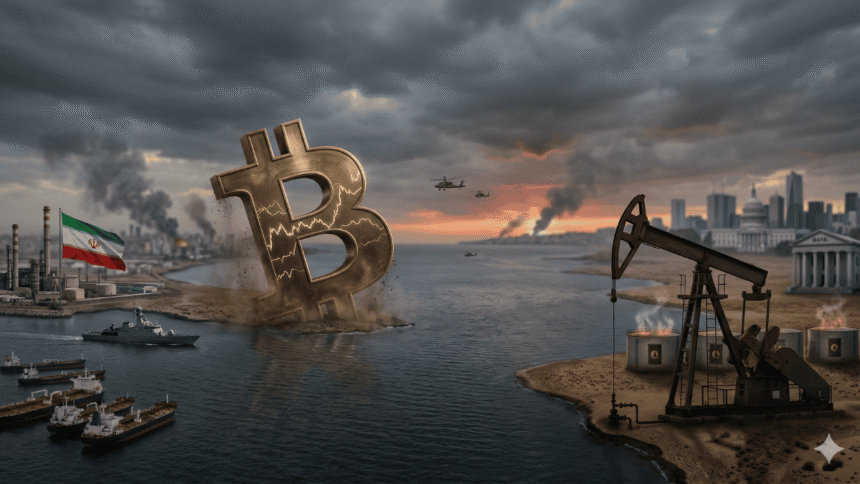
This Thursday, April 9, 2026, the price of Bitcoin (BTC) stalled around $71,000 without continuing to rise, although the ceasefire agreement between the United States and Iran showed the first cracks within 48 hours of its announcement.
Israel resumes bombing of LebanonIran maintains a blockade of the Strait of Hormuz; Crude oil is approaching $100 per barrel again. The market is in standby mode.
This stagnation is in contrast to the rebound on April 7, when U.S. President Donald Trump’s announcement of a two-week bilateral cease-fire conditional on reopening the Straits sent Bitcoin above $72,000.
This move has already been analyzed by CriptoNoticias as a relief reaction rather than a sign of a change in trend. What is happening today confirms that reading.
The following graph shows Bitcoin’s performance over the past 7 days.
What is happening in Lebanon?
According to Reuters, Israel launched new attacks in Beirut and southern Lebanon in the early hours and early hours of Thursday, following a previous attack that left more than 250 people dead. The Israeli military also reported that it had removed Naim Qassem, the nephew of Hezbollah’s secretary-general.
Israel insists its operations in Lebanon are outside the scope of the ceasefire announced by President Trump. Washington supported that position. But Iran and Pakistan, the mediators in the negotiations, insist that the deal explicitly includes Lebanon. Britain, France and other countries also join in this interpretation.
Hezbollah initially said it would pause its attacks in accordance with the cease-fire agreement, but announced Thursday morning that it would resume attacks.
Iran was tough: There will be no deal as long as Israel continues to bomb Lebanon. Iran’s Deputy Foreign Minister Saeed Khatibzadeh said the Israeli attack was a “grave violation” of the ceasefire agreement.
Strait of Hormuz remains closed
Despite the ceasefire announcement, there is no sign that Iran will completely lift its blockade of the Strait of Hormuz.
According to Reuters, daily shipping traffic through the strait has fallen to less than 10% of the historical average since the start of the war, causing the worst disruption to global energy supplies in history.
Similarly, CriptoNoticias reported yesterday that Iran will begin imposing tariffs on oil tankers passing through the Strait of Hormuz on Bitcoin and cryptocurrencies. Apparently, that hasn’t happened yet.
Impact on Bitcoin price
Some readers may wonder What does all this have to do with the price of Bitcoin? Here’s the relationship:
- 1) Expensive oil accelerates global inflationary pressures.
- 2) Inflation puts pressure on the US Federal Reserve (FED) and other central banks around the world to maintain high interest rates.
- 3) High interest rates are detrimental to assets that are considered “risky.”
- 4) It’s a shame that Bitcoin continues to be categorized by institutional investors.
The logic is simple. If the ceasefire collapses and the Strait of Hormuz remains closed, oil prices will continue to rise and the Fed will have less room to cut rates. This scenario is negative for Bitcoin.
In this context, we can see that: Bitcoin trades in a world with unstable equilibrium And no one yet knows in which direction events will develop.
Some are optimistic, like Michael van de Poppe, who claims Bitcoin will soon reach $80,000.
Some people remain cautious, while others remain bearish. Willy Wu, a trader and market analyst, is one of them. Recently, as reported by CriptoNoticias, he claimed that Bitcoin price could fall to $46,000.
Outside of the Bitcoiner space, one person who has expressed major pessimism about the current situation is American investor Ray Dalio. Experienced businessmen assure: We are in a world war that is emerging from multiple fronts. And the situation is unlikely to improve in the near future.


