

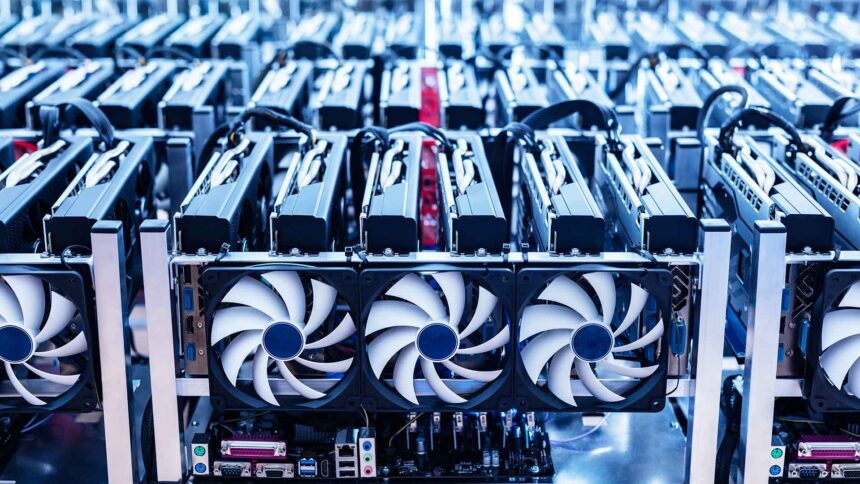

Recent data shows that Bitcoin mining difficulty has decreased significantly over the past days. This development follows a severe bearish price struggle last week that saw Bitcoin fall a total of 11%.
Bitcoin mining difficulty has hit a historic decline following China’s crackdown.
As the name suggests, mining difficulty measures how difficult it is for a miner to solve the mathematical problems required to add a new block to the Bitcoin blockchain. Therefore, as the difficulty increases, mining becomes difficult for the average network node and vice versa.
Typically, the Bitcoin network adjusts this metric every 2,016 blocks (about two weeks). According to developer Mononaut, Bitcoin has seen its mining difficulty decline by 11.6% over the past 24 hours, representing the largest single adjustment since China’s mining ban and the 10th largest negative adjustment of all time.
In 2021, the Asian country issued an order banning all forms of Bitcoin mining activity within its borders, effectively eliminating more than half of the world’s hashrate. As a result, mining difficulty also collapsed, lowering the barrier to participation for new miners.
Additional data shared by Mononaut shows that Bitcoin mining difficulty has now reached 125.86T after a recent decline that started at block 935,429.

Mining difficulty crashes reflect the harsh price environment.
A decline in Bitcoin mining volume means mining activities have become easier, but it also means a surge in miner surrenders. This means that miners become unprofitable and close down. This is usually caused by skyrocketing energy costs, regulatory crackdowns like China’s, or market crashes, as we’ve seen recently. Notably, the price of Bitcoin suffered an initial loss of 28% in the opening week of February, trading at a low of $60,000 before rebounding to $70,000. Therefore, it is likely that many miners will suffer significant losses due to this modification.
However, it is worth noting that Bitcoin’s difficulty adjustment is a self-sustaining mechanism designed to ensure that new blocks are continuously mined regardless of the number of miners participating. Also, considering the recent negative adjustment, the influx of new miners is expected, so it is not a level worth worrying about.
Meanwhile, MARA Holdings’ publicly available data for the third quarter of 2025 shows that the average Bitcoin mining cost is $67,704. According to Julio Moreno, head of CryptoQuant, most Bitcoin mining companies are likely to suffer steep losses at current market prices, and increased selling activity is expected to contribute to the recent mining flight. At press time, Bitcoin is trading at $69,357 after losing 1.71% the previous day.
Featured image of Bison, chart from Tradingview
editing process for focuses on providing thoroughly researched, accurate, and unbiased content. We adhere to strict sourcing standards and each page undergoes diligent review by our team of top technology experts and seasoned editors. This process ensures the integrity, relevance, and value of the content for readers.


