

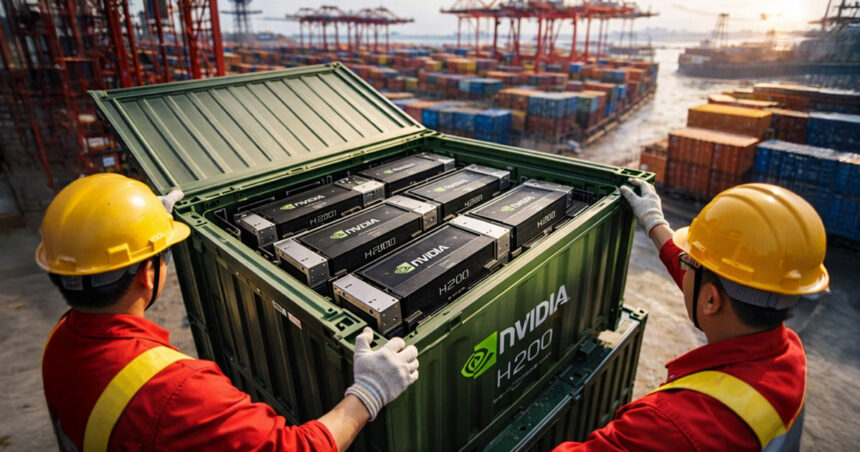
The Chinese government’s reported request for Chinese tech companies to halt orders for Nvidia’s H200 chip comes at a time when Bitcoin is becoming uncomfortably tied to sentiment in AI stocks.
As The Information and Reuters reported on January 7, the move could affect “some” Chinese companies and foreshadow a mandatory domestic purchase of AI chips.
For Bitcoin holders, the question isn’t directly about the geopolitics of chips, but whether regulatory disruptions in the AI supply chain could trigger the same risk-off cascade that has repeatedly driven Bitcoin lower during volatile tech stocks.

According to data from Newhedge, the correlation between Bitcoin and Nasdaq remained above 0.5 for most of 2025.
The mechanism is institutional positioning. Bitcoin is increasingly trading as a risk asset, embedded in the same macro framework that determines the prices of NVIDIA, semiconductors, and growth stocks.
As AI stocks sell off on regulatory and supply chain headlines, the Nasdaq absorbs the volatility and Bitcoin captures either a downdraft or an updraft depending on the direction of the move.
This correlation works through two channels. One is a multi-asset risk budget that treats Bitcoin as part of a broader allocation alongside tech stocks, and the other is a spot crypto ETF flow that amplifies changes in sentiment.
In 2025, $46.7 billion will be collected in crypto ETPs around the world, making ETF flows the primary driver of short-term price fluctuations. A tech-driven risk-off episode will quickly lead to lower ETF inflows or outflows, which will feed back into Bitcoin.

Wildcard where miners turned into AI hosts
Bitcoin’s impact on GPU economics goes deeper than stock correlation.
Some publicly traded Bitcoin mining companies are pivoting to AI infrastructure, betting that hosting AI workloads has better unit economics than mining Bitcoin at current hash rates and power costs.

In December, a former Bitcoin miner was involved in a multibillion-dollar AI data center lease deal. These companies currently rely on GPU availability, utilization, and lease prices, all of which are influenced by the global GPU market.
If China’s moratorium leads to a diversion of GPU supply and softening of rental rates outside of China, the economics of AI hosting will change and the stock prices of miners-turned-AI hosts will move as well.
These stock moves could ripple through the broader crypto market, creating a feedback loop in which Bitcoin’s price reacts to the economics of AI infrastructure, even if the underlying protocol doesn’t rely directly on GPUs.
The timing is important as China was preparing to receive more than 2 million H200 units in 2026. At a reported $27,000 per unit price, this equates to a total chip value of approximately $54 billion.
This size is three times NVIDIA’s available inventory of approximately 700,000 units.
If orders from China are canceled or delayed indefinitely, NVIDIA could theoretically redirect H200 supply to other regions, easing short-term GPU shortages for hyperscalers and companies outside of China.
That could lower spot prices and GPU lease rates, changing the revenue profile for miners pivoting to AI hosting.

Geopolitical pricing models reshape the economics of AI
The moratorium sits on top of the existing policy trajectory. In November, China issued guidelines banning the use of foreign AI chips in state-funded data center projects, forcing the removal or cancellation of foreign hardware in early-stage construction.
The H200 outage extends that logic, as the Chinese government appears to be accelerating the bifurcation of its AI stack, which consists of domestic accelerators, software layers, and computational sovereignty.
The US policy framework further complicates the situation.
President Donald Trump’s decision to allow H200 exports to “approved customers” came with an unusual 25% revenue-sharing requirement that effectively treated strategic computing as a taxable export.
The deal remains politically contentious within the country. If that fee structure persists, a template is established. Access to frontier AI hardware comes at a price, increasing the effective cost of computing globally.
This is important for Bitcoin because the same institutions that are setting the future price of AI are also setting the price of Bitcoin’s risk premium.
As the cost of deploying AI infrastructure increases, fees, charges, and supply constraints may compress the expected return profile of AI investments, leading to widespread reallocation from growth assets.
Bitcoin is in the crossfire of that reallocation not because it is competing with AI for capital, but because it trades in the same risk-on/risk-off framework that responds to changing fundamentals in the technology sector.
Scenario path and Bitcoin sensitivity
Three scenarios show different results. In the basic case of a short-term suspension followed by conditional approval, China would extract concessions and then allow limited H200 imports.
The AI market has primarily seen headline volatility, with Bitcoin experiencing fluctuations in risk sentiment without sustained directional pressure.
The hybrid scenario includes a “soft mandate” where China allows a portion of H200 shipments but ties it to domestic chip purchasing requirements, creating a two-tier market with mixed signals on GPU pricing.
Bitcoin will closely track NVIDIA’s stock price movements, but if the economics of GPU leasing change, the miner-AI convergence story will become even more sensitive.
The tail risk scenario is a strict mandate that goes beyond state-funded projects and effectively treats foreign chips as an import-controlled category.
China’s AI capacity growth is expected to slow in the short term as global markets expect GPU supply to be diverted from China, potentially lowering spot prices but raising questions about Nvidia’s revenue streams in China.
Bitcoin will feel most sensitive to this scenario through the risk-off positioning of tech stocks and the AI hosting economy channel as GPU lease rates adjust and miner-focused companies readjust their capex plans.
| scenario | Risk Sentiment (Broad Technology/AI Beta) | GPU lease fees (outside China) | Miner stocks (especially miners exposed to AI/HPC) |
|---|---|---|---|
| A — short pause | Down from neutral (short term): Headline wavers, but stabilizes once orders/approvals are resumed | neutral: There is almost no net change in global tightness. | Down from neutral (short term): Sentiment takes a hit, fundamentals remain almost unchanged |
| B — soft mandate date | Down (sustained mild resistance): Policy uncertainty + bifurcation of China stack | descending (gradually): Part of China’s demand is driven out → Gradual easing of supply in other countries | down from neutral: Mixed — AI hosting companies could see margin pressure as lease rates soften. Non-AI miners primarily track risk sentiment |
| C — strict command | Significant decline (risk-off): Bigger geopolitical/policy shocks. AI narratives take a hit | Descending rapidly (faster/more clearly): Massive rerouting of H200 class power to RoW → rate compression | Decline (short term): AI/HPC related miners can be sold by unwinding “AI trading”. Possible in the long run Be neutral/positive When cheaper GPUs improve hosting availability (timing dependent) |
What to watch for as actual signals
Leading indicators are order flow, GPU pricing, and Bitcoin’s unique correlation regime.
If H200 orders are resumed from Chinese companies, the suspension is a negotiation tactic and the correlation between Bitcoin and AI stocks is likely to remain intact without deepening. If orders are not resumed, Bitcoin’s sensitivity to tech sector volatility will be the primary transmission mechanism.
GPU prices in the secondary market and cloud rental rates indicate whether supply is loosening. If demand in China dies down and prices soften elsewhere, the economics for AI-hosting miners will improve, which could be a positive signal for crypto stocks.
If prices hold or rise, supply constraints remain binding globally, maintaining upward pressure on AI infrastructure costs and maintaining risk-off tension in growth stocks.
For Bitcoin in particular, the barometer is the ETF’s net flows and its correlation regime with the Nasdaq. Geopolitical pricing models will drive up the cost of building AI globally.
Bitcoin trades in the shadow of that friction, not because it relies on GPUs, but because it relies on risk appetite flowing through the same markets that will price the future of AI.
China’s suspension is a stress test of that relevance, and the answer will come from how fast Bitcoin’s price moves in response to Nvidia’s next earnings release or the next headline regarding export permits.
(Tag translation) Bitcoin


