


Bitcoin’s resilience amid recent global macro stress is starting to attract the attention of trading desks.
The largest cryptocurrency has risen about 7% from Sunday night’s lows to just below $71,000, even as geopolitical tensions over the Iran conflict escalate and the market faces risks ranging from disruptions to oil supplies to stress in private credit markets.
Their relative strength is beginning to become noticeable. The Nasdaq 100 and S&P 500 have been mostly flat over the same period, but gold, typically a safe haven during turmoil, has only risen modestly. Looking at the results so far in March, $BTC This is the only one of the three post profits.
Bitcoin is also showing early signs of breaking away from its tight correlation with beleaguered software stocks. Over the past five days, BlackRock Spot Bitcoin ETF (IBIT) has risen 3.75%, while iShares Expanded Tech Software ETF (IGV) has fallen 2.45%.
The price movement has analysts cautiously optimistic that the cryptocurrency market may finally be stabilizing after months of decline.
exhaustion of sellers
One encouraging sign, said Aurélie Bartel, principal research analyst at Nansen, is that $BTC Reacted to new geopolitical headlines.
Earlier this week, a brief wave of optimism boosted stocks and cryptocurrencies along with softening oil prices, suggesting that markets are tentatively pricing in the possibility of a calming down in the Iran conflict. But that optimism faded as the session progressed, and risk assets regained some of the gains.
“Bitcoin’s downside sensitivity has been relatively limited,” he said, noting that some traditional benchmarks, such as the Euro Stoxx index, have fallen even more sharply over the same period.
This resilience suggests that Bitcoin’s marginal sellers may not be as active as stocks, Bartel added.
Changes in correlation with gold
Another change that has caught the attention of traders is the changing relationship between Bitcoin and gold.
According to Brian Tan, a trader at crypto trading company Wintermute, $BTC– Gold’s correlation turned positive, rising to +0.16 from -0.49 a week ago.
Tan noted that in the early stages of the Middle East conflict, Bitcoin fell while gold rose in a typical risk-off move. Recently, both assets have risen while the US dollar has fallen, suggesting that investors may be starting to treat both assets as beneficiaries of a weaker dollar, rather than against risk trading.
“If this correlation continues to trend positively, it will change the direction of the story.” $BTC “In a conflict environment, it moves from ‘selling risk assets’ to something more nuanced,” Tan said.
ETF flows return
Improving Bitcoin ETF flows may also be supporting the recent strength.
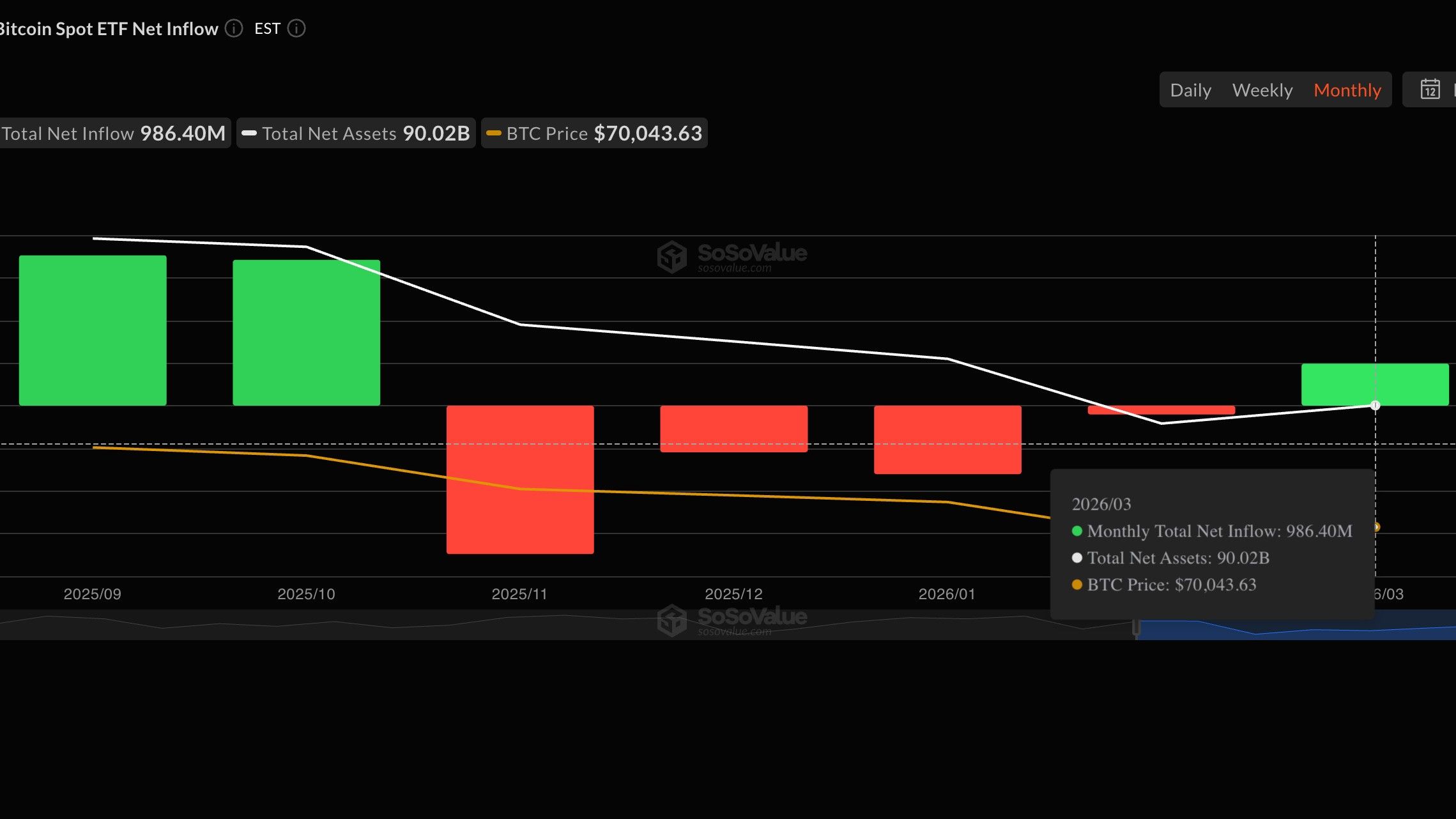
Monthly flow of US-listed Bitcoin ETF (SoSoValue)
Bitcoin ETF flows have been trending negative for several months since their peak in October. However, data over the past two weeks has shown a notable improvement, particularly consistent inflows to BlackRock’s IBIT fund, the largest Bitcoin ETF, said Joe Edwards, head of research at Enigma.
A sustained recovery in ETF demand could be important for Bitcoin, he added. A sustained recovery in ETF demand could be important, he added. Many analysts believe Bitcoin’s next stage of growth will depend on access to deeper institutional capital pools, such as ETF investors in brokerage accounts. With that in mind, Edwards said the recent wave of spills is concerning.
The “good news” is that there are signs that that era is coming to an end, he said.
IBIT has attracted nearly $1 billion in new inflows so far in March after losing more than $3 billion from November to February, according to SoSoValue data.
If this trend persists in the coming weeks, Edwards argued, it could support a broader recovery in Bitcoin heading into the second quarter.


