

One thing we rarely think about is how bad weather affects the security of Bitcoin, but bad weather happens fairly regularly. Snow can pose a legitimate risk to Bitcoin miners securing the blockchain.
Snow appears first on weather maps, showing dark smears that extend across state lines. And it turns into what you actually feel. Power lines flapping in the wind, workers on standby, homes trying to keep the heat on.
Behind the ordinary human sight, there is another kind of equipment. Rows of Bitcoin miners perform one task when electricity is cheap and plentiful, and may intentionally shut down when the grid is stressed.
This is the background to two events that happened in close proximity, and it’s easy to misread them if you just look at the headline numbers. A sudden change in Foundry, the largest Bitcoin mining pool in the US, and a significant drop in network hash rate appeared on the charts.
The decline in hashrate that everyone sees
If you track mining data on a daily basis, you’ve probably seen the same thing. Your hashrate suddenly appears low, with a big red percentage next to it.
BitInfoCharts is a chart that many people are screenshotting and sharing, but as of this writing, we’ve noticed a noticeable decrease in daily estimates over a 24-hour period. This is where the “nearly 10%” chatter comes from, and the swing can be even bigger depending on the exact moment you look at.
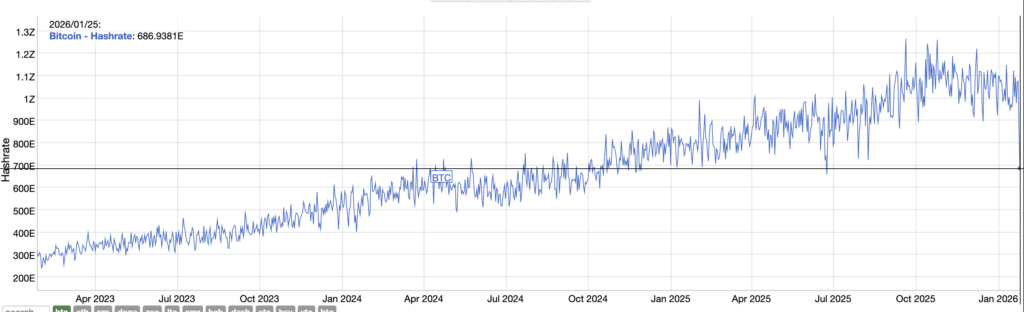
The first thing to keep in mind is that the “hashrate” on these dashboards is rarely a direct machine read. This is an estimate drawn from blocks found over a period of time.
It sounds academic until you learn how Bitcoin works. Blocks appear suddenly and then dry up, even if nothing changes in the real world.
Providers like Blockchain.com have long pointed out that short time periods can be noisy for that very reason, and that using 7-day or 14-day averages is often less sensational.
So the drop in the day is a clue. That’s not a certainty.
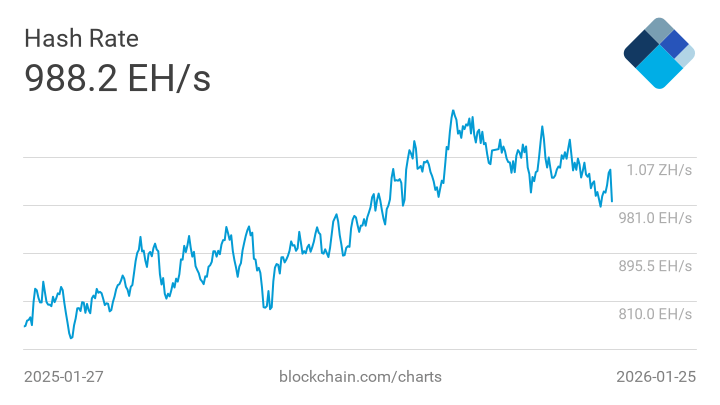
If the dip is real, you usually see it elsewhere. Block times may be extended, difficulty estimates may roll over, and memory pools may begin to tighten if there is demand.
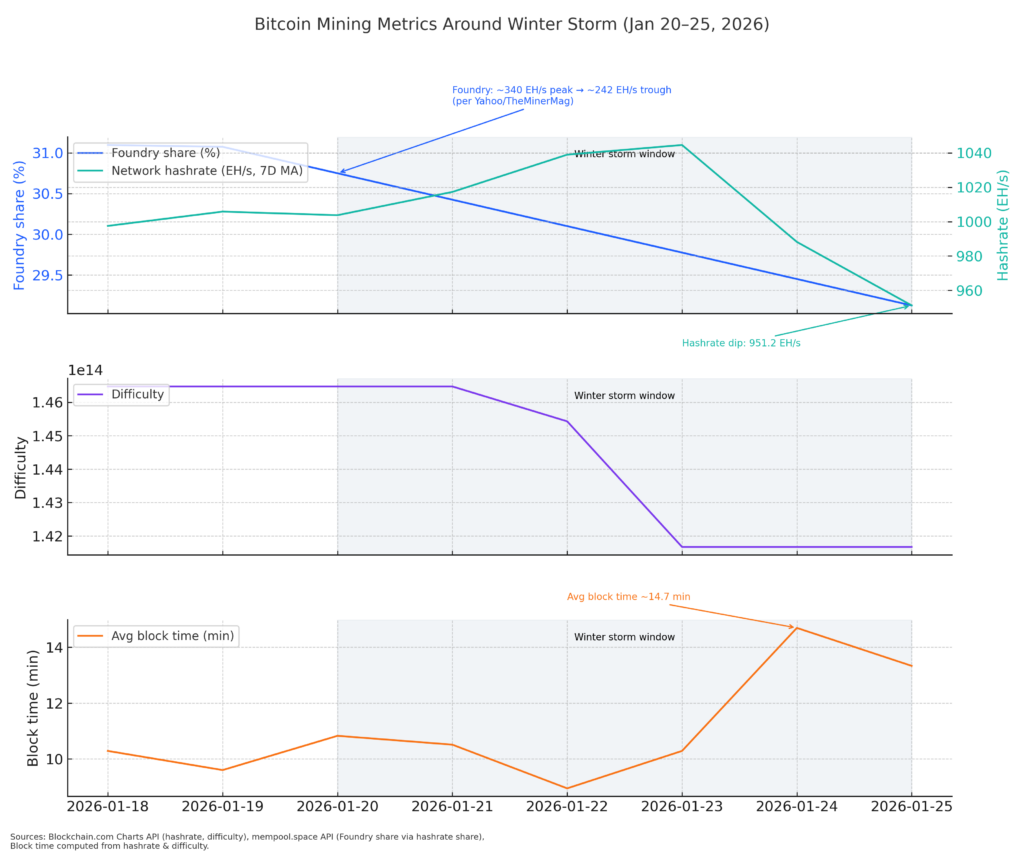
In fact, on the day in question, mempool data was showing a drop in block production, with the snapshot view of mempool.space showing average block times in the 11 minute range.
Still, such a reading alone does not prove a specific percentage decline. But this rhymes with periods when some of the mining capacity is actually offline, not just shuffled between pools.
Storms, Grids, and the Parts People Forget
Now add the human part again. The United States is entering a full-fledged winter regime.
A report from the AP says the severe storm had widespread effects, leaving many customers without power in some areas.
When a storm like this hits, it’s the grid that gets talked about, not Bitcoin. It’s easy to see miners as bystanders.
In the United States, they are often incorporated into plots.
Growing industrial-scale mining in places like Texas operates like an interruptible load. Miner signs the contract. They can be reduced quickly, credits can be earned, and grid operators can pull levers when demand spikes.
This concept is also explained in government language. The U.S. EIA is discussing large-scale workloads, including cryptocurrency mining, and is participating in a voluntary reduction agreement with ERCOT.
For companies, this speed is no longer a hypothetical.
CleanSpark talked about reducing hundreds of megawatts across multiple sites within minutes in response to TVA requests, as covered by DataCenterDynamics.
Because it’s a cliff, it’s the kind of ability that can appear as a cliff on your chart.
This is why big storms and sudden drops in hashrate can be linked, even if you don’t see miners in the snowbank.
Weather drives demand. Demand puts stress on the power grid. Miners either lose power or choose to sell power back to the grid.
The network feels like there are fewer hashes per second.
There is also another layer. Grid operators often telegraph stress windows.
Reports from Axios warned of the risk of strains across systems including ERCOT and PJM during the storm.
Local reports also indicate that emergency measures and backup power generation are being considered, including a Houston Chronicle report on measures taken during the frigid weather.
This is where you need to ground your story without exaggerating it. Storms create conditions for limited driving and power outages.
Feature reductions and outages may result in a decrease in the actual hashrate. Drawdowns can manifest as slower block speeds and lower daily hashrate estimates.
Foundries and why this one pool matters
Foundries are lightning rods in mining discussions because they are large companies associated with the United States and coordinate key parts of block production.
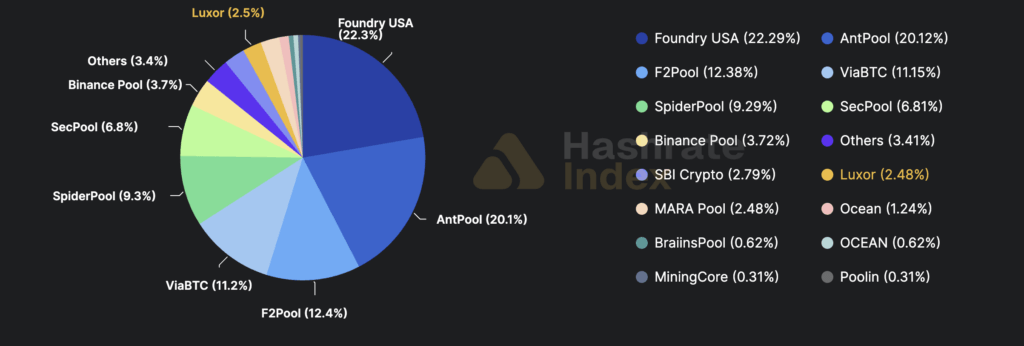
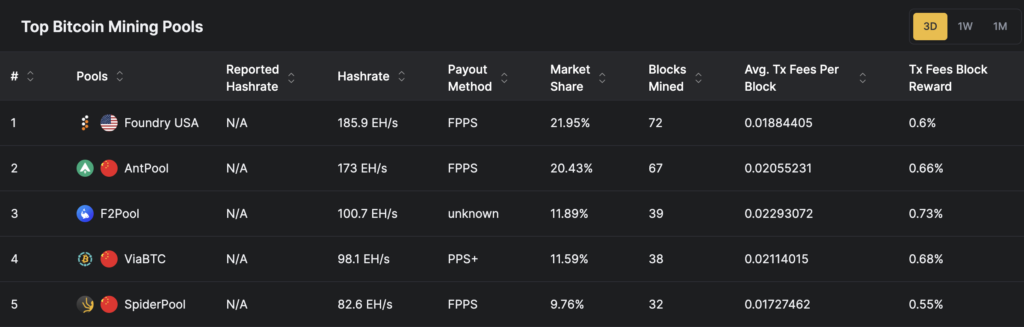
Depending on the lookback window, Foundry’s block share often stays in the high 20s to low 30s. The hashrate index is currently around 22% over the past three days, down from 30% a month ago.
When Foundry makes a sharp move, it starts a conversation that goes beyond Foundry.
During the recent cold snap, TheMinerMag reported that Foundry’s hashrate dropped by about 30%, from a peak of about 340 EH/s to about 242 EH/s.
We also noted that Luxor has fallen, with over 110 EH/s offline across these two pools.
At the time of writing, Foundry’s three-day average market share has fallen to 21.95%, with a hashrate of just 185.9 EH/s.
This is important because Foundry can act as a proxy for U.S. mining behavior.
When a lot of U.S.-based generation capacity is concentrated within the same weather system, connected to the same power market logic, and coordinated through several major pools, storms don’t just knock on one door.
It knocks down the same hallway.
important risks
This is where we can escape the daily rush and find something to hold on to.
There are two types of concentration in mining systems that are problematic during times of stress: geographic concentration and coordination concentration.
Geographic concentration means that many machines are located under the same sky and are exposed to the same cold fronts, the same ice, and the same grid operator notifications.
Centralized coordination means that many machines are pointing to the same pool, so the public dashboard behaves as if it were a single organism.
If both are true, the weather will trigger a sudden and visible hashrate shock.
Even if the broader network doesn’t lose 30%, the public sees the large pool wobbling, and that has its own consequences.
The technical results are clear. If a miner truly goes offline, blocks will slow down until the difficulty is adjusted.
The economic impact will depend on demand. If the blocks are slow and the memory pool is busy, the charges will increase.
If the blocks are slow and the memory pool is quiet, the impact on pricing will be smaller.
The “busy mempool” part is not guaranteed at this time.
For mempool.space, the recommended pricing level is sometimes set low, allowing the impact of pricing to be framed as conditional on whether demand spikes during supply shocks.
The impact of the story is even greater. Whenever large pools associated with the US move rapidly, people begin to question resilience, decentralization, and who will actually be at the helm of block production.
Miner behavior when lights flicker
There is another reason why storms are important to mines. Because the storm intersects with the miners’ balance sheets and quiet stories of survival.
When miners stop working for a few hours or a day, their revenue decreases and fixed costs continue to accrue. Management must decide what to do.
Some miners will monetize the electricity market, some will sell Bitcoin, some will do both, and their choices will show up downstream.
Riot’s update is a useful example of how financial management is becoming more active.
According to Riot’s own release, Riot revealed that it sold 1,818 BTC in December 2025 for a net profit of $161.6 million.
CleanSpark also reports sales activity in its own updates, and industry coverage, including Blockspace, summarizes those numbers.
This is important because the storm reduction period can be a cash flow event.
If miners can earn credits by turning it off, they have a cushion. If that is not possible, it may rely even more on bond sales.
We all understand what happens when the income clock stops, but that’s not the case with bills.
Macro layer, why this is repeated over and over again
Storms are temporary. System design is in progress.
Mining is moving to areas where power is abundant, flexible and market-based. That often means getting closer to the power grid, which may be called upon to curtail when demand spikes.
That’s part of the reason the U.S. mining industry has become so influential and exposed.
As discussed on HashrateIndex, comments from Mining Analytics Shop also highlight that winter energy dynamics and energy reductions are recurring factors behind hashrate weakness.
JP Morgan’s opinion points to the other side of the coin. The idea is that if the hashrate decreases, the remaining miners may become more profitable.
This creates a perverse incentive loop where some miners benefit from being forced offline.
Next, we can consider long-term forecasts that focus more on the supply side. This means more hashrate will come online over time, increasing competition for megawatts and increasing pressure on margins.
For example, Hashlabs models a wide range of hashrate outcomes for the end of 2026, with estimates around 1.7 ZH/s depending on assumptions.
Storms punch harder in tight margin environments.
If your miner can afford it, absorb the downtime. When constraints are severe, reduction allowances are entirely economic decisions.
So does the storm have anything to do with a drop in hashrate?
Here’s the honest version. Yes, that may be true.
You can build a reliable case without pretending that every ASIC in America has a meter.
A strong association looks like this: Storm warnings have been strengthened, power grid operators are bracing, power outages are widespread, miners are reducing or losing power, network block times are rising, difficulty expectations are falling, daily hashrate estimates are declining, and large pools with US exposure are showing visible declines.
We have several of these factors, including storm severity and outages from AP, grid stress framing from Axios, and suppression capabilities and incentives from EIA and DataCenterDynamics.
There is also Foundry drawdown at low temperatures.
What we should avoid is treating the highest number in a 24-hour period as everything that happened.
Daily hashrate charts are useful. They are also easy to jump on, and their warnings are documented by Blockchain.com.
What does this mean for everyday holders?
The real theme is the idea that the networks that people call unstoppable are still connected to the same chaotic world as everyone else.
Bitcoin works on mathematics, but it also works on electricity. Electricity runs on weather, politics, and infrastructure that can fail.
As the storm heads toward the United States, families stock up on batteries, power companies deploy trucks, and miners have the flexibility to decide whether to keep hashing or cashing in.
In the midst of all this, the blockchain continues to move, sometimes slowing down a bit and the chart twitching like a seismograph.
Changes in foundries are part of this. This is a reminder that there is gravity in regulating mining, that large pools reflect large concentrations of power, and that extreme weather can turn that concentration into a sudden jolt, visible even on your mobile phone.
A broader hashrate decline is the other half. This is a network-level pulse check, and it raises questions that even readers who have never cared about hashrate will understand.
How vulnerable is this system when the weather gets weird?
Where are we going next?
Looking ahead, the conclusion is simple. Extreme weather has become a recurring stress test for US mining, and US mining has become a stress test for Bitcoin’s visible decentralization story.
If miners continue to lean into the grid program, we can expect to see more short-term cliffs during heatwaves and freezes.
If hashrate continues its upward trend over time, the cliff could become sharper if margins are tight. That’s where Treasury’s actions start to matter, as Riot and others have shown.
The next storm will not just be a weather story, it will be a systems story.
That’s what makes this interesting, even if the hashrate line rebounds after a day.


