


Bitcoin mining difficulty eased on Thursday, dropping 3.28% from 146.47 trillion to 141.67 trillion. This is the highest level since September 2025 and a welcome respite after months of hardship. This adjustment should favor Bitcoin miners, especially since revenue per petahash (PH/s) has fallen by 5.45% over the past week, making this realignment feel more like expired arithmetic than an act of charity.
Mining difficulty will drop again in 2026, Bitcoin will start self-correcting
At block height 933408, Bitcoin’s mining difficulty setting will drop by 3.28% and remain at 141.67 trillion blocks for the next two weeks, or 2,016 blocks to be exact. This is a quiet dial setting that gives miners a moment to catch their breath.
Essentially, Bitcoin mining difficulty is a native network setting that recalibrates approximately every two weeks, and new blocks continue to arrive approximately every 10 minutes, no matter how much computing power you have vying for the prize.
As miners and hashing power flood in, the block spacing accelerates and the difficulty becomes more severe. As that power weakens, block times slow and difficulty parameters loosen, keeping Bitcoin’s issuance schedule stable, predictable, and stubbornly resistant to gamesmanship.
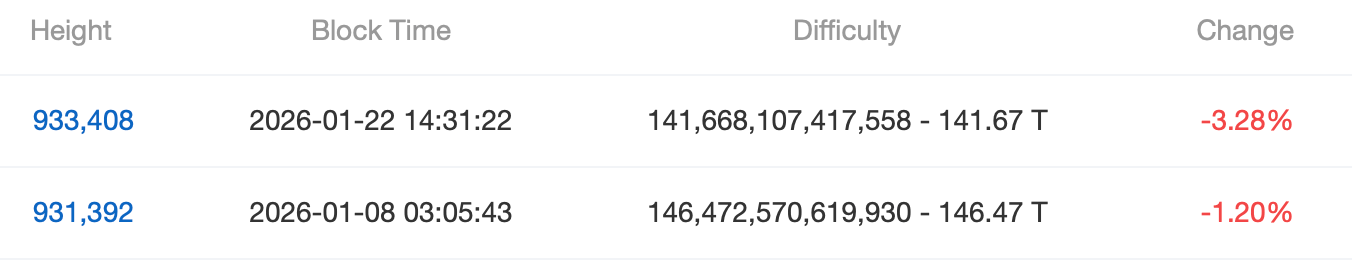
So far, there have been two difficulty changes in 2026, both of which were decreases in difficulty. The last difficulty change was a 1.20% drop, with a modest 0.04% increase on December 24th last year.
The last time the difficulty was in this same range was 18,144 blocks before block height 933408, when the difficulty changed to reach 142.34 trillion in two weeks ending September 18, 2025. The latest difficulty reduction provides a modest reprieve for Bitcoin miners, as revenues have been steadily declining over the past eight days.
Also read: 11 EH/s: Bitmain eyes new Bitcoin mining proxy? – Miner Weekly
According to statistics from hashrateindex.com on January 14th, the estimated value of 1 petahash per second (PH/s), known as Hashprice, was $42.20, but by January 22nd it had fallen to $39.90. This is a 5.45% decline over the week. This is a reminder that mining in a hurry can be detrimental.
For miners, the opportunity ahead presents a narrow but meaningful opportunity to achieve operational stability while margins remain under pressure even as the broader economics for securing networks continue to change.
Frequently asked questions ❓
- What is causing Bitcoin’s latest mining difficulty change? After a drop in network hash power, Bitcoin difficulty was adjusted lower and an automatic rebalance was triggered at block 933,408.
- How much has Bitcoin mining difficulty decreased?The difficulty level has been reduced by 3.28% and the new level for the next 2,016 blocks has been set to 141.67 trillion.
- Why does Bitcoin adjust its mining difficulty every two weeks?The network recalibrates the difficulty approximately every two weeks to keep block times close to 10 minutes, regardless of changes in hash power.
- Is the difficulty reduction helping Bitcoin miners at the moment?Yes, this reduction provides short-term relief as miner revenue per petahash has decreased over the past week.


