


Taiwan’s Ministry of Justice holds 210 bitcoins worth about $14 million seized from criminals. Most governments treat this as a footnote. The Bitcoin Policy Institute believes this should be the starting point.
A case built based on the worst-case scenario
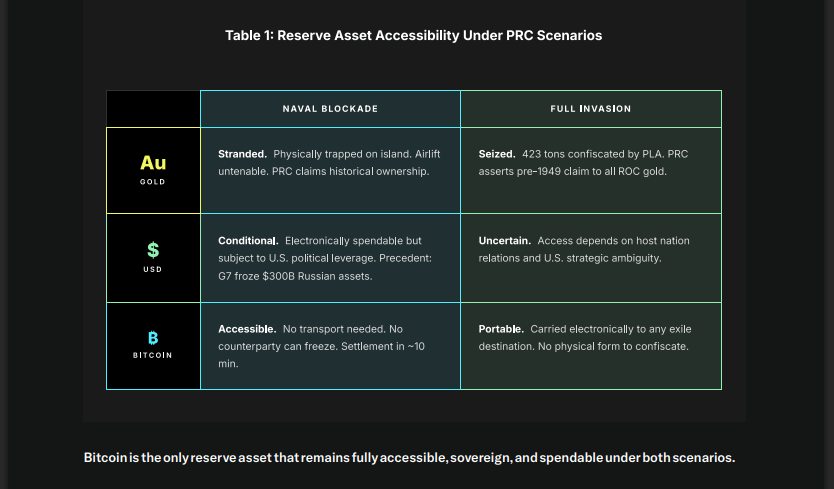
In a report published Tuesday, BPI researcher Jacob Langenkamp argued that Taiwan should build national bitcoin reserves primarily as protection against a possible military blockade or invasion by China, rather than as a financial play.
His argument is simple. If China blocks Taiwan, gold will not be able to move and dollar reserves may be frozen. He wrote that Bitcoin does not require physical transportation and will remain accessible no matter what happens on the ground.
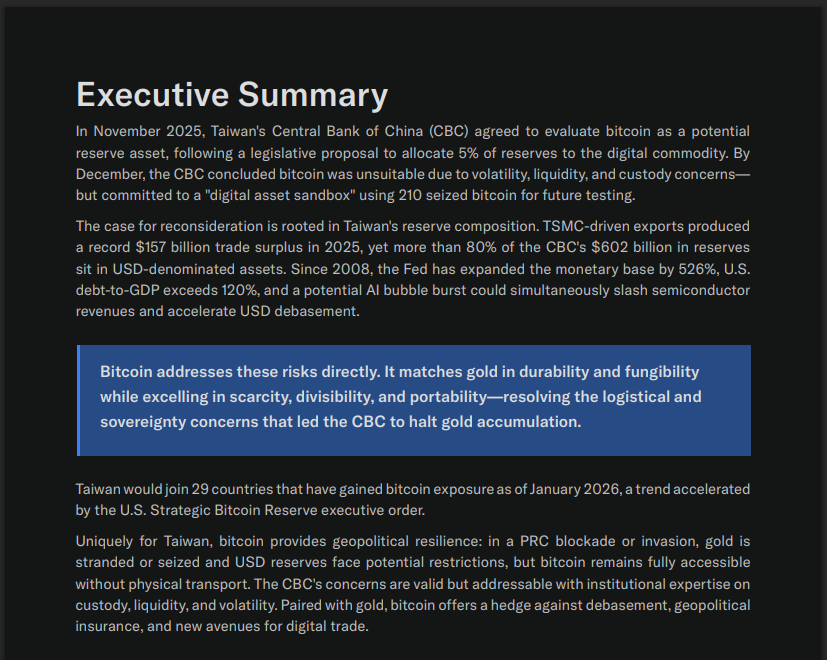
Taiwan’s central bank has already considered the idea and backed away. In December, the bank concluded that Bitcoin was too volatile, too difficult to store safely, and too illiquid to be used as a reserve asset.
Source: Bitcoin Policy Institute
It pointed out that the US dollar was a more reasonable choice. Langenkamp acknowledged that these concerns were real, but argued that they could be addressed with the right institutional know-how in storage and risk management.
Dollar Issue Analysts say Taiwan is ignoring it.
The report centers on a broader warning about how exposed Taiwan already is to the US dollar. At least 80% of central bank reserves are held in dollar-denominated assets, and most transactions take place in the same currency.
Source: Bitcoin Policy Institute
Langenkamp listed several pressures that could erode the value of the dollar over time, including rising U.S. government debt, monetary expansion by the Federal Reserve, a possible decline in the value of the AI sector, and declining semiconductor profits.
He argued that Bitcoin, paired with gold, could provide a buffer against these risks, giving Taiwan’s central bank a hedge before other countries do the same.
Taiwan’s central bank did not close its doors completely after the December decision. Officials said the bank will continue to test digital asset technology through its sandbox program using cryptocurrencies the country already holds.
The numbers behind Taiwan’s existing holdings
The 210 Bitcoin figure was put forward by Rep. Go Ju-cheon, who made it public on social media last year. If these holdings were officially calculated, Taiwan would rank seventh among countries with Bitcoin, just behind El Salvador and ahead of Finland, according to data from cryptocurrency financial tracker BitBo. The country is not currently listed in BitBo’s country holdings rankings.
It remains to be seen whether the Taiwanese government will take action on the BPI report. The think tank has no official role in Taiwan policy, and the central bank’s position remains unchanged.
But this report adds a new dimension to the global debate about Bitcoin as a sovereign asset. This is a question that goes beyond the economy and what countries do when access to their own money is at risk.
Featured image from Unsplash, chart from TradingView
editing process for focuses on providing thoroughly researched, accurate, and unbiased content. We adhere to strict sourcing standards, and each page is diligently reviewed by our team of leading technology experts and seasoned editors. This process ensures the integrity, relevance, and value of the content for readers.


