


Bitcoin has spent the last 24 hours returning to major levels on my channel map rather than continuing the breakout. It tested boundaries but could not convert that test into acceptance and was rotated to the next pocket of supporting memory.
Bitcoin prices in Europe fell from the high $68,000s and low $69,000s to around $66,400 by early morning on April 2nd. The 24-hour price movement was about 3%, with a high of around $69,170 and a low of around $66,218.
Over a 48-hour period, the net change was roughly flat, but the path within that window shifted the balance of the chart downward. Price abandoned the white shelf near $66,894, refused re-examination, and closed the market below the levels that had previously sustained the regional structure.
Why this is important: It’s not just the price movement that has changed, but the level it has broken through. Bitcoin lost the support zone that supported its recent structure and was unable to regain it in the first retest. At the same time, the dollar and oil have risen in tandem, a combination that tends to weigh on liquidity and risk appetite. This combination raises the bar for immediate recovery and then refocuses the lower support zone.
That pattern falls precisely within the 2024 channel framework originally laid out in the Bitcoin Channel Forecast and is consistent with the market movement over six months. The premise was simple and practical.
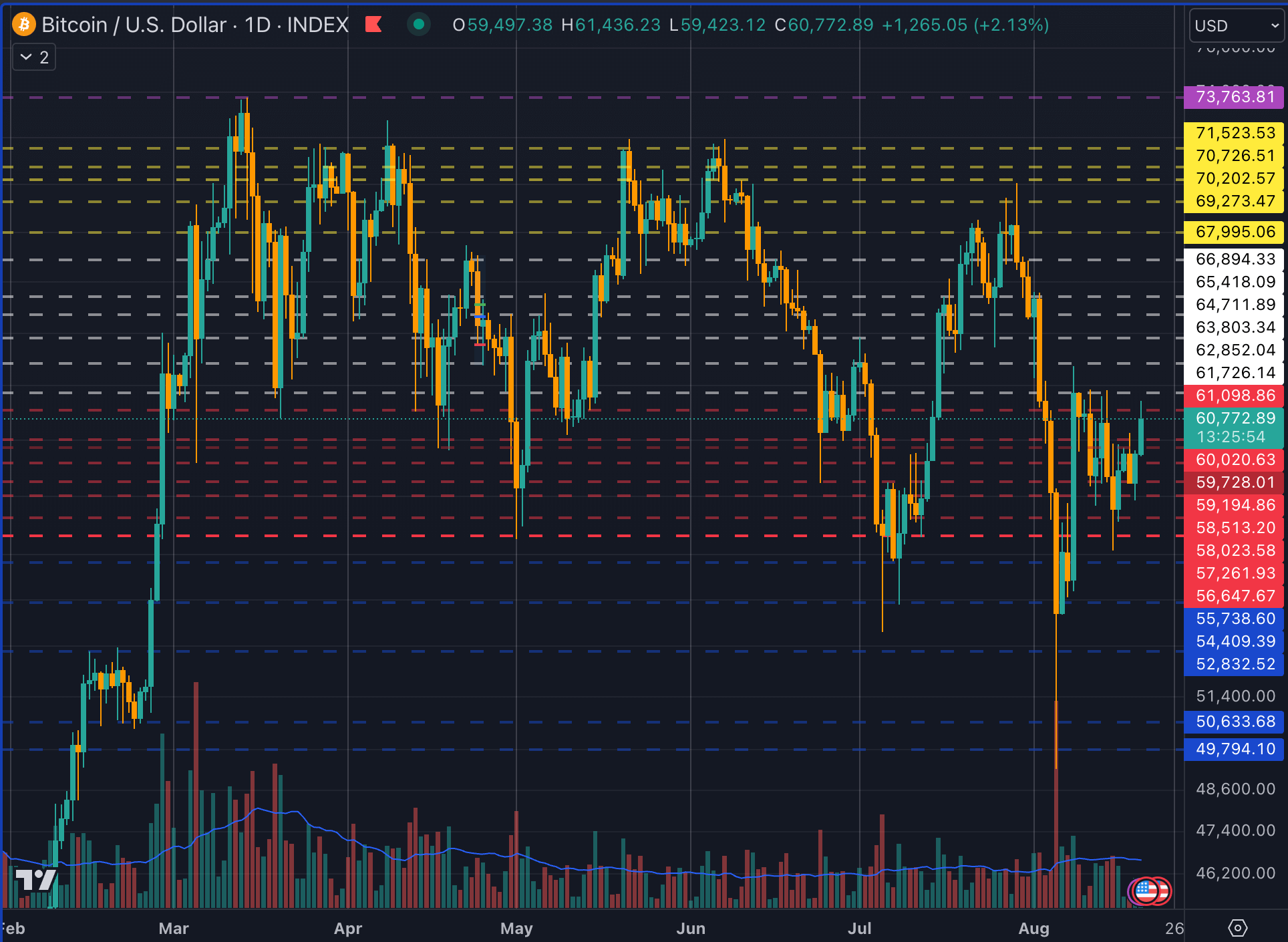
By repeating closing prices on the 30-minute chart, you can identify leverage, stop placement, and where spot liquidity tends to be concentrated. Those shelves keep popping up at tipping points.
They framed the rebound, capped the rally, and guided the path during it with more coherence than many elaborate narratives built around Bitcoin.
The last two days unfolded in three steps. First, Bitcoin spent time in the upper half of its short-term range, pushing back towards the yellow border around $67,995.
Second, the movement stalled before any real acceptance could build on its ledge. Third, the chart reversed sharply, with the price passing through the white line at $66,894 before finding temporary footing in the mid-$66,000 range.
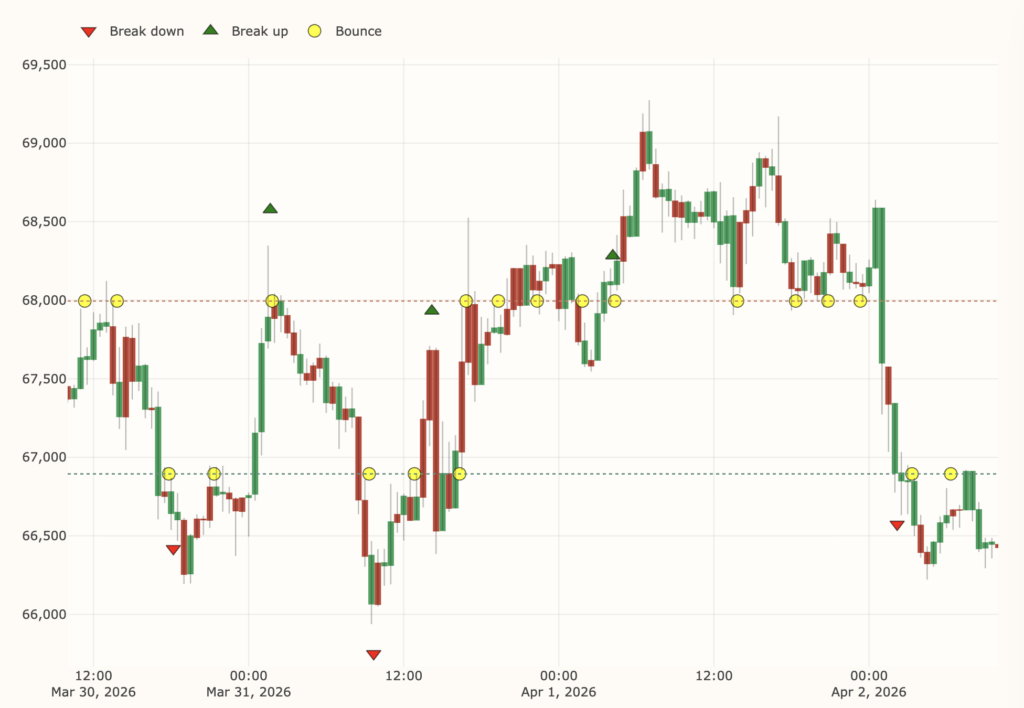
This sequence shows where control is currently located. Buyers still have a path back into sales range, but that path starts with repairs.
For the structure to become constructive again, the price will need to regain $66,894 and then push back to $67,995.
Bitcoin loses the shelf it needs to hold and short-term structure has declined
It’s the same logic that led Bitcoin to fail to break above $71,500 seven times. Repeated failures at one level increase the weight of the next test.
The ceiling becomes a lid when sellers pull out and meet the price early, and the bottom becomes vulnerable when buyers lose the urgency to protect it on first contact. In that February article, the major level was $71,500, the next friction zone above it was around $72,000, and $73,700 to $73,800.
Below, I’ve flagged the same shelves that are visible on the current chart. Deeper support exists at $68,000, then $66,900, and then the low $61,000 area. That ladder is still in place today.
The difference is that Bitcoin has moved down a notch.
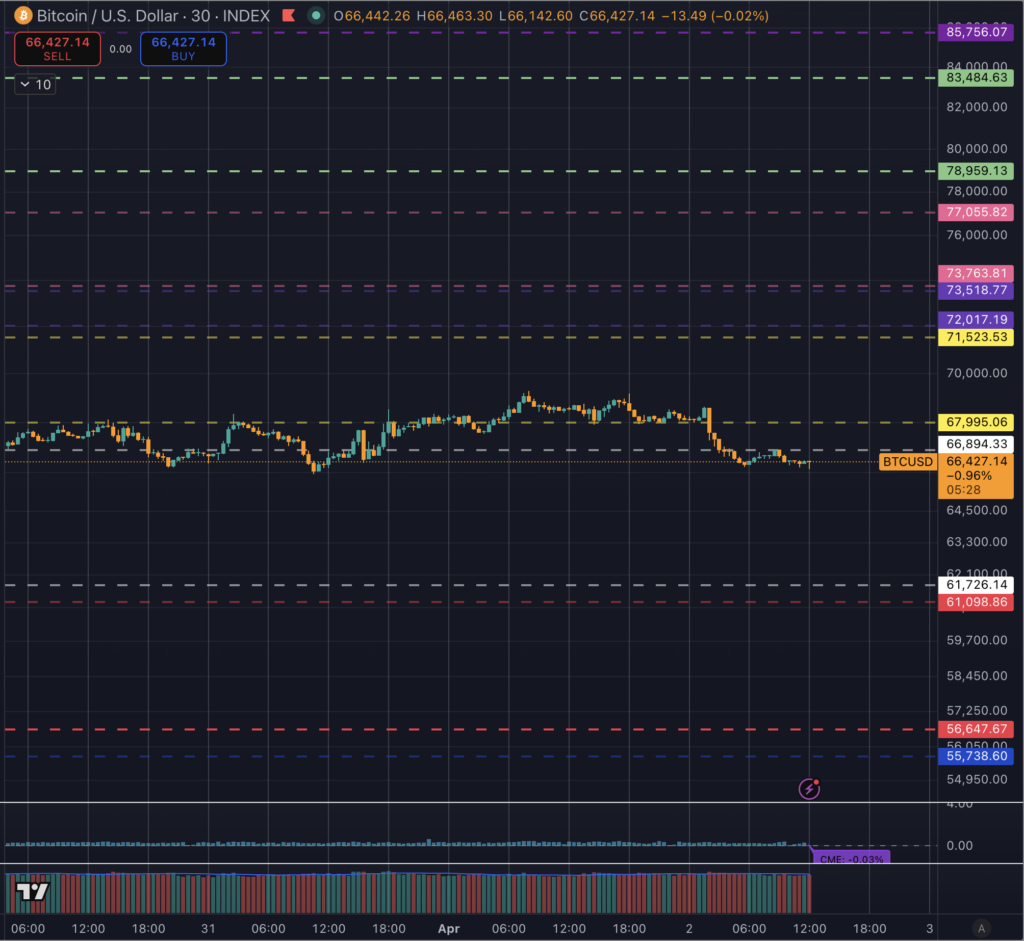
The actual steps are simple. While the market remained above the white shelf, there was room for recovery.
Losing that level and failing the retest shifted the burden to buyers to prove that the decline was a flush rather than a new acceptance at a lower level. So far, the rebound is not authoritative.
The brief moment back toward the broken shelf marked the kind of weak retest that typically accompanies markets that are still under pressure. The candlesticks after the decline look small, the rebound appears to be struggling, and range compression is occurring below resistance rather than support.
The 24-hour figures support that view. Bitcoin has fallen about 3.02% from its closing price 24 hours ago, but the 48-hour change was only slightly positive.
This combination often appears when the market builds a foundation over the course of one day and then builds it back up the next day. In other words, the chart maintained a wider range while damaging the short-term structure.
For the general audience, that distinction fixes analysis on thresholds rather than emotions. The market remains within the known shelf ladder.
Moved from one shelf to the next. The immediate task for the bulls is to collect $66,894 and then $67,995.
The immediate risk for those who are bullish is that continued trading below these levels will draw attention to the lower white line around $61,726.
This lower target should already be familiar to you from my original channel activity. Channels were built to identify support and resistance rather than forcing unidirectional calls. This is also consistent with the “Bitcoin to $73,000? Prepare for notable price levels in a bear market” roadmap, where the key was to treat the lower shelf as a historical liquidity pool.
The graph here fits neatly into that framework. Bitcoin is trading below a broken support shelf and the next meaningful repair level is above the current price.
Until that changes, the burden of proof will remain high.
Support memory follows the same channel logic that formed the previous call.
These levels are well maintained as they are built from where the market repeatedly closes, pauses, and builds positioning. Some zones have memories of spending hours or days there.
Other zones looked dramatic on the way up or down, but they provided weak support as Bitcoin quickly moved through them and the inventory the market had built there diminished.
This distinction shaped my October 2024 analysis in “Exceeding the all-time high of $73.7K could be a new resistance level to watch,” where I argued that Bitcoin was trading at the top of its core price channel between $67.9K and $71.5K, and that the zone between $71.5K and $73.7K has historically seen relatively little price volatility.
The meaning was clear. The market has moved beyond a well-traded ledge and into thin territory where movements can be more abrupt.
The same logic applies later to the downside. In “It’s Stupid to Pretend $79,000 Isn’t Part of Bitcoin’s Story This Year,” I described the green band around $79,000 as more substantial territory because Bitcoin has spent time consolidating there early in the cycle.
Below that lies deeper structural support in the red and blue channels, roughly $49,000 to $56,000, an area that Bitcoin has defended repeatedly before approaching six digits. Next, in “Akiba’s mid-term $49,000 Bitcoin bearish thesis – why this winter is the shortest ever,” I framed $49,000 as a cyclical support case related to miner stress, fee shares, hash prices, and ETF flow elasticity.
These longer-duration calls work on a different scale than today’s 30-minute movements, but all rely on the same discipline. That is, identify the shelf, assess how well the price is holding, and define the next level relevant when it breaks out.
The current movement fits neatly into that sequence. Bitcoin has approached the yellow floor around $67,995 and is no longer able to sustain it.
It then slipped under a white shelf near $66,894. A 30-minute breakdown candlestick in the early morning hours of April 2nd accelerated the move from the low $68,000s to the low $67,000s, and subsequent sell-offs brought the price down to the low $66,000s.
Once there, the market recorded a small rebound, but then drifted sideways below the broken support. Such actions usually indicate that the market is still negotiating inventory reductions rather than preparing for an immediate reversal.
Anyone who has been through the 6-digit phase in the latter channel will notice the same design principles in “Bull or Bear? Today’s $106,000 retest sealed Bitcoin’s fate” and “Bitcoin price’s next move: $92,000 or $79,000? Let’s break it down.” The exact price changed as Bitcoin passed through new territory, but the method remained the same.
If the retest is successful, the next band will open. Retest with failed hand control to bottom shelf.
The current chart falls into the second category. Price is still under the broken ledge, so the ladder below continues to function.
A strong dollar and high oil prices coincided with the break, leaving recovery levels above and deeper support below.
Broader market conditions over the past 24-48 hours have added a new layer to the chart. In addition to Bitcoin’s decline, a comparative view showed the US dollar index recovering above 100 while Brent crude oil rose towards $108.
This combination creates tougher conditions for risk assets. A strong dollar typically puts pressure on marginal global liquidity, and rising oil prices can exacerbate inflation concerns, interest rate sensitivity, and geopolitical caution.
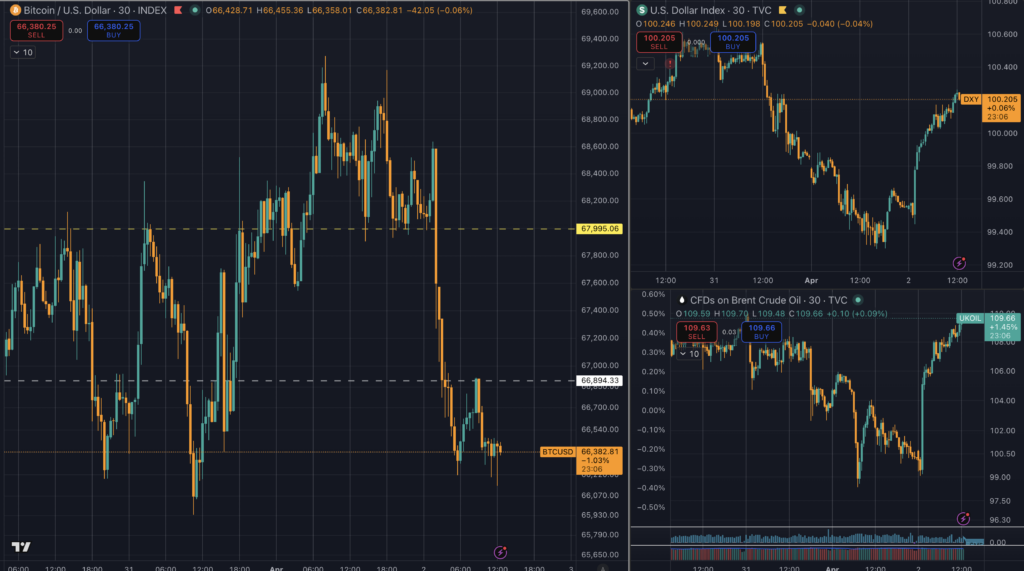
Bitcoin tends to trade with more friction when both markets are moving in the same direction, with risk mitigated.
This setup fits comfortably within the framework of the later channel parts. In the $79,000 article, I wrote that liquidity could become an issue if ETF outflows intensify and risk appetite weakens.
In my $49,000 bear thesis, I argued that 20-day ETF flows were negative, which, combined with the weakness in the minor economy, would increase the likelihood of a sharper decline. In my analysis of the 7 failures at $71,500, I pointed to a macro environment in which yields remain high enough to maintain tight conditions.
The latest move reflects similar pressure from a shorter time frame. Structurally important shelves collapsed, and the macro context provided little relief.
With practical maps, the levels do the heavy lifting for you. Resistance begins at $66,894 and then increases to $67,995.
As Bitcoin regains both and spends time outpacing them, the short-term damage begins to heal and the next higher levels come back into view: $71,523, then $72,017, then $73,519 and around $73,764, and an upper extension around $77,056. These higher levels are already well known from price discovery work above old all-time highs.
Support begins at the intraday low below $66,000, but stronger structural memory lies even lower near $61,726. This puts Bitcoin in a narrow but important situation.
If the buyer rushes back, it’s close enough to recover the broken support, but if not, it’s close enough to invite a deeper sweep.
The conclusion is the same as the charts have been presenting since early 2024, when these channels were first drawn. Bitcoin respects ledges until they give way, and once a ledge is broken, the next ledge tends to be the destination.
In the past 24 hours, Bitcoin has lost the shelf it needs to maintain bounce credibility. In the past 48 hours, we have maintained a broader range while shifting the short-term structure lower.
The next move will depend on whether the price can move above $66,894 and $67,995 quickly enough to change the mood on the charts. If that fails, the lower white border around $61,726 returns to focus as the next significant test on the ladder.
At the time of press April 2, 2026, 12:37 PM (UTC)Bitcoin ranks first in terms of market capitalization, and the price is under 3.15% Over the past 24 hours. Bitcoin market capitalization is $1.33 trillion The trading volume for 24 hours is $37.1 billion. Learn more about Bitcoin ›
Overview of the virtual currency market
At the time of press April 2, 2026, 12:37 PM (UTC)the value of the entire cryptocurrency market is $2.29 trillion in 24 hour volume $99.35 billion. Bitcoin dominance is currently 58.09%. Learn more about the cryptocurrency market ›
(Tag translation) Bitcoin


