

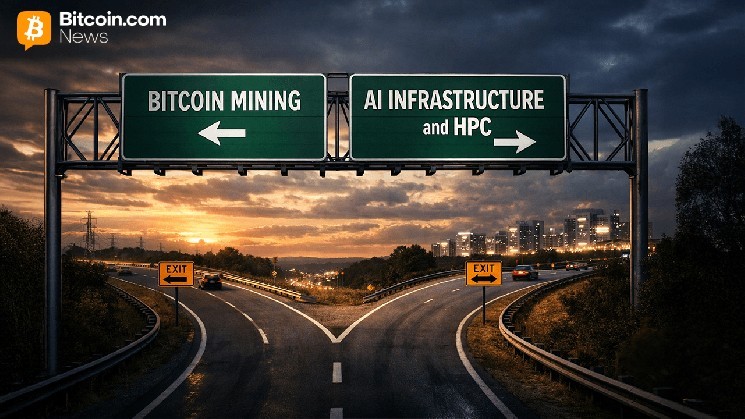
Bitcoin miners are shedding hashing power and aiming for hyperscale as multibillion-dollar artificial intelligence (AI) contracts vastly outpace mining, forcing a rethink of the industry that protects the world’s largest cryptocurrency.
Bitcoin mining economy struggles as AI boosts revenue per megawatt
What started as a side hustle has turned into a full-blown identity crisis for Bitcoin miners. Across the U.S. and beyond, companies that once lived and died on hashprice are now chasing the returns of AI and high-performance computing (HPC), which can yield many times more revenue for the same megawatt of power.
The inflection point dates back to April 2024, when Bitcoin’s fourth halving reduced the block reward from 6.25. $BTC up to 3.125 $BTC. This cut revenue in half overnight, while network difficulty continued to rise, squeezing margins in what appears to be the toughest revenue environment since its inception.
AI, on the other hand, has emerged with a much larger checkbook. Data center workloads associated with AI models can generate millions of dollars per megawatt. That is, the same electron suddenly became much more valuable by doing something different. “[AI]has become Bitcoin mining’s biggest competitor,” crypto trader Ran Neuner wrote this week. “What will happen to Bitcoin if AI becomes the highest bidder for electricity?” asked Neuner.
Miners are making that decision quickly. Companies that were once solely focused on Bitcoin mining have already signed billions in AI infrastructure contracts, and analysts estimate that even a partial conversion could unlock tens of billions more annually.
The transaction flow is more like a stampede than a pivot. IREN signs $9.7 billion deal with Microsoft for GPU cloud services. Hut 8 signs a $7 billion, 15-year AI data center lease backed by Google-linked infrastructure.
Terawulf followed with a $9.5 billion long-term deal, and Cipher Mining signed a $5.5 billion deal with Amazon Web Services. BitFarm has gone even further, announcing plans to completely scale back Bitcoin mining over the next two years.
Bitfarms CEO Ben Gagnon said last year: “Even though it’s less than 1% of our entire developable portfolio, we believe converting just our Washington site to GPU-as-a-Service has the potential to generate more net operating income than we’ve ever generated from Bitcoin mining.”
If AI continues to pay a premium for computing, the mining exodus may be just beginning.
The market is reacting accordingly. By late 2025, more than 70% of major mining companies are already generating some revenue from AI infrastructure, and that share is expected to rise as long-term contracts come online.
Others frame the issue in more cautious terms. “The big undervalued headwind for Bitcoin is the disaster that is hitting the mining economy,” said Quinn Thompson, chief information officer at Wrecker Capital, arguing that the shift to AI is accelerating an already fragile situation.
Still, Bitcoin advocates aren’t losing sleep. The network’s difficulty adjustment mechanism automatically recalibrates every 2,016 blocks, reducing mining difficulty when participants leave and restoring profitability for remaining participants.
There are also structural wrinkles that are often overlooked in the midst of desperation. That means miners are unusually well-positioned to build AI infrastructure. The company’s facilities already have extensive power connectivity, industrial cooling, and fiber connectivity, assets that can shorten implementation schedules by as much as 75% compared to building a new data center from scratch.
In other words, miners are not just walking away from Bitcoin, they are profiting from being early owners of something AI desperately needs: power.
The real tension is in what happens next. If AI continues to command a premium price for computing, the exodus from mining could continue and gradually reduce Bitcoin’s security budget over time. The pendulum could swing back if AI capacity exceeds demand, or if the price of Bitcoin rises enough to restore mining profitability.
For now, the industry seems to be heading towards a dual personality. While large publicly traded players are turning Bitcoin into AI infrastructure providers as a secondary business, small, energy-efficient miners continue to ensure the network is secure.
This is more of an uneasy coexistence than a clean separation. Bitcoin continues to go block by block, even as its former champions quietly redeploy its megawatts elsewhere.
Frequently asked questions 🔎
- Why are Bitcoin miners moving to AI infrastructure?AI workloads generate significantly higher and more predictable revenue per megawatt than Bitcoin mining.
- How much will it cost to transition to AI?More than $65 billion in AI infrastructure contracts have already been signed by mining companies.
- Is Bitcoin network security weakening? Although hashrate has decreased, the difficulty adjustment mechanism stabilizes the network over time.
- Could miners return to Bitcoin later?Yes, mining could become attractive again if the price of Bitcoin increases or the profits of AI infrastructure decrease.


