


A new debate is emerging over whether the continued pivot away from Bitcoin miners to artificial intelligence could impact Bitcoin’s security and role as a store of value.
Some argue that miners fleeing the network makes it more susceptible to a 51% attack, while others argue that this simply triggers the Bitcoin network to rebalance as designed, making it attractive to miners again.
“AI killed Bitcoin forever,” crypto trader Ran Neuner said on Sunday, arguing that AI has become Bitcoin mining’s biggest competitor as both industries compete for power.
“AI is going to pay more for it,” he added, adding that Bitcoin ($BTC) Mining revenue per megawatt is around $57 to $129, but the revenue per megawatt in AI data centers is up to eight times higher at $200 to $500 for the same power, which is why miners are starting to pivot.
Earlier this month, Core Scientific secured up to $1 billion in financing for AI hosting, and MARA Holdings recently filed with the SEC to indicate its intention to sell part of it. $BTC Neuner claimed that Hut 8 has pivoted to AI, signing a $7 billion AI infrastructure deal with Google in December.
Meanwhile, Cipher Mining has reduced its hashrate to focus on AI calculations, and Bitmain co-founder Jihan Wu has quit mining and shifted his focus to AI, he added.
“If I were a miner, it wouldn’t be a difficult decision. And that’s why more and more miners are leaving the network every day.”
This sounds like a doomsday scenario for Bitcoin, but not everyone agrees.
Bitcoin pioneer and cryptographer Adam Back argued that adjusting difficulty would simply drive out the least efficient miners, increasing profitability.
“What will happen to Bitcoin is simple: tick-tock, next block! Downward corrections will be difficult, the least efficient AI switchers will leave, and Bitcoin mining profitability will converge to AI profitability. QED.”
Investor Fred Krueger added: “If the AI outbids the miner for power, the miner can simply turn off the power until the difficulty is adjusted and they’ll make a profit again. That’s literally how Bitcoin works.”
Bitcoin’s energy demand fluctuates
But Neuner argued that the decline in hashrate, which is down 14.5% since its peak in October, means fewer miners are protecting the network, making 51% attacks more likely.
All of this has happened before in bear markets, where automatic network difficulty adjustments usually compensate, “but this time it’s different, because there’s no energy,” he said.
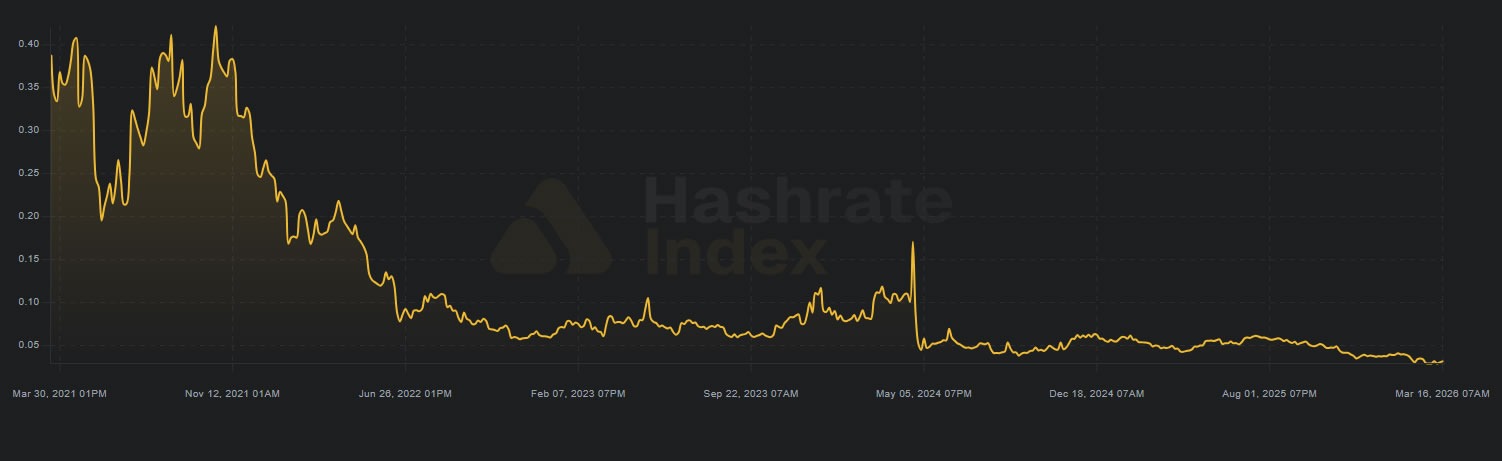
The profitability of Bitcoin mining, or the hash price, is near an all-time low. sauce: hash rate index
Related: Crypto miners must leverage Bitcoin to survive: Wintermute
Bitcoin ESG expert Daniel Batten disagreed, saying the opposite is true: “The evidence shows that AI relies on Bitcoin to scale.”
He argued that it’s not all about high demand and expensive electricity, as Bitcoin mining can harness stranded energy, act as a flexible load balancer for the energy grid, and use older equipment for cheaper energy.
One green candle to prevent AI competition from dooming
Neuner believes that one way to ensure that AI does not overshadow Bitcoin is to $BTC Prices will go up.
“What I want is for Bitcoin to have one green candle. Maybe it’s because of the war, maybe it’s because of regulation, who knows. But in the end, all I want is Bitcoin to have one green candle.”
“If you look at the price behavior of Bitcoin during this war, that’s exactly what’s happening,” he said, adding that another scenario where Bitcoin prices continue to fall is “almost the apocalypse for Bitcoin.”
Bitcoin recorded its fifth consecutive monthly red candlestick, which hasn’t happened since the 2018 bear market. However, March is currently on track with assets up 8% so far this month, according to Coinglass.
magazine: All 21 million Bitcoins are at risk from quantum computers


