

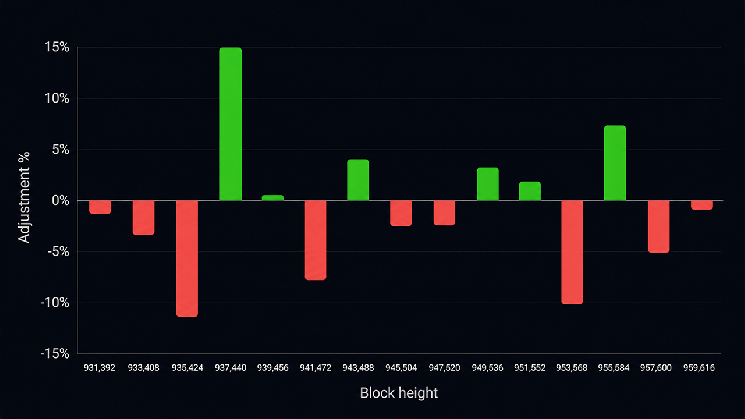
15th difficulty reduction this year
This weekend, the network difficulty decreased by 0.74% at block height 959616, making the block slightly easier to mine. Bitcoin difficulty is a self-adjusting metric that keeps the average time between blocks close to 10 minutes, ensuring a consistent issuance schedule despite changes in total mining capacity.
With the latest adjustments, the network recorded 9 difficulty decreases and 6 increases in 2026, ranging from block heights 931392 to 959616. The average adjustment across 28,224 blocks from January 8 to July 25 was 6.4 percentage points.
This is a fairly large variation considering what the system is trying to do. We only make the necessary modifications to keep block production hovering around one every 10 minutes, especially as mining power increases and decreases.
Nine cuts and six gains: a year of uneven adjustment
The network has experienced a cumulative difficulty increase of 31.04% and a cumulative difficulty decrease of 43.96% so far this year. Since January, Bitcoin mining difficulty has decreased from 146.47 trillion to 126.23 trillion, a 13.82% decrease since the beginning of the year. But what is causing the change?
There is more than one answer. A combination of factors reduced the difficulty, but the biggest one was Bitcoin’s market performance. Since January 1st, Bitcoin has fallen 26%, and that decline is weighing heavily on the miner economy.
Over the past 206 days, Hashprice, the estimated daily value of one petahash per second (PH/s) of hashing power, has fallen from $37.39 to $32.21. In addition to this, many large mining companies are finding stronger revenue opportunities by shifting megawatts to artificial intelligence (AI) infrastructure and cloud services.
Difficulty decreases due to falling Bitcoin price and transition to AI
This shift in direction is being felt across the industry. Large mining companies with existing power contracts and site infrastructure find it easier to lease that capacity to AI and cloud computing customers rather than continue operating with low mining profits. Equipment will not disappear. It just points to a different type of workload.
For now, block times remain close to 10 minutes as the difficulty algorithm continues to do its job, trimming targets as hashing power decreases. Whether there will be another drop in the price in the second half of this year or a return to the upside will largely depend on where Bitcoin’s price and the miner economy go next.


