


According to Coinbase Institutional, stablecoin supply has roughly doubled since January 2024, and entity-adjusted trading volume has increased four to five times, creating a wide gap between the amount of dollar liquidity held on-chain and the amount of activity that liquidity supports.
Market capitalization records the inventory of stablecoins in circulation and captures available liquidity, reserve demand, and issuer size. Transaction throughput, on the other hand, records how intensively those tokens move through exchanges, payment systems, financial accounts, and payment workflows.
A system that holds $500 billion and moves infrequently provides more productive capacity than a system that holds $250 billion, but a smaller system can support more economic activity if each dollar is exchanged repeatedly. Stablecoins are now moving to a second model, where the value of the network increasingly reflects how much can be settled with an existing pool of digital dollars.
Coinbase index comparison clearly shows that change. Stablecoin market capitalization has nearly doubled from January 2024 levels, and adjusted trading volumes have grown several times faster. Monthly adjusted trading volume has increased from hundreds of billions of dollars in 2023 to well over $1 trillion in recent months, indicating that each unit of supply is moving more frequently.
Era of stablecoin exchange with guaranteed supply
Market capitalization is suitable for the first major use of stablecoins, so it has become the standard adoption criterion. Traders held Tether $USDTCircle’s $USDCand other dollar-linked tokens on the exchange served as trading capital, collateral for derivatives, liquidity for DeFi, and a haven from volatile crypto assets.
Under that structure, additional supply almost always represents additional demand. The increase in balances suggested that more capital is flowing into cryptocurrencies, deeper liquidity is becoming available across markets, and traders are amassing greater purchasing power. Redemptions were often accompanied by a drop in activity, a clear sign of capital leaving the ecosystem.
However, stablecoins are now pervasive in institutional treasury accounts, cross-border transfers, payment applications, and tokenized markets. A single token will now be able to settle multiple transactions before its holder redeems it or returns it to the exchange, allowing activity to grow faster than the underlying supply.
So, while the supply represents actual usage, the supply now approximates the installed capacity and works. A larger float means more liquidity can be deployed in the market, while faster circulation allows the same float to support more activity.
Monetary velocity describes how often monetary units change hands within a given period of time. A $100 bill sitting in a drawer generates little trading activity, but that same $100 can be used to pay a worker, pay a supplier, pay a transportation company, and the transportation company can pay another company. The amount of money remains constant as the value that is settled through money accumulates.
The same principle can be applied on-chain. Stablecoin velocity is typically calculated by dividing the transaction volume by the outstanding supply, but the results vary greatly depending on which transfers enter the numerator.
Raw blockchain data may include exchange sweeps, automatic routing, arbitrage loops, and transfers between addresses controlled by the same entity. Entity-adjusted datasets group related addresses and filter activity determined to have limited independent economic substance to more accurately estimate true monetary transfers.
CryptoSlate’s analysis of automated stablecoin activity shows the scale of that distinction, with blockchain aggregates shrinking rapidly when internal, bot-driven, and other non-economic transfers are removed.
Coinbase numbers use entity-adjusted trading volume. Even after passing through these filters, activity continues to grow much faster than supply, supporting the conclusion that stablecoins are becoming more concentrated in circulation.
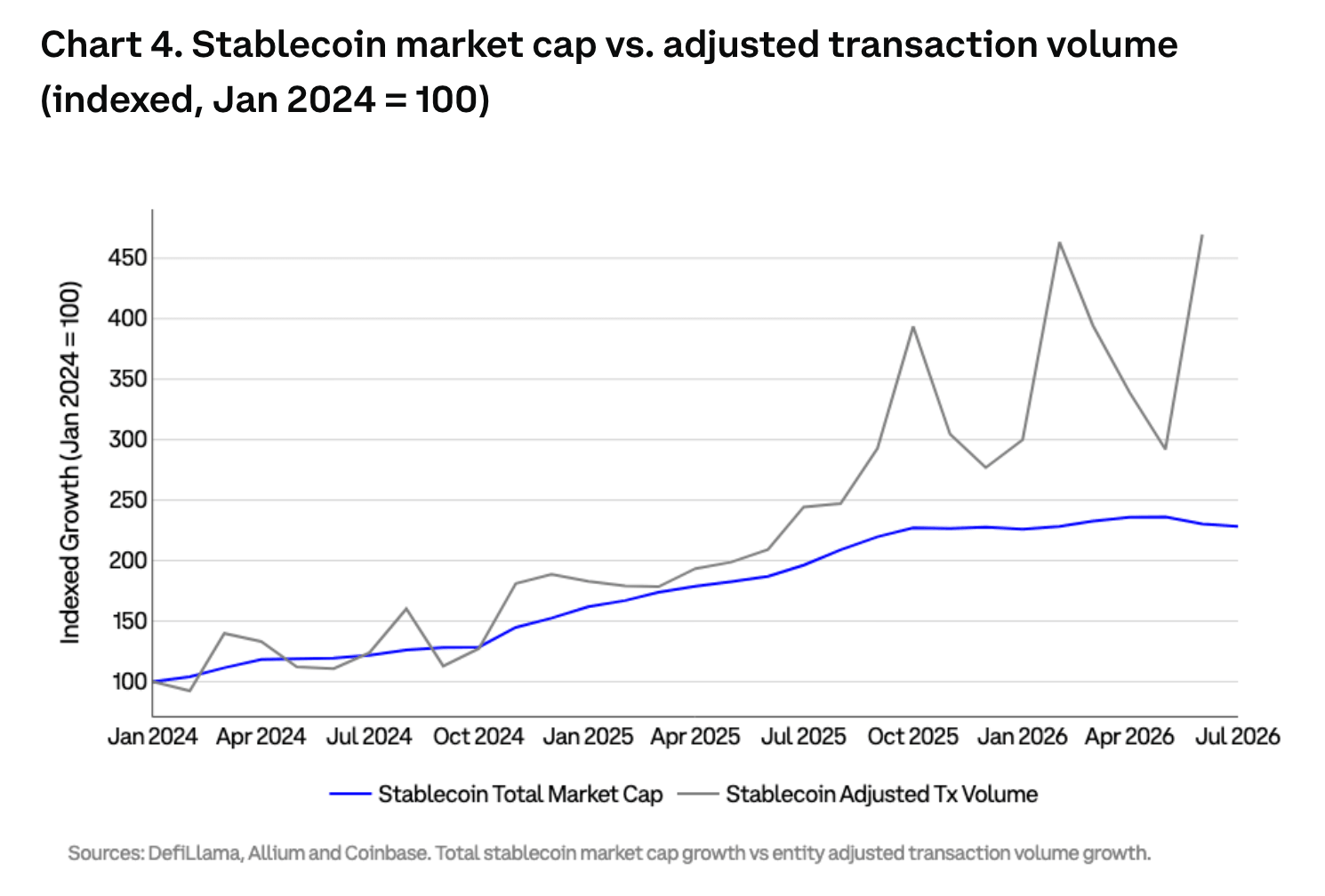
This metric cannot determine the purpose of all transfers. Trading, arbitrage, collateral movements and government bond rebalancing still account for the bulk of the activity, and the sharp monthly increase may reflect financial market sales rather than household spending. These transactions still have economic significance as they use stablecoins as a payment method.
Visa’s Institute for Economic Empowerment calculated the total stablecoin velocity for Q4 2025 to be 13.56. This means that the average token traded more than 13 times during the quarter. The US M1 velocity for the same period was 1.65.
Although the differences are obvious, it is important to note that these numbers represent different forms of activity. While M1 velocity links cash and current accounts to spending on goods and services, the total velocity of a stablecoin includes investing, trading, funding, liquidity management, and payments.
Visa tested a retail proxy by separating stablecoin transfers under $250. By this measure, Q4 velocity was 0.08, with retail-scale transfers accounting for less than 1% of the stablecoin’s total activity. Therefore, daily purchases account for only a small percentage of overall sales.
Larger benchmarks allow for more detailed comparisons. Visa calculated Fedwire’s velocity for the quarter at 93.84, nearly seven times the stablecoin’s figure of 13.56. While stablecoins have generated significant returns, the established US wholesale system still processes value at a much higher intensity compared to the reserve balances backing it.
This comparison places stablecoins between two categories. Since financial activities account for the majority of its usage, its total circulation velocity exceeds that of retail currency, but its relative turnover is still below Fedwire. This position supports the payment infrastructure theory without treating stablecoins as replacements for consumer finance or wholesale banking systems.
Payment networks report payment volumes and transaction numbers, ports track cargo movements, communication networks monitor traffic, and large-scale payment systems measure the value transferred through them. Their economic importance comes from the activities they perform.
For stablecoins, circulating supply establishes an available pool of dollar liquidity, and throughput indicates whether companies, financial institutions, and crypto markets are using that pool to settle routine activities.
This leaves two forms of growth: expanding capacity through new issuance and increasing utilization through faster distribution. Coinbase data suggests that usage has become stronger since early 2024.
CryptoSlate follows similar developments across the payments industry, with Visa, Stripe, and Mastercard building stablecoin payment systems under their familiar consumer and business products. Customers can still interact with their cards, bank accounts, or payment applications, but tokenized dollars behind the transaction process part of the institutional transfer.
We have already seen that this change will impact business operations. DoorDash’s work on stablecoin-powered payments illustrates how global platforms are seeking faster movement between corporate accounts, merchants, and employees as payment speed impacts access to working capital and revenue.
Throughput Reshaping Stablecoin Competition
Differences in supply and throughput are changing the face of competition between the two largest stablecoins. $USDT While maintaining the largest circulating supply and widest distribution across the world’s trading venues, $USDC The share of adjusted trading activity is growing.
Coinbase July Analysis Results $USDCThe adjusted share of stablecoin circulation was approximately 70%, up from the mid-20% range in 2024. $USDT Continued to lead with outstanding supply and divided stablecoin leadership into two categories: Dollar. held and dollars Moved.
coinbase associate $USDCAn increasing proportion of regulated financial activities, payments, settlements and treasury operations. Trading, arbitrage, and liquidity management also contribute to this number, so the data shows higher attrition rates from institutional investors rather than consumer adoption.
CryptoSlate documented the same differences when: $USDC moved forward $USDT With adjusted transfer volumes, even though Tether maintained a much larger supply base. More recent network data shown $USDC It accounted for around 67% of June’s adjusted stablecoin volume, with activity increasingly spread across Base and Ethereum.
This number shows that the largest stablecoin balance and the busiest stablecoin payment network do not have to be the same.
According to Coinbase research, weekends have consistently accounted for about one-fifth of adjusted weekly stablecoin trading volume for several years, giving the market a steady flow of payments activity beyond the standard framework used by many banks and corporate treasury systems.
This has nothing to do with cryptocurrency convictions. Financial institutions are looking for payment availability and stablecoins are the best way to get it. While card authorization continues through the weekend and FedNow supports instant payments 24 hours a day, Fedwire’s current schedule treats Saturdays and Sundays as holidays and ACH operates through defined processing windows. Stablecoins can be transferred on public blockchains throughout the week, without relying on bank business days.
This gives stablecoins a substantial advantage in global markets where counterparties operate across time zones and crypto transactions occur continuously. Capital can be moved between exchanges, market makers, custodians, or treasury accounts on Saturdays through the same blockchain processes used during the week.
CryptoSlate has covered this benefit for years, including the 24-hour implementation of Checkout.com. $USDC Payment for merchants. The continued share over the weekend indicates that continuous availability is developing into repeat usage across the broader market.
The next winner controls the movement of the stablecoin.
On July 16, Visa introduced the Stablecoin Platform, an enterprise service that provides financial institutions, fintech companies, and crypto businesses with access to stablecoin operations through a Visa-managed environment.
The beta platform starts with Open USD and includes wallet infrastructure, minting and writing connectivity, bank account linking, transfers, redemptions, authorization management, and audit logs. Visa says the service will allow it to connect stablecoins with existing payment, card and remittance products.
The launch follows the formation of the broader Open USD Network, which joins Visa, Mastercard, Coinbase and more than 100 other companies in a partner-led stablecoin initiative built around distribution and usage.
This product shows how much competition already exists in this space. Before stablecoins become a daily operational tool, institutions will need custody, compliance, financial management, wallet management, fraud management, and linking to bank accounts. Issuers earn income from their reserve assets, while payment companies and service providers can capture value every time a token is transferred.
Stablecoin supply remains central to issuer economics, as reserve assets generate interest income, while increased float deepens liquidity and expands trading capacity. It also increases demand for Treasury bills and other short-term assets.
CryptoSlate has been tracking how stablecoin reserves have become an important source of Treasury demand, with increased supply directly related to government funding markets and issuer profitability.
Throughput, on the other hand, creates another source of economic value. Payment processors, custodians, banks, blockchain networks, compliance companies, and tokenization platforms can participate in the stablecoin movement even if they do not issue the underlying dollars.
High-capacity networks can create demand for transaction processing, foreign exchange conversion, identity management, fraud monitoring, and financial services. A large supply base can generate large reserves revenues with lower distribution rates. The most powerful companies want to combine both models, using broad float to attract liquidity and operational services to capture recurring activity.
The introduction of stablecoins has entered a phase where market capitalization measures capacity and velocity measures utilization, giving analysts a better way to distinguish digital dollars held within the system from digital dollars that support recurring financial activities.
Coinbase’s adjusted volume increased 4x to 5x, $USDCThe company’s growing share of that activity and the sustained contribution of weekends all point to a market experiencing the strongest expansion in payment intensity. Visa research shows where those boundaries are. Stablecoins now more closely resemble wholesale financial products than consumer cash, and their relative revenue remains well below Fedwire.
The next stablecoin leaders could include issuers with the largest reserves, payment companies that connect tokens to merchants and banks, custodians that manage institutional balances, or blockchain networks that carry the highest quality payment flows. Their position is determined by how much value they can move, how reliably they can move it, and how deeply those moves are integrated into their regular financial operations.
Stablecoins are becoming more like payment networks than digital bank balances. As this transition progresses, supply indicates how much capacity the system holds, and throughput indicates how much economical work the system performs.


