


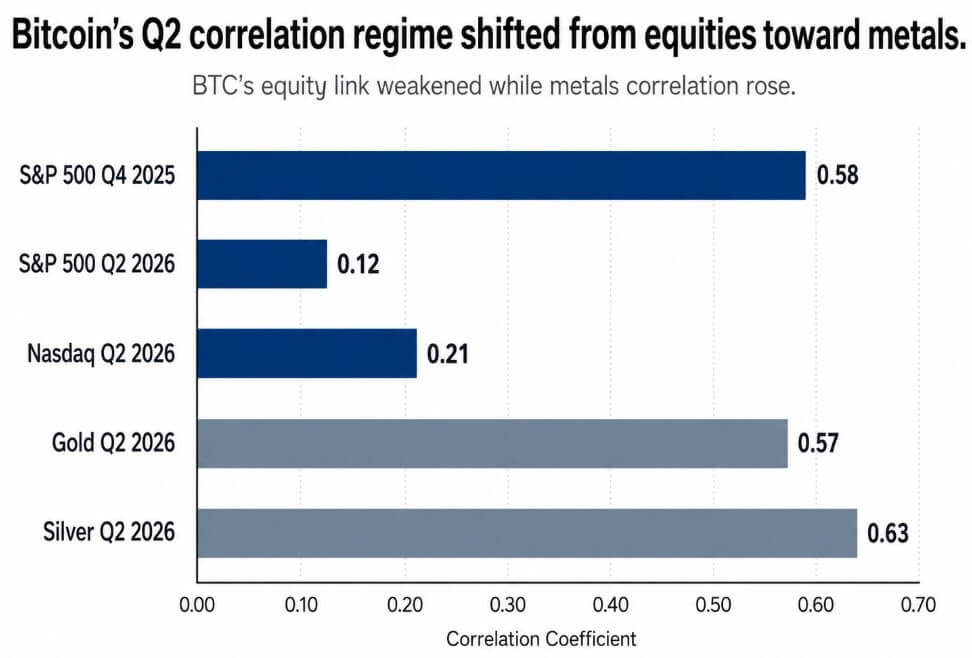
The daily correlation between Bitcoin and the S&P 500, which covers data through June 30, fell from 0.58 in Q4 2025 to 0.12 in Q2 2025, according to a joint report by Coinbase Institutional and Glassnode.
The correlation with the Nasdaq remained at 0.21 over the same window, with gold moving in the opposite direction. The correlation between Bitcoin and the metal rose to 0.57, while the correlation with silver reached 0.63.
The reversal, which separates Bitcoin from the AI-driven stock trading that has driven much of the cryptocurrency’s price movement over the past two years, comes as the Federal Reserve meets on July 28-29, Microsoft and Meta report earnings on July 29, and Amazon on July 30.
Hyperscalers’ capital spending guidance and the Fed’s interest rate decisions will be released in the same week, within the quarter that Bitcoin just entered.
Colin Basco of Coinbase Institutional and his team of analysts at Glassnode have a similar reading of the current situation, explaining the move from correction to accumulation, pointing to on-chain data showing that coins last traded within three months are trading at multi-year lows.
They also found an increase in dormant supply. This, together with the on-chain data presented, represents a pattern that has historically emerged during the accumulation phase.
shared macro channel
The report frames the relationship with gold in the second quarter by pointing to a strong dollar and a hawkish Fed weighing on both Bitcoin and gold, pushing them both down.
Bitcoin and gold sold off at the same time because both are responding to the same real interest rate and liquidity forces that have set Bitcoin’s price all year.
This framework will change the impact of AI stock declines on Bitcoin heading into the third quarter. Money flowing out of expensive tech stocks will only help Bitcoin if it drives down U.S. Treasury yields and encourages a weaker dollar.
An unwinding from inflation, tariffs, or energy costs would tighten the same channels that already drove Bitcoin down in Q2 along with gold.
Alphabet on July 22 raised its 2026 capital spending outlook to $195 billion to $205 billion from $180 billion to $190 billion, and reported its first negative quarter with free cash flow of $5.9 billion.
If current spending continues, the four largest U.S. hyperscalers – Microsoft, Alphabet, Amazon and Meta – could collectively spend more in capital spending than they generate in free cash flow by 2027.
Big Tech is on pace to spend more than $700 billion on AI infrastructure this year, with Morgan Stanley predicting more than $1 trillion next year.
New York Fed President John Williams linked higher inflation to demand for goods and power driven by tariffs, the cost of energy and goods from the Middle East, and technology investment, citing semiconductors and transformers specifically.
The Fed’s July Monetary Policy Report lists PCE inflation at 4.1% and core PCE at 3.4% for the 12 months ending in May, and the Fed has kept the funds rate at 3.50% to 3.75% since the beginning of the year.
In June’s economic forecast summary, the median PCE forecast for 2026 was 3.6%, and the median year-end fund interest rate was 3.8%, up from 3.4% in March.
Two versions of the same sale
In a bullish case, AI stocks will fall as investors reject overvalued valuations or demand tangible returns on capital already committed.
Treasury yields are falling, the dollar is weakening, and capital is moving into scarce assets. Bitcoin has risen alongside gold and silver, remaining disconnected from technology stocks as its upward correlation with metals turns into a new source of demand.
In the bear case, AI stocks fall as oil, tariffs, and infrastructure demand stubbornly keep inflation up, pushing yields and the dollar higher. Under these circumstances, expensive technology stocks, metals, and Bitcoin could all fall.
Bitcoin price is currently responding to the real rate channel, and the same lever is pulling down gold and silver. A common correlation with gold provides no protection if both assets face similarly high costs.
| AI sale type | Why technology declines | rate/dollar reaction | metal reaction | Impact of Bitcoin |
|---|---|---|---|---|
| Bullish on BTC | Investors reject AI overvaluation or demand clearer return on capital investment | Government bond yields will fall. weak dollar | Gold and silver benefit as rare assets | BTC could rise with metals while remaining decoupled from Nasdaq |
| Bearish on BTC | Inflation will remain high due to the costs of oil, tariffs, electricity demand, and AI infrastructure. | Government bond yields rise. strong dollar | Metals struggle despite inflation risks | Bitcoin falls along with metals as real interest rate pressure prevails |
| Neutral/Lagging Risk | AI returns justify capital spending and technology recovery | Yields remain steady. The dollar hasn’t fallen enough | metal remains capped | BTC May Miss out on AI Stock Price Recovery While Still Facing Macro Pressures |
Oil determines which version is played
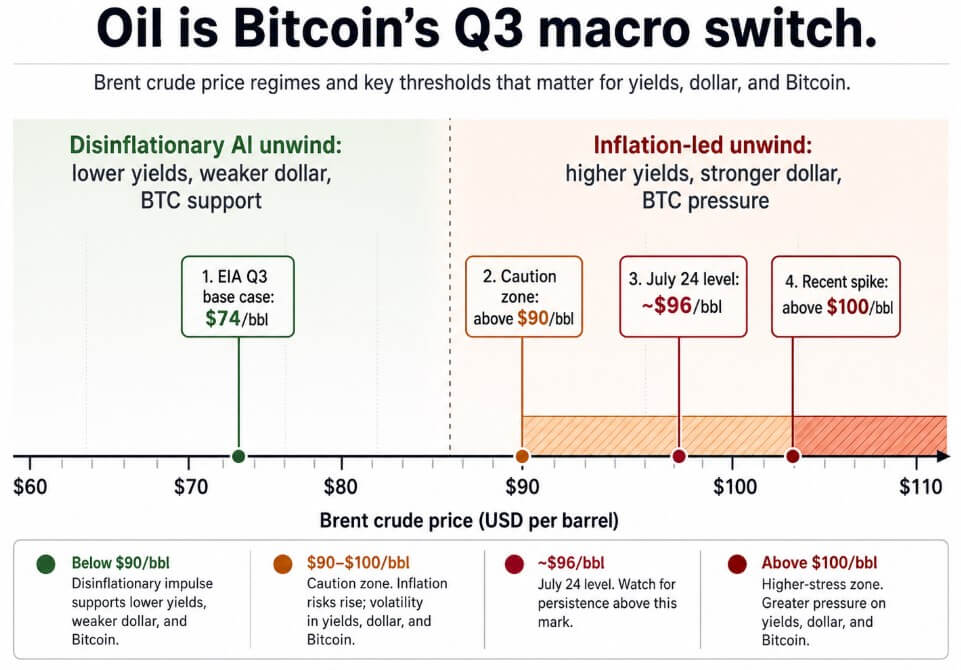
The U.S. Energy Information Administration’s base case as of July 7 calls for Brent crude oil prices to average $74 per barrel in the third quarter. Brent soared above $100, but fell to around $96 by July 24, the same day the 10-year Treasury yield hit 4.713% and the 30-year Treasury yield was near a 19-year high.
On July 24, gold was trading around $4,073 an ounce and silver was trading around $58.77 an ounce, with expectations for higher long-term interest rates holding back gold’s gains throughout the year.
The gap between EIA forecasts and the actual price of oil sets the test for the third quarter, with a return to $74 supporting the bull market and sustained prices above $90 sustaining the bear market.
Bitcoin ETF flows add a confirming signal this quarter, as US spot funds posted net outflows throughout the first half of the year before showing early signs of drying up the pace by June.
The fund recorded seven consecutive days of net inflows through July 22nd, totaling nearly $1 billion, but the streak stopped on July 23rd when the Spot Bitcoin ETF lost $225 million.
Short-term inflows confirm that demand is stable, and it will take more than a week of inflows to see if that capital will be rotated out of AI and into cryptocurrencies.
Three assumptions under test
While the decoupling from the Nasdaq appears bullish on the surface, it could also mean that Bitcoin is now responding to a different macro channel than the one investors are expecting to profit from. The correlation with gold during declines indicates a common sensitivity to real yields and the dollar.
Money out of tech stocks will only flow into cryptocurrencies once inflation relief is lifted. In an inflation-driven unwind, that money tends to go toward shorting cash, government bonds, and the dollar.
Portfolio managers who hold both metals and Bitcoin face the same challenge from a different direction. Its 0.57 correlation with gold limits its diversification benefits. Bitcoin offers a portfolio that already holds precious metals. During the same period, the company’s dominance over stocks strengthened.
Bitcoin enters Q3 free from the assumption that AI weakness automatically becomes crypto strength.
What happens over the next three months will depend on whether the ongoing selloff in AI stocks drives costs down or up. Oil will answer before the Fed answers, and Bitcoin will trade either way.
(Tag translation) Bitcoin


