


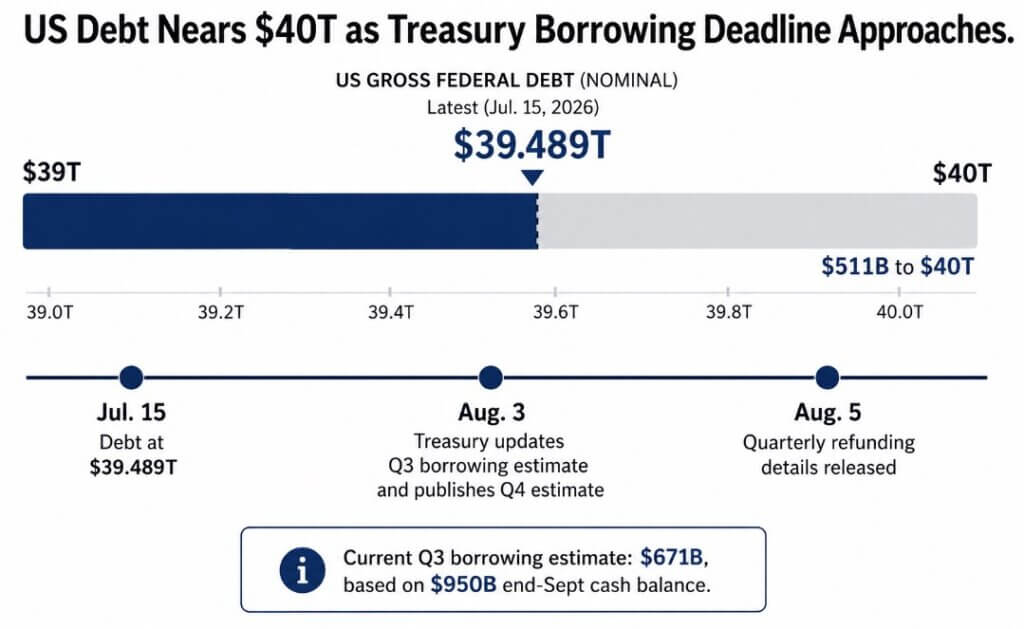
The total federal debt of the United States reached $39.489 trillion on July 15th, leaving about $511 billion remaining before the $40 trillion threshold, and this total debt strengthens the argument that Bitcoin’s supply is fixed.
The Treasury currently expects to borrow $671 billion in private net marketable debt in the July-September period, an estimate based on $950 billion in cash outstanding at the end of September.
The ministry is scheduled to revise its third-quarter figures on August 3 and release its first forecast for the October-December period, setting out total expected borrowings.
The quarterly full repayment package arrived on Aug. 5, along with auction and financing details, showing how the Treasury plans to distribute the funds among bills, notes, bonds, floating-rate notes and inflation-linked securities.
A larger total can increase the amount that retail investors have to absorb, and a heavier coupon mix can introduce more duration risk into the market.
A total of $39.489 trillion has already been recorded as outstanding debt, and the borrowing estimates indicate the government’s upcoming funding needs. Total debt also reflects maturities, intragovernmental flows, cash movements, and Federal Reserve portfolio effects, and the $671 billion estimate does not allow for a one-to-one mapping of total debt.
Government bond supply reaches Bitcoin through yields
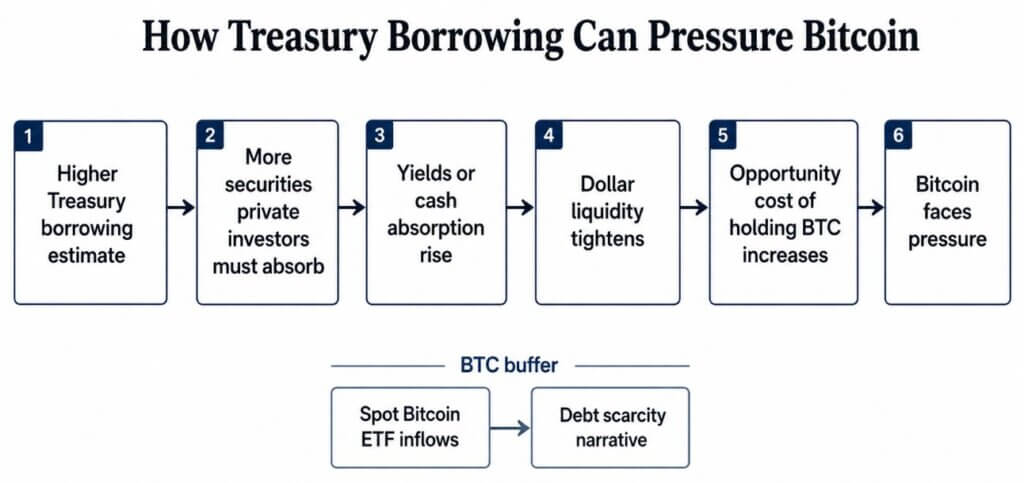
If borrowing levels are revised upward, investors may have to absorb more government bonds. The buyer may demand a higher yield or finance the purchase with cash drawn from savings or other assets.
A Fed study released in May found that a 1 percentage point increase in expected U.S. debt as a percentage of GDP increases the term premium on 10-year Treasuries by about 2 to 3 basis points.
BTC pays zero coupons, so higher Treasury returns increase the opportunity cost of holding Bitcoin, and a strong dollar could add new constraints as dollar liquidity becomes more expensive across global markets.
Bitcoin has been hovering around $65,000 with the 10-year US Treasury yield around 4.60% this week, and there were also reports that the benchmark yield rose to 4.6% on July 20 due to oil-related inflation concerns.
At the Federal Reserve’s most recent official close on July 16, the two-year bond yield was 4.16%, the 10-year bond yield was 4.57%, and the 30-year bond yield was 5.09%. These levels already offer investors large contractual returns across the curve, making Bitcoin more sensitive to yield increases in early August.
At the time of writing, Bitcoin has reached $66,190, its highest price since June 17th.
As of July 15, the Treasury Department’s general account held nearly $795.98 billion, about $154 billion less than the current quarter-end estimate of $950 billion. Achieving this goal through borrowing would accumulate additional cash in the Treasury’s Federal Reserve account before the money is returned to the banking system through government spending.
The source of funds shapes the market effect, as bills tap cash in the short-term money market, while long-term securities tap bank deposits and asset sales.
The Fed reports overnight reverse repo usage for the first half of 2026 to be near zero on most days and foreign exchange reserves at about $3.1 trillion, reducing the inventory of idle capital funds available to absorb note issuance.
Bitcoin also has a direct demand buffer, with the US-traded Spot Bitcoin ETF receiving total inflows of $520.02 million in four positive sessions from July 14 to July 17, reversing the $424.7 million outflow on July 13.
Continued demand for funds could absorb some of the macro resistance caused by higher borrowing estimates.
Early August threshold
In the bullish case, Treasury would keep its third-quarter forecast below $671 billion, keep its $950 billion cash target unchanged, and issue fourth-quarter requirements that are lower than market expectations.
Lending measures that maintain demand across the curve could push 10-year Treasury yields lower, leading to a weaker dollar.
Positive Bitcoin ETF inflows would provide BTC with a direct source of demand, allowing it to sustain the $65,000 region, and the debt milestone would strengthen the scarcity theory.
| signal | Bullish on BTC | Bearish on BTC | why is it important |
|---|---|---|---|
| Third quarter borrowing estimate | below $671 billion | The above has been significantly revised. $671 billion | Determine whether Treasury supply pressure will increase |
| Fourth quarter borrowing estimate | below market expectations | Requires large amount of new borrowing | Extend or reduce supply overhang |
| Treasury cash target | stay nearby $950 billion | went up $950 billion | The higher your TGA target, the more cash you can absorb |
| Publication composition for August 5th | Marketable without yield pressure | Increased amount of coupons/long-term supply | Term premiums may increase due to long-term supply |
| 10 year yield | below or below the recent range | rise above 4.6% | As the yield increases, the opportunity cost of BTC increases. |
| dollar index | become weaker | strengthen | Global liquidity is tight due to strong dollar |
| BTC ETF Flow | Positive inflow continues | the flow turns negative | ETF demand may offset or amplify macro pressures |
| bitcoin price | hold close $65,000 | Lose recent support coverage | Indicates whether macro pressures are on cryptocurrencies |
If bearish, the Treasury will raise its third-quarter forecast, issue significant fourth-quarter requirements, or raise its funding target. A larger coupon bid on August 5th could push term premiums and long-term yields higher, especially if investors demand more compensation for duration.
A strong dollar and ETF redemptions remove two supports from Bitcoin, increasing the risk of a rebound breaking below recent ranges.
The Congressional Budget Office projects a fiscal year 2026 federal deficit of $1.9 trillion and public federal debt to reach 120% of GDP by 2036. These numbers support Bitcoin’s long-standing scarcity argument and will lead to repeated Treasury funding tests over the coming quarters.
Aug. 3 turns a long-standing theory into a short-term market event by tying debt records to yields, cash absorption, and the cost of financing through the dollar.
Bitcoin’s $65,000 defense will carry more weight if it can survive larger borrowing estimates and a higher financial curve.
(Tag to translate) Bitcoin


