


Bitcoin entered weekend trading around $62,500 to $64,300, holding intraday lows as the market’s clearest immediate threshold.
This level of defense, along with trends in Ethereum, HYPE, and the broader altcoin market, present a combined test this weekend of whether Bitcoin can sustain $62,500 as the rest of the market begins to pull away.
Altcoin market capitalization fell to $976.3 billion on July 16, but recovered to $983.8 billion by July 17. Still, altcoin market capitalization is still $8.8 billion short of $992.6 billion on July 10, and altcoin dominance followed the same pattern, rising from 20.55% to 21.40% without reaching the 21.76% share it held a week ago.
| metric | July 10th | July 16th low price | July 17th | what it shows |
|---|---|---|---|---|
| Altcoin market capitalization | $992.6 billion | $976.3 billion | $983.8 billion | It has collected $7.5 billion since Thursday, but is still less than $8.8 billion since July 10. |
| Advantages of altcoins | 21.76% | 20.55% | 21.40% | Although it has recovered from its lows, it is still below last week’s share. |
| market signals | Risk-on attempt | risk off flash | partial rebound | Width has not recovered on bounce |
Rebound from this week’s losses
Altcoins have recouped some of the damage from July 16th, leaving this week’s widespread losses largely intact.
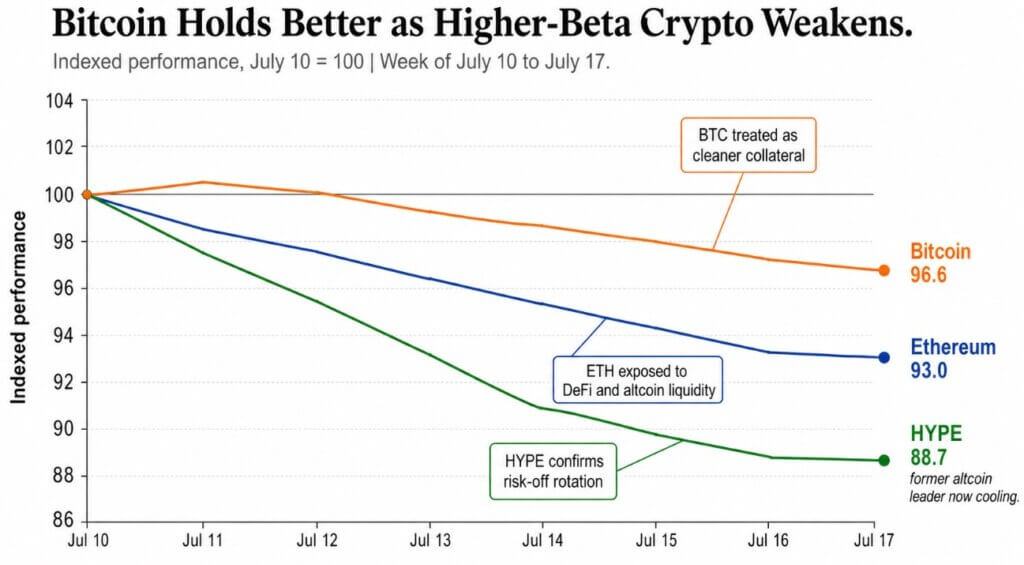
HYPE was the token most responsible for the recent altcoin rally and is currently leading the pullback, reaching an all-time high of nearly $77 on June 16th.
This week’s broad decline has been particularly hard hitting, with the token dropping more than 10% during the same session that drove Bitcoin below $63,000, evidence that the token, which recently confirmed a new risk appetite, is now confirming its risk-off.
Lacie Zhang, research analyst at Bitget Wallet, views this divergence as a macro and positioning shock unfolding within the crypto market.
He noted that the market treats Bitcoin as the cleanest institutional collateral asset, while Ethereum has greater exposure to DeFi borrowing, altcoin liquidity, and broader risk appetite.
This distinction changes how traders behave when mitigating risk. This is because even if you cut your exposure to ETH or HYPE, it could mean that it remains a cryptocurrency only to be rotated into Bitcoin or stablecoins. In this pattern, Bitcoin remains more stable because the riskier ones around it take a bigger hit.
This week’s drop in chip stocks provided real-world proof of that argument.
The Philadelphia Semiconductor Index has fallen nearly 24% from its late June peak, wiped out more than $2 trillion in semiconductor market value and pushed the index into bear market territory in the wake of disappointing earnings outlooks from Samsung and SK Hynix.
Bitcoin fell with that decline, falling below $63,000. Ethereum fell even more, while HYPE fell the most, following the pattern predicted by Zhang’s framework.
What do you have to show on the weekend?
The U.S.-traded Spot Bitcoin ETF saw inflows of $79.1 million on July 16th, the latest record for three-day inflows since a sharp outflow of $424.7 million on July 13th.

The Ethereum ETF moved in the opposite direction on the same day, recording net outflows of approximately $28 million in just one day after inflows of $53.9 million.
This split confirms Zhang’s core point that flows provide a bid and it is still positioning and macro conditions that determine which assets benefit from it. Bitcoin’s price is supported by that bid, and raising ETH in the same way has proven difficult.
Bitcoin’s rebound, with ETH/BTC still falling, HYPE still weak, and altcoin dominance still below last week’s levels, would indicate that the market is defensively absorbing risk and its underlying weakness continues under Bitcoin’s relative strength.
Measurements worth tracking include perpetual futures open interest, funding rates, liquidations, and whether BTC, ETH, and stablecoin exchange balances indicate whether traders are still de-risking or starting to redeploy.
If Bitcoin defends $62,500 and recovers towards $65,000 as ETH/BTC stabilizes and altcoin dominance climbs towards 21.76%, this combination will likely see borrowed positions unwind with the broader market remaining intact, especially if funding is subdued and altcoin participation expands beyond one or two tokens.
If Bitcoin loses $62,500 and falls towards the $62,300-$61,800 area as ETH/BTC and altcoin dominance continue to fall in tandem, the rebound will look less like a normal pullback and more like a forced unwind still operating throughout the system, with high-beta tokens and heavily borrowed altcoin positions taking the first and biggest hit.
| weekend results | BTC status | ETH/altcoin status | meaning of market |
|---|---|---|---|
| constructive repair | Hold $62,500, push towards $65,000 | ETH/BTC will be stable. Alternative advantage goes to 21.76% | Deleveraging is absorbed without destroying the market |
| defensive rotation | BTC holds $62,500 but stalls below $65,000 | ETH, HYPE and Alternative Dominance Continues to Delay | Capital is hidden in BTC and stablecoins and is not widely returned. |
| break | BTC loses $62,500 and falls towards $62,300-$61,800 | ETH/BTC and alternative dominance become one | Pullbacks run the risk of being forced to rewind |
| macro drag | Bitcoin continues to languish, while chip stocks remain under pressure | High beta tokens will initially perform poorly | Cryptocurrencies remain tied to widespread technology risk trading |
The immediate line will be set and extensive testing will be carried out on a longer stretch over the weekend.
Zhang has cited the stabilization of AI and semiconductor stocks as the most important catalysts for the next move in cryptocurrencies, and this week’s selloff in chip stocks directly supports that argument, as cryptocurrencies have increasingly traded like an extension of the tech sector’s high beta over the past two years.
Until chip stocks find their bottom, a string of positive ETF flow days will carry limited weight as evidence that broad risk appetite is returning.
Bitcoin’s hold on ground as surrounding assets continue to decline could mean the market has turned a corner. It could also mean that capital is simply retreating to crypto’s safest assets, and this weekend provides the first evidence pointing to either explanation.
(Tag to translate) Bitcoin


