

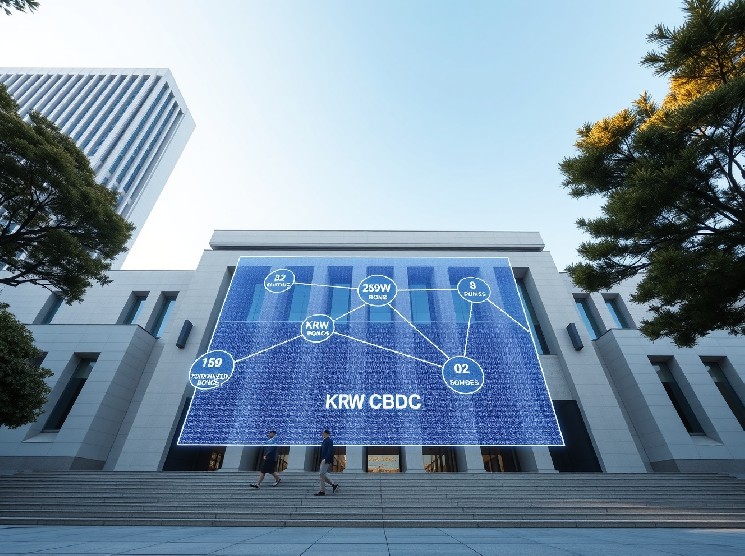
South Korea plans to launch a pilot program to tokenize government bonds on a blockchain linked to the Bank of Korea’s wholesale central bank digital currency (CBDC), Yonhap Infomax reports. The initiative was announced at a cabinet meeting on July 14 as part of the government’s broader “economic growth strategy for the second half of 2026.”
Pilot program details and strategic background
This pilot marks an important step in integrating blockchain technology into the country’s core financial infrastructure. The Bank of Korea aims to test the efficiency, safety, and transparency of distributed ledger technology in the sovereign debt market by tokenizing government bonds and settling them using wholesale CBDC. This approach has the potential to reduce settlement times and operational costs compared to traditional systems.
The strategy also includes preparing measures to strengthen industrial competitiveness through large-scale blockchain pilot projects and securing leadership in emerging technologies later this year. The move is in line with global trends, as several central banks, including those of China and the European Union, are exploring similar tokenization and CBDC initiatives.
New digital asset laws are on the horizon
In parallel with the technology experiments, the South Korean government plans to promote the enactment of a “Digital Asset Basic Act.” The law aims to fragment the digital asset industry, regulate business activities, and create a legal framework specifically for stablecoins. The legislation is expected to provide clarity to market participants and strengthen protection for investors.
Additionally, the government will develop a framework for cross-border stablecoin transactions as part of the second phase of the Digital Assets Act. This is especially important given the increasing use of stablecoins in international payments and remittances.
Impact on capital markets
In a move that could reshape South Korea’s investment environment, the government will support amending the capital market law to introduce spot exchange-traded funds (ETFs). Although the announcement did not specify any asset classes, the inclusion of spot ETFs suggests a potential path toward digital asset-based ETFs, similar to those approved in the United States and Hong Kong.
For investors and industry observers, these developments suggest a comprehensive regulatory approach that balances innovation and oversight. This pilot program, combined with the legislative roadmap, positions South Korea as an active player in the global digital asset ecosystem.
conclusion
South Korea’s decision to pilot tokenized government bonds on a blockchain linked to a CBDC, coupled with new digital asset laws and ETF amendments, represents a concerted effort to modernize its financial system. This initiative is expected to provide valuable data on blockchain scalability and regulatory effectiveness, influencing future policy decisions both domestically and internationally.
FAQ
Q1: What is Wholesale CBDC?
Wholesale CBDC is a digital currency issued by a central bank for use only among financial institutions rather than the general public. It is designed to improve the efficiency of interbank payments and securities transactions.
Q2: How will tokenized government bonds work in this pilot?
Tokenized government bonds are issued as digital tokens on the blockchain. Payments will be made using Bank of Korea’s wholesale CBDC, and the process will be automated through smart contracts, potentially reducing the need for intermediaries.
Q3: When will the Digital Asset Basic Law come into effect?
The government has not announced a specific schedule for enactment. The bill is part of a broader strategy for the second half of 2026, and further details are expected to be revealed as the bill passes through parliament.


