


On July 7, the U.S. Treasury Department’s Office of Foreign Assets Control revoked General Permit
Its replacement, General License X1, only allows closing transactions by July 17th at 12:01 a.m. ET.
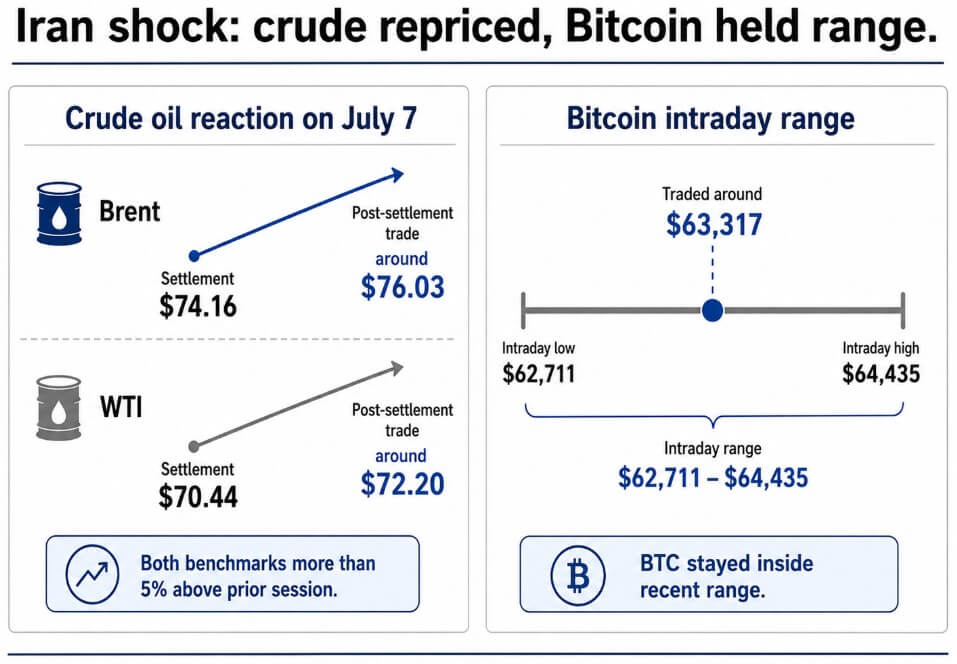
On the day, Brent crude oil settled at $74.16 and WTI at $70.44, extending the gains to about $76.03 and $72.20 in post-settlement trading, with both indicators up more than 5% from the previous session.
The move was prompted by an attack on a tanker near the Strait of Hormuz, with maritime authorities raising the risk of transit through the strait to serious and U.S. officials warning of further repercussions.
Bitcoin absorbed the same news near $63,317 and traded within a range of $62,711 to $64,435 during the day. Bitcoin remained within the band it had occupied for weeks, with markets pushing oil prices up more than 5% on the resurgence of Middle East risks.
This gap leaves open the question of whether Bitcoin’s calm reflects confidence that the oil shock is fading, or whether it reflects a lag before the shock appears in the data on which Bitcoin is traded.
clock behind the heading
With the deadline expiring on July 17, the announcement will act as a market clock, giving traders about 10 days to see whether Iranian barrels, Hormuz shipping flows, U.S.-Iranian diplomacy calm down before the deadline, or whether the deadline itself becomes the next flashpoint.
According to the EIA, the strait will handle about 20 million barrels per day in 2024, representing about 20% of global liquid oil consumption, and there are few alternative routes available if flows through the strait are disrupted.
There could be a disruption premium in oil long before the Strait closure is confirmed, and that premium is already driving Brent and WTI.
The Cleveland Fed’s inflation nowcast model treats gasoline as a direct input to composite CPI and PCE forecasts, and its gasoline nowcast is derived from oil prices. This link provides a rough guide to the inflation data that the Fed monitors most closely, regardless of what else is happening in the economy.
According to EIA data, regular U.S. gasoline prices for the week of July 6 were $3.777 per gallon, down from $4.146 per gallon on June 8, but still $0.652 higher than the same week last year.
According to EIA’s cost breakdown, crude oil will account for 57% of regular gasoline prices in March 2026, and while retail pass-through will depend on refining, distribution, taxes, and timing, pump prices will be directly affected by fluctuations in crude oil prices.
| channel | Data points worth noting | Why is it important for Bitcoin? |
|---|---|---|
| Strait of Hormuz risks | Transport flows, tanker attacks, insurance costs, end July 17th | Determine whether crude oil has a sustained destruction premium. |
| crude oil | After the initial shock, Brent and WTI holdings rise | If oil prices continue to rise, the possibility that gasoline relief efforts will stall increases. |
| gasoline | Weekly EIA pump prices | Gasoline is a direct and visible conduit to headline inflationary pressures. |
| CPI/inflation expectations | June CPI announcement on July 14th, inflation expectations, break-even point | Persistent inflation reduces the Fed’s room for easing. |
| supply path | FOMC, Yields, Dollar for July 28-29 | A prolonged high price policy could weaken Bitcoin’s liquidity support. |
| Bitcoin | BTC maintains or breaks range between $62,711 and $64,435 | Indicates whether traders are still treating the shock as suppressed. |
What is the value of Bitcoin’s quietness?
The calendar compresses three separate events into three weeks. The Bureau of Labor Statistics will release the June CPI on July 14 at 8:30 a.m. ET, OFAC’s easing deadline expires on July 17, the Fed’s next policy meeting will be held July 28-29, and the Fed’s decision date is set after both the inflation measure and the easing deadline.
The Fed has already treated energy as a live input to its outlook, leaving interest rates unchanged at 3.50% to 3.75% in a June 17 statement and citing supply shocks, including energy, as one of the reasons why inflation remained high compared to its 2% target.
Nine of the Fed’s 19 policymakers expected a rate hike in 2026, up from zero three months ago, in their June forecast, as inflation risks from oil steered internal discussions away from cutting rates.
In a contained case, Strait traffic will stabilize and oil prices will regain their risk premium over the next 10 days.
Gasoline relief resumes. The June CPI release on July 14 shows inflationary pressures that have yet to subside from the latest oil shock, and Bitcoin’s sideways reaction to this week’s headlines can be seen in hindsight as the market correctly estimating a shock that dissipated before it reached consumers.
In the troubling case, depending on how quickly Hormuz traffic normalizes, Brent could remain in the $70-$100 range suggested by UBS, or rise toward the $110-$120 range modeled by HSBC if flows remain subdued for months.
In that scenario, the gasoline bailout would stall. Inflation expectations and break-even points have brought energy shocks into the Fed’s discussions, and inflation data in late July will be the first real test of whether oil prices are reaching consumers. Fed policymakers, already divided on the likelihood of raising rates in 2026, have even more reason to hold rates steady or be hawkish.
Bitcoin’s liquidity support has shrunk as both yields and the dollar have strengthened, and this week’s calm has given way to the market returning to the same headlines as the Fed’s problems.
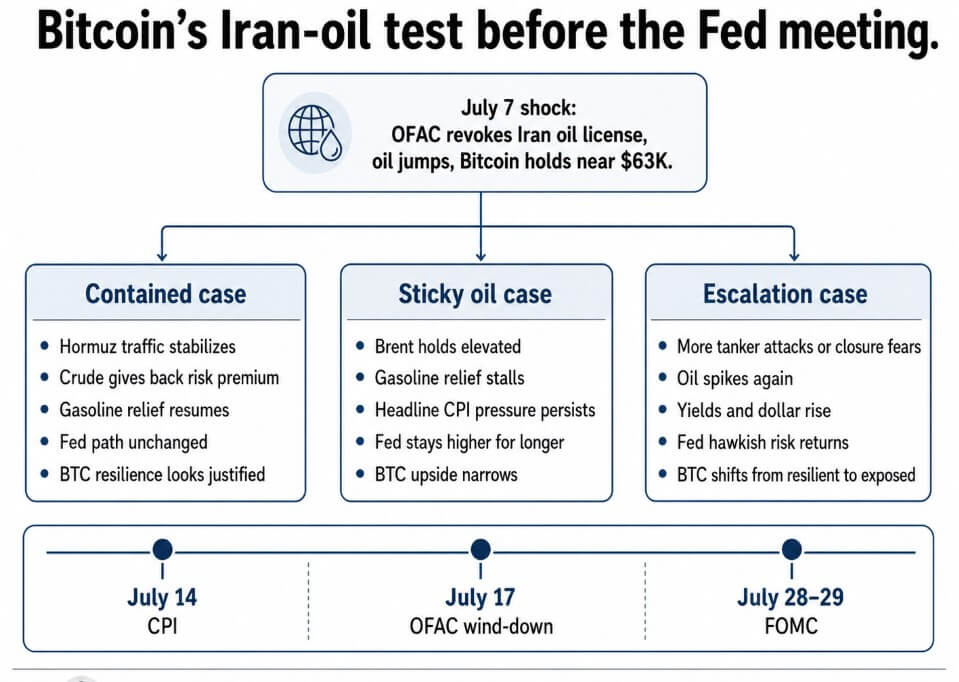
Bitcoin’s sideways price movement this week shows that traders are treating the Iran shock as a background risk so far. The three-week period between July 7 and the July 28-29 FOMC meeting will determine whether this reaction holds true.
Every link from Holmes to gasoline to CPI to the Fed needs to be confirmed with data before a troubling incident takes hold.
Whether the price of the oil shock will be reflected in Bitcoin will depend on the CPI announcement in June, the easing deadline on July 17th, and the Fed meeting on July 28th-29th.
(Tag translation) Bitcoin


