


U.S. spot Bitcoin exchange-traded funds (ETFs) posted their biggest daily inflows since May as a weaker-than-expected jobs report eased concerns about interest rate hikes and the digital asset recovered from new bear market lows earlier in the week.
The fund recorded net inflows of $223 million on Thursday, ending a 10-day period of withdrawals that had drained $2.73 billion from products, according to SoSoValue data.
The reversal came as Bitcoin briefly fell back above $62,000 after falling below a 21-month low of $58,000 earlier in the week.
The return to demand for ETFs has provided some relief for Bitcoin after weeks of pressure from fund redemptions, rising real yields and concerns that the Federal Reserve will extend its tight monetary policy.
Still, the day’s inflows only partially offset the size of the recent selloff. Bitcoin ETFs have recorded nearly $8.5 billion in net outflows since early May, according to Santiment.
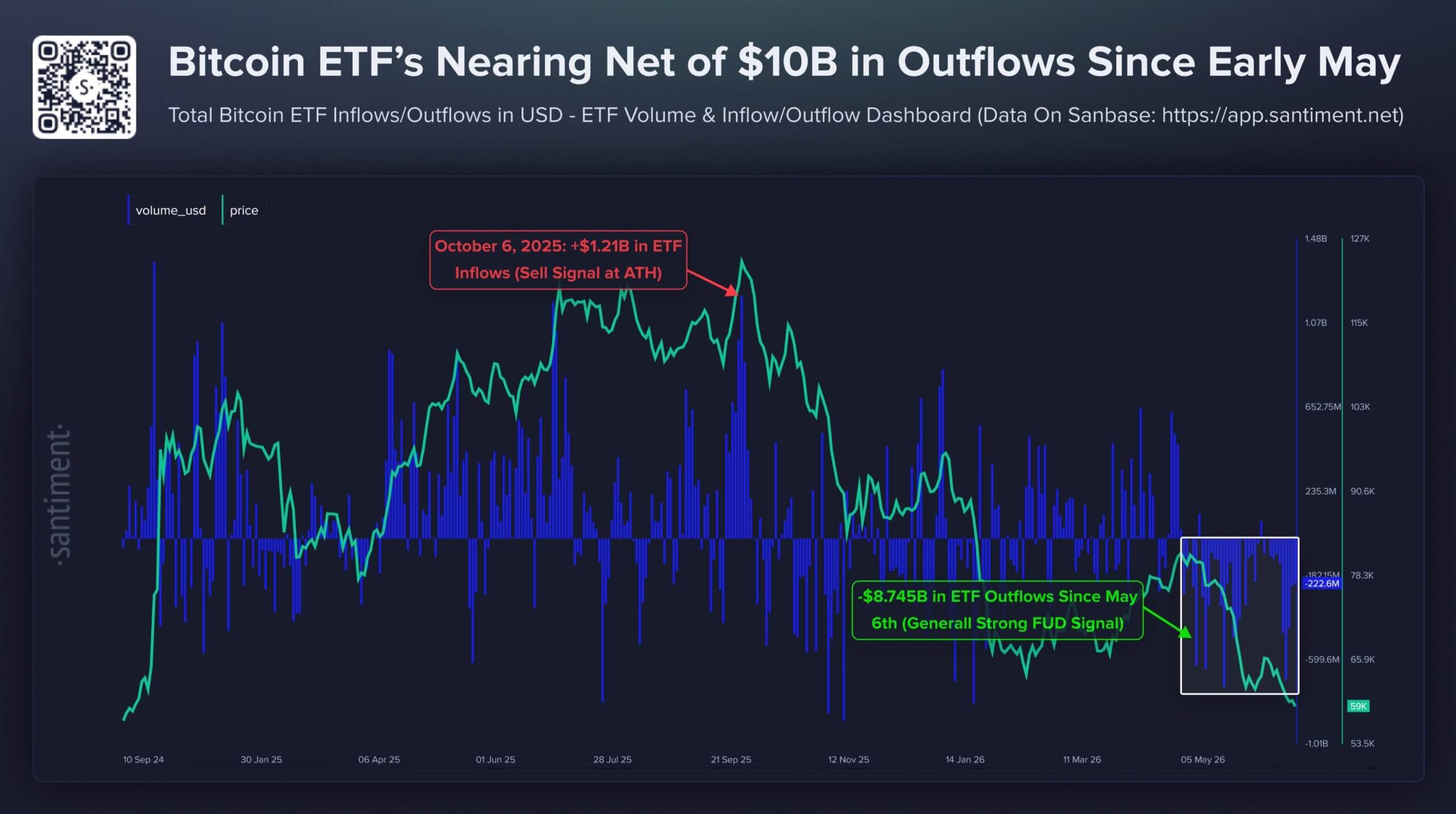
So the market is trying to figure out whether this recent inflow is the beginning of new demand or a short-term rebound after a crowded selloff.
Some analysts see the prolonged outflow as a sign that weaker holders have already reduced their exposure, but the market has yet to show buyers willing to come back for multiple sessions.
Slowdown in wages eases upward pressure on interest rates
The labor report gave investors reason to reassess the timing of the Fed’s next action.
U.S. employers added 57,000 jobs in June, about half of what economists expected. The Bureau of Labor Statistics also revised downward its payroll numbers for April and May by a combined 74,000 jobs, weakening employment trends that had appeared to be more resilient.
The unemployment rate fell to 4.2%, due to a decline in the labor force. Approximately 720,000 people left the labor force in June, and the labor force participation rate fell from 61.8% to 61.5%.
The household survey also showed that the number of employees fell by 507,000, further increasing signs that the main unemployment rate is underestimating the extent of the economic slowdown.
Recruitment was concentrated in a few sectors. Education, health care and social assistance added 69,000 jobs, outpacing overall pay increases. Employment in the leisure and hospitality industry fell, while employment in the government sector increased by just 8,000 people, with expectations for seasonal employment associated with global sporting events disappointing.
Although the report does not point to widespread job destruction, it does show that the labor market is losing momentum.
Rick Rieder, BlackRock’s chief investment officer for global fixed income, described the U.S. jobs report as “more fizz than fireworks” and said the overall picture still suggests a gradual cooling in employment rather than a sharp break.
According to him:
“One month’s jobs report rarely defines trends. When we look at the broader labor market, we continue to see a moderately cooling economy rather than one experiencing widespread job destruction. Stability, rather than strength or weakness, remains the defining characteristic of today’s labor market.”
For Bitcoin, that detail was enough to ease immediate macro pressures. The asset was struggling as markets priced in higher funding costs, a stronger dollar and tighter financial conditions. Weak labor data reduced the urgency of trading, allowing risk assets to recover.
Market supports Fed rate hike expectations
The jobs report comes as investors have already begun to reevaluate the Fed’s policy direction after Chairman Kevin Warsh declined to give any clear indication of when the next rate hike will occur.
Warsh continues to emphasize the Fed’s goal of getting inflation back to its 2% target, even as price pressures remain high after years of inflation above target. Tariffs and the recent war between the U.S. and Iran have fueled the inflation debate, and policymakers remain cautious even as some growth indicators soften.
June’s labor data gave the market room to dial back expectations for further tightening. Traders are no longer fully pricing in October’s 25 basis point rate hike, but there remains hope for another rate hike before the end of the year.
Tuan Nguyen, an economist at RSM US LLP, said the data gives the Fed room to keep interest rates on hold at its July meeting. He added:
“We believe this job report is enough to cause the Fed to hold off on its July meeting. Looking ahead, there is more room for economic growth as headwinds continue to subside.”
This repricing reduced pressure across interest rate sensitive assets. The dollar weakened, the two-year Treasury yield fell to about 4.11%, and gold extended its rebound from earlier losses.
Ole Hansen, head of commodity strategy at Saxo Bank, said lower energy prices, easing inflation expectations, lower yields and a weaker dollar are helping to stabilize precious metals.
Bitcoin also benefited from the same changes. Rising interest rates tend to reduce demand for speculative assets by making cash and short-term government debt more attractive.
The expected delay in rate hikes gives Bitcoin more room to recover, especially after the selloff that drove leveraged traders out of the market.
However, macro easing does not eliminate the Fed’s risks. Wage growth remains above the central bank’s inflation target, and policymakers may still prioritize price stability if inflation proves to be persistent.
However, the labor report eased immediate pressure on the market and provided a catalyst for Bitcoin after weeks of defensiveness.
Bitcoin rebound still faces technical pressures
BTC price recovery now depends on whether ETF demand continues and whether Bitcoin can sustain key levels around $60,000 and $62,000.
Bitwise Europe said investor stress remains high, with only 47% of Bitcoin supply remaining profitable and total paper losses amounting to approximately $281 billion. The company also noted that realized losses have been decreasing with each decline, suggesting selling pressure may be easing around current levels.
However, the company noted that option positioning can still amplify volatility. If Bitcoin loses momentum, a negative gamma concentration around $60,000 and $55,000 could strengthen downside moves, while a positive gamma around $62,000 could help dampen volatility and keep the asset locked in around that level if buyers remain active.
Apart from that, BTC technical signals are also mixed. According to cryptocurrency research firm 10x Research, Bitcoin is above its 7-day moving average, which is a short-term positive signal, but remains below its 30-day moving average, and the overall trend remains under pressure.
Exchange flow data requires additional attention. Bitcoin’s fall below $58,000 earlier this week coincided with a large amount of transfers to trading platforms, including moves by large holders.
While such transfers do not always result in immediate sales, they do increase the available supply on exchanges during weak market conditions.
For now, the market is moving from stress to stability. The jobs report dampened the interest rate hike debate, ETF investors returned after about two weeks of withdrawals, and Bitcoin returned to the $60,000 level.
The next test is whether the influx continues. A second wave of ETF demand would strengthen the case for investors viewing drawdowns as entry points. But if outflows return quickly, the recent inflow movement will look more like an interest rate-driven rescue rally than the beginning of a sustained recovery.
(Tag translation) Bitcoin


