

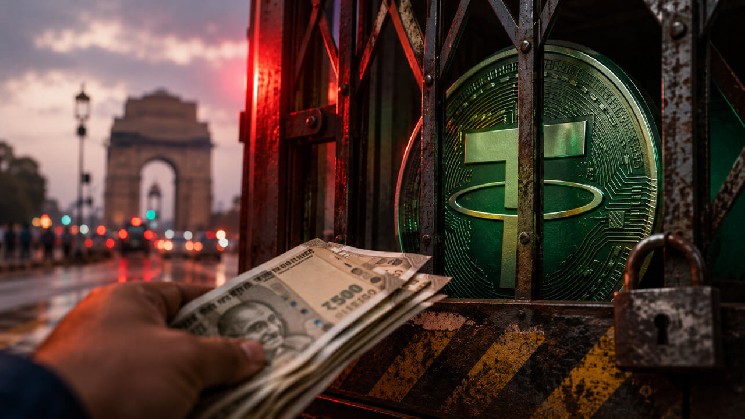
indian $USDT Premium has turned local execution into a live price signal for access to dollars.
According to the June 29 Stablecoin Premium Report, India’s local premium has exceeded 8.5% due to supply shortages. $USDT USD/INR closed near Rs 94.65 but traded around Rs 102.88.
This spread is well above the typical premium range of 3% to 4% cited in the report. This points to a lack of India-specific accessible dollar-pegged crypto liquidity, which still imposes additional costs on buyers who require the rupee route. $USDT.
According to Tether USDt global market data, the token was trading around $1 as of June 29, with significant concentrated trading volume. The two readings create a segmented image. $USDT While access to the rupee within India became more expensive, it remained close to the global peg.
Timing has to do with coercive pressure. The Enforcement Directorate announced on June 19 that a suspect had been discovered in an investigation related to multiple cryptocurrencies and fintech platforms. $USDTForeign remittance activities on a basis without the approval of the Reserve Bank of India.
The agency alleged violations of FEMA for amounts exceeding Rs 2,500 billion and said about Rs 6 billion was suppressed. This release remains a claim by authorities.
Premium turns that background into a realistic cost. Cryptocurrency users, exchanges, payment intermediaries and remittance-related flows in India may seek dollar liquidity even if some routes become riskier or less available. Demand may persist, but the cost of meeting it may rise.
Regional price shocks around global pegs
The core market segmentation is as follows: $USDT As a global stablecoin, and $USDT As a token that users in India can purchase for Rs. While dollar-pegged assets trade for close to $1 globally, local buyers end up paying much more because routes to the asset are rarer, legally uncertain or more expensive.
Insurance premiums in India reflect its access tiers. The token itself still tracks its global peg. The local path to get it is under stress.
Potential regional frictions include access to banks, market maker vigilance, reduced P2P supply, tax costs, compliance uncertainty, and reduced appetite for intermediary flows that may be subject to regulatory scrutiny. These factors are plausible pressure points, and there is no single confirmed explanation for the June 29 price movement.

Stablecoins often act as financial plumbing. A premium may indicate that the route to obtaining the token is becoming scarce, risky, or expensive.
CryptoSlate previously reported that users in emerging markets with dollar access frictions may pay more for stablecoins because the tokens play too expensive a role in processing local rail.
India’s premium has become sharper as it combines its familiar dollar access pattern with a new enforcement context and updated policy calendar. Price signals are easy to perceive even for general users.
Buyer trying to get $USDT India could face significantly higher rupee costs than the normal dollar exchange rate would suggest. This additional cost could impact traders moving between venues, users seeking stablecoin liquidity, and remittance-related demand that relied on faster or less formal rails.
Policy pressures meet sustained demand
The release of an exposure draft is the immediate legal context. The agency named Transak, Carret, Xpat/Remit2any, Onramp.money, and Onmeta in connection with the search, alleging that some of the entities facilitated overseas remittances. $USDT No permission from RBI.
The release also claims that the customer deposited Indian rupees into a domestic bank account, the equivalent virtual currency was transferred to a wallet abroad, and the foreign beneficiary received the equivalent fiat or virtual currency.
Boundaries are important. ED complaints relate to specific acts and named entities. Legitimate remittance users, Indian cryptocurrency users, and FIU-registered VDA service providers are in a separate category unless sources link them to suspected activity.
The same distinction applies to compliance status. Anti-money laundering registration and remittance authorization are separate issues.
The March Lok Sabha reply said that as of March 9, 2026, 54 VDA service providers are registered with FIU-IND and 53 apps or URLs have been directed for removal.
This relates to AML and compliance oversight. RBI approval for remittance businesses is another legal criterion.
It is this gap that appears as a policy barrier. While India has tax systems, AML obligations, takedown actions, and enforcement activities, crypto assets still sit outside an established comprehensive framework.
Another Rajya Sabha response said that VDAs and crypto assets are currently unregulated, while also noting that reporting and tax obligations will be tightened from April 1.
For firms and market makers, this combination could create incentives to reduce exposure or widen spreads until the rules for activities related to transfers become clearer. The exact response of each venue and intermediary remains unresolved.
India also remains one of the largest retail markets for cryptocurrencies. TRM Labs’ Q1 2026 Global Cryptocurrency Adoption Index states that India is the leading retail crypto market with activity fueled by P2P and domestic exchange usage.
CryptoSlate’s explainer on India’s VDA tax system and AML framework shows why the demand plays into the complex mix of high tax frictions and expectations for increased compliance.
This is the pressure point. Enforcement can reduce risky and illicit flows, while sustaining demand can be passed through to prices. Widening spreads is one of the consequences.
Another risk is that unclear or expensive compliance rails force some activities onto P2P or offshore routes that are difficult to monitor. The Rajya Sabha’s March response already outlined the authority’s oversight of cross-border flows of offshore VDA service providers and private wallets, indicating that this concern predates the latest premium hike.
The premium lands just before another policy marker. India’s Parliamentary Standing Committee on Finance is scheduled to meet with RBI officials on July 2 to discuss virtual digital assets and the way forward, with the Institute of Chartered Accountants of India also expected to be involved on taxation and compliance issues.
Official committee documents indicate that this discussion belongs to an ongoing process. A May 20 Standing Committee notice mentions a similar study on virtual digital assets and future directions, and calls for the participation of exchanges and government agencies in the process.
His batting stance is already visible. In a speech hosted by the Bank for International Settlements, RBI Deputy Governor T. Ravi Sankar warned that crypto assets and stablecoins could raise concerns about dollarization, currency substitution, weakening capital movement controls and unmonitored cross-border flows.
This context suggests that central banks approach stablecoin remittance channels through the lens of financial risk and capital flow risk.
Market prices reveal trade-offs. Before the available compliance channels are fully established, users are likely to seek solutions to the problem at hand, even if the rules primarily focus on restrictions and enforcement. In this case, the instrument is $USDT.
The July 2 discussion was a signal, and there is no indication that an immediate deadline for rulemaking will be set. The key question is whether policymakers respond to premiums as evidence that demand requires clearer, regulated rails, or as evidence that enforcement pressures should be stepped up.
If the first pathway is successful, exchanges and payment companies will finally have clearer lines around INR on/off ramps, remittance-adjacent activities, reporting, and stablecoin liquidity. If there are no viable alternatives and the second route prevails, the premium may remain as an ongoing tax on access.
indian $USDT The premium is now a simple number with a bigger caveat. Demand for stablecoins could drive policy frictions, but it comes at a cost. The higher the wall surrounding the informal dollar rail, the more visible the costs of crossing it can become.


