


Base has delayed the Beryl mainnet upgrade by one day to ensure the B20 activation registry is fully operational before the hard fork goes live.
Base announced that Beryl will be activated on mainnet on June 26th at 18:00 UTC, instead of the previously scheduled June 25th launch.
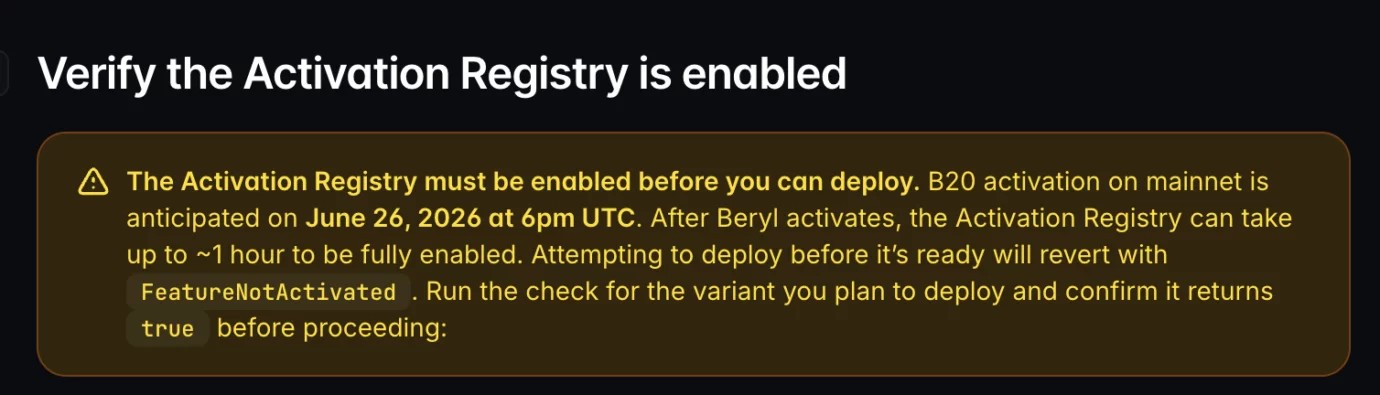
Source: basedocs.
The Ethereum Layer 2 Network attributed the delay to timing dependencies related to the B20 activation registry, which requires developers to complete initialization before deploying native B20 tokens.
The network explained that the activation registry will control whether the B20 feature flag becomes available after a hard fork. Base added that it can take up to an hour for the registry to come online after activation, requiring an additional delay before proceeding with the upgrade.
B20 deployment and withdrawal changes
Beryl is Base’s second independent network upgrade, following Azul, which reached mainnet in May. This release introduces B20, a protocol-level token standard that allows issuers to create stablecoins and real-world asset tokens directly within Base’s Node software instead of deploying traditional ERC 20 smart contracts.
Base previously stated that B20 will maintain compatibility with the ERC 20 specification and support ERC 2612 permission features, allowing existing wallets, exchanges, and indexers to work without modification. The protocol also includes an issuer toolkit that provides role-based permissions, mint and write controls, transfer limits, optional supply limits, and freeze and foreclosure capabilities for regulated issuers.
The hard fork will also reduce the standard withdrawal period from Base to Ethereum from 7 days to 5 days, a route used by most bridge providers. Base previously attributed this decrease to improvements introduced through Azul’s Multiproofs framework that reduced reliance on the original faultproof challenge window.
Beryl has also integrated Reth V2, which the network says can reduce node storage requirements by up to 50% and support higher block gas goals.
An outage occurred before a planned activation
Base originally scheduled Beryl for June 25, but on that day the network experienced a block production outage that lasted nearly two hours. The engineering team identified the consensus issue after an invalid block entered the sequencing pipeline, temporarily halting the creation of new blocks.
Engineers restored normal block production later that day, but the base confirmed that the incident was unrelated to the planned Beryl upgrade.
We have confirmed that the blocks are successfully generated and are widely recovered within the ecosystem.
The remaining stuck base node will recover upon reboot and synchronization.
Now that the team has discovered the root cause of this outage, we plan to share a full post-mortem based on what we learned.
— Base Build (@buildonbase) June 2026 25
Base creator Jesse Pollack also acknowledged that a network outage was unacceptable for an infrastructure meant to support global financial activity, but said users’ funds remained safe during the outage.
Base is planning its next network upgrade, Cobalt, in September. The company expects this release to introduce native account abstraction, protocol-level smart accounts, gas sponsorship, transaction batching, additional B20 features, and an integration node binary that combines consensus and execution clients.


