

BTTInferGrid is a distributed GPU computing network purpose-built for AI inference. BTTInferGrid bridges the global supply of idle GPU capacity with the burgeoning demand for AI workloads, providing open-access, verifiable, and secure pay-as-you-go computing infrastructure to AI developers around the world.
On June 17th, decentralized technology pioneer BitTorrent announced that BTTInferGrid To capture the rapidly growing AI inference market. The platform leverages a distributed edge computing architecture to globally aggregate fragmented and underutilized GPU resources. By eliminating friction between hardware providers and AI developers, BTTInferGrid provides a highly scalable inference engine featuring plug-and-play access, on-chain validation of computed results, and flexible utility-based billing.
By leveraging distributed orchestration, BTTInferGrid solves the bottlenecks inherent in traditional centralized cloud providers, such as high concurrency latencies and rigid pricing models during demand spikes. On the supply side, the network redefines the economics of idle hardware and optimizes resource allocation across the computing ecosystem.
This release marks the strategic expansion of BitTorrent’s utility beyond its core BitTorrent File System (BTFS) storage protocol. By combining high-performance computing with proven expertise in scheduling large-scale distributed resources, BitTorrent has established itself as the foundational infrastructure layer of the distributed AI era.
From training to inference: BTTInferGrid re-engineers the AI computing supply chain
The structural demand for AI computing is fundamentally shifting from training to inference. At this critical time, BTTInferGrid aims to transform the supply side through distributed infrastructure, address prohibitive cost and resource bottlenecks, and deliver cost-effective high-performance computing.
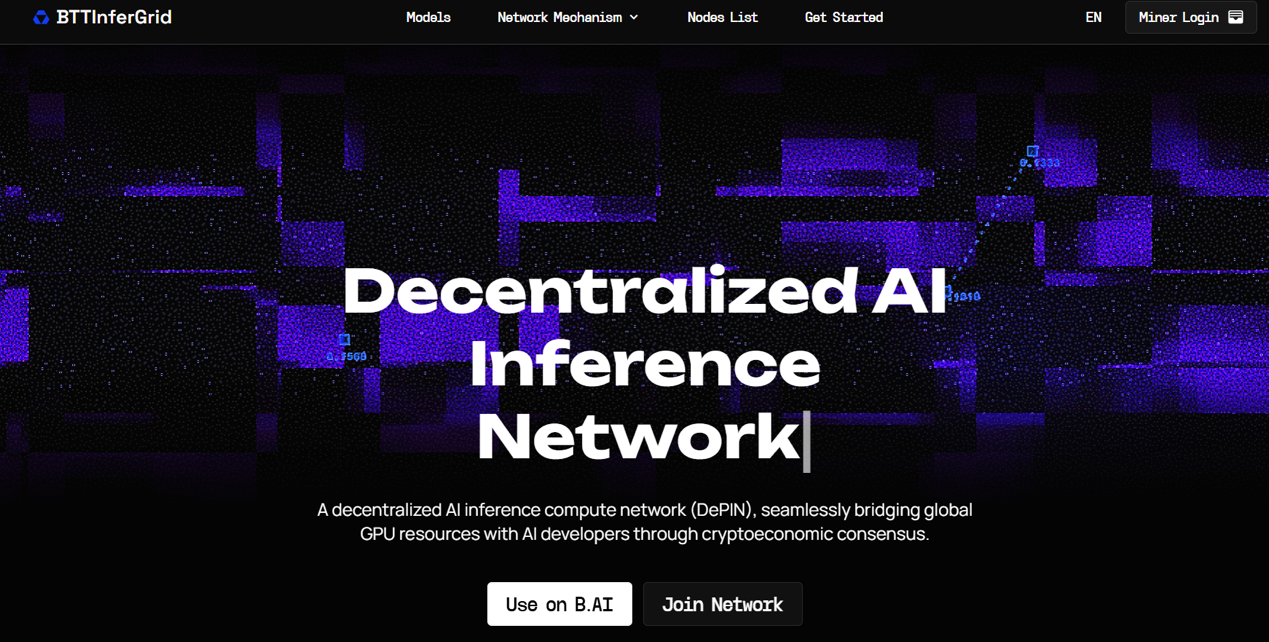
Industry consensus predicts that more than 70% of future AI computing workloads will be dedicated to inference, the critical phase where AI models move from development to production-grade deployment. Training is a one-time capital expense, whereas inference is an ongoing operational cost that directly impacts user experience and business viability. Oracle predicts that the inference market will eventually reduce the scale of training. Academic Zheng Weimin also points out that the majority of computing power is currently consumed by users interacting with large models on a daily basis. This is reflected in operational budgets, with inference accounting for up to 95% of LLM computing costs. Traditional platforms like ChatGPT cost up to $700,000 per day, while even optimized models like DeepSeek V3 cost $87,000 per day.
As AI development becomes increasingly democratized and extends beyond tech giants to millions of independent developers, traditional centralized infrastructure is failing on three fronts:
1. Inflexible allocation and unstable workloads: Demand for inference is exponential in nature, with peak-to-trough utilization varying by orders of magnitude throughout the day. Centralized data centers pose costly dilemmas for operators. In other words, over-provisioning hardware to guarantee peak availability can result in expensive idle capacity or under-provisioning and risk service degradation. This system inefficiency is further exacerbated by massive data center overheads such as power and maintenance, making rental costs artificially high.
2. Exorbitant GPU prices hinder innovation: Despite the proliferation of open source models, real-world deployments are still constrained by the cost of stable and accessible hardware. Instead of scaling down, GPU access costs are skyrocketing. In specialized clouds, secondary market rates for mainstream H100 GPUs rose from $1.70/hour in October 2025 to $2.35/hour in March 2026. This is a nearly 40% jump, as developers have sophisticated models but no longer have the viable compute to run them.
3. Supply-demand mismatch and siled compute pools: There is vast amounts of GPU capacity sitting in private networks, academic labs, and regional data centers around the world. Lacking standardized access and unified orchestration, these distributed resources remain locked out of the global inference market. This creates a market paradox. Developers face chronic hardware shortages, while vast amounts of computing power remain idle.
In summary, the AI inference market is under a triple squeeze. Rigid, centralized architectures lack elasticity, soaring GPU rental prices stifle innovation, and fragmented global computing remains stranded. To break this impasse, BTTInferGrid leverages decentralized technology to provide a new solution.
Specifically, the platform eliminates centralized monopolies and infrastructure bottlenecks by establishing a direct decentralized corridor between global developers and idle GPU resources. First, BTTInferGrid aggregates fragmented and underutilized hardware into a highly integrated, open-access computing commons. Second, it bypasses traditional intermediaries, eliminating artificial barriers to entry and opaque pricing, facilitating a frictionless trading environment. Driven by strong DePIN incentives and coordination protocols, this network ensures continued access to high-performance, cost-effective inference power, neutralizing stifling financial barriers and supply constraints at the source.
BTTInferGrid: Redefining computing power allocation with a decentralized network for AI inference
BTTInferGrid is designed with the sole mission of establishing the definitive decentralized infrastructure for AI inference. By bridging the global gap between idle GPU supply and escalating inference demand, the platform provides a permissionless gateway to high-performance computing that combines verifiable execution with a flexible pay-as-you-go model.
BTTInferGrid leverages the robust DePIN architecture to power both sides of the AI computing market.
- On the supply sideaggregates fragmented and idle GPUs to create an open, shared computing foundation. The network leverages tokenized incentives and intelligent routing to enable resource providers to seamlessly monetize idle hardware, turning it into a revenue-producing asset while ensuring a stable and scalable supply of compute.
- demand sideprovides an accessible, on-chain verified, on-demand inference service to AI developers around the world. Compared to traditional centralized cloud providers, BTTInferGrid offers a cost-effective and scalable alternative. This significantly lowers the barrier to entry for small and medium-sized teams, accelerates product development cycles, and returns value to the supply-side ecosystem.
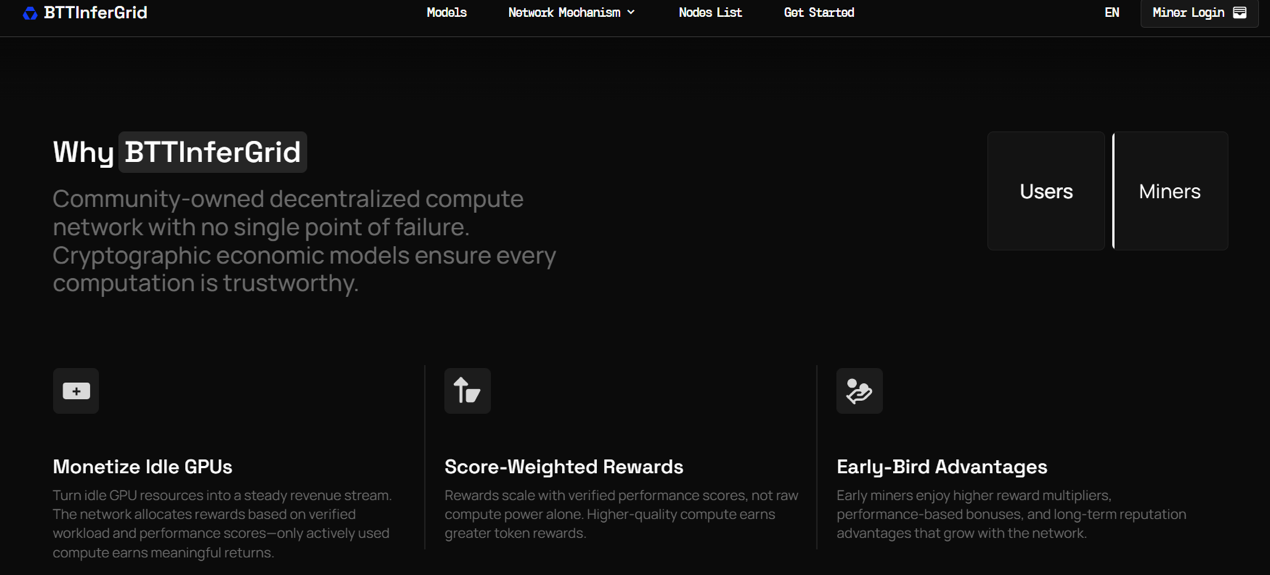
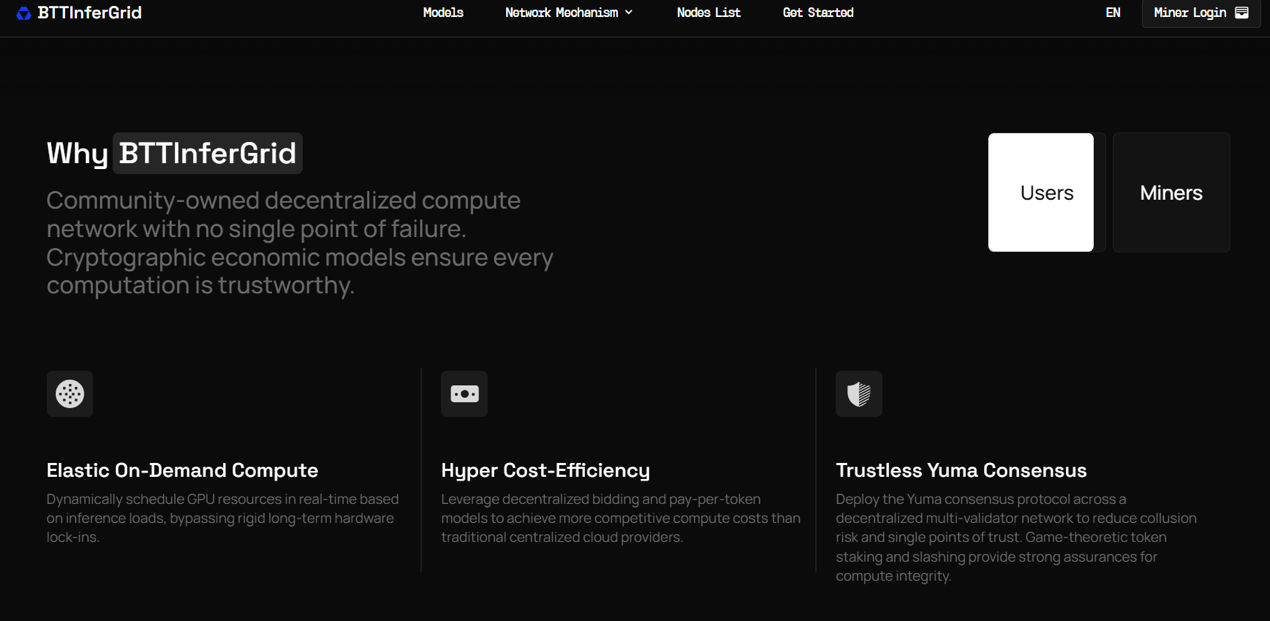
BTTInferGrid is driving a strong, self-sustaining growth flywheel. A growing network of idle GPU nodes reduces computing costs, which in turn accelerates developer adoption. This surge in demand will further encourage new hardware suppliers to join the ecosystem, ultimately transforming scarce and high-cost AI computing power into a comprehensive, on-demand, distributed infrastructure.
While most distributed GPU platforms are currently hampered by prohibitive entry barriers, opaque service reliability, and unsustainable business models, BTTInferGrid was designed from the ground up to deliver three strategic breakthroughs, establishing a clear competitive advantage.
1. Permissionless access and fast GPU aggregation: Individuals or organizations with idle GPUs that meet baseline performance and reliability standards can seamlessly connect to the network. This frictionless approach significantly lowers supply-side barriers to entry and quickly integrates distributed global computing into a unified network.
2. Verifiable quality of service and trustless execution: To overcome the trust flaws inherent in decentralized networks, BTTInferGrid leverages advanced blockchain architecture to cross-validate the actions of all participants. By integrating intelligent task routing, cryptographic spot checks, dynamic reputation scoring, and smart contract-based incentive and slash mechanisms, the network effectively neutralizes fraud risks and ensures that all AI inference outputs are reliable, tamper-proof, and highly verifiable.
3. Demand-driven economics for sustainable ecosystems: BTTInferGrid is powered by genuine AI inference demand and performance-based node incentives. Computing suppliers generate real revenue directly from developers who pay active network usage fees, rather than relying solely on inflationary token emissions. This utility-first mechanism alleviates speculative agriculture and ensures robust, long-term viability of the ecosystem.
The strategic breakthroughs achieved by BTTInferGrid, including dismantling traditional barriers to entry, mobilizing the world’s idle GPUs into a borderless computing grid, and engineering an end-to-end trustless validation loop, are fundamentally redefining the distributed computing landscape. By pegging tokenomics to true AI demands, the network pioneers a new standard for how computing resources should be handled. Aggregated, verified, and fairly monetized.
BTTInferGrid Roadmap: Scaling to meet real-world demands
BTTInferGrid is more than just a hardware aggregator. It is a full-stack decentralized computing protocol that seamlessly integrates intelligent task routing, dynamic demand and supply matching, and automated on-chain payments.
This ecosystem is powered by the synergy of three key participants. Computing provider (miner) Provision idle GPUs to your network in exchange for tokenized rewards;Computing requester (AI developer) Access scalable computing power through integrated APIs. and validator Validate quality of service and enforce agreements to maintain network integrity. This tri-party architecture provides cost-effective and reliable AI inference for developers while generating sustainable utility revenue for hardware providers.
BTTInferGrid follows a clear, robust, demand-driven, phased launch strategy. Rejecting the industry trend of unsustainable and aggressive expansion, the network prioritizes optimal resource utilization, economic viability, and systematic expansion of its technical architecture.
- Phase 1: Network Bootstrapping (2026)Onboard core nodes and validate distributed inference services. The main objective is to scale the GPU node network and successfully navigate the cold start phase.
- Phase 2: Ecosystem Diversification (2027)Enhance network stability and privacy while expanding support for diverse AI model architectures. During this phase, the protocol expands its usefulness to accommodate complex scenarios such as fine-tuning of distributed models.
- Phase 3: Foundational AI Infrastructure (2028 and beyond)Establish BTTInferGrid as a native Web3 infrastructure layer to provide scalable computing for large-scale AI applications. The ultimate vision is to seamlessly integrate decentralized computing, storage, and smart contracts into a unified ecosystem.
At launch, the network prioritizes professional-grade GPUs. To ensure initial stability, supply-side onboarding (miners) will initially be a permissioned process, but developers will maintain seamless on-demand access to the inference service. BTTInferGrid will then evolve into a consumer, professional, target=”_blank” rel=”noreferrer noopener follow”>fully permissionless supercomputing grid. BTTInferGrid is built on the proven foundation of BitTorrent and BitTorrent File System (BTFS). Having operated globally, BTFS has already validated the DePIN model, demonstrating mature capabilities in hardware orchestration, tokenomic incentives, on-chain payments, and decentralized governance. As the flagship initiative of BitTorrent’s expansion into Web3 AI, BTTInferGrid represents an evolutionary upgrade of the BTFS ecosystem. By moving these proven operational frameworks into the AI inference domain, BTTInferGrid leverages important architectural advantages to drive rapid and sustainable growth.
Disclaimer: TheNewsCrypto does not endorse any content on this page. The information contained in this press release does not constitute investment advice. Readers of TheNewsCrypto are encouraged to make decisions based on their own research. TheNewsCrypto is not responsible for any damages or losses related to the content, products, or services mentioned in this press release.


