


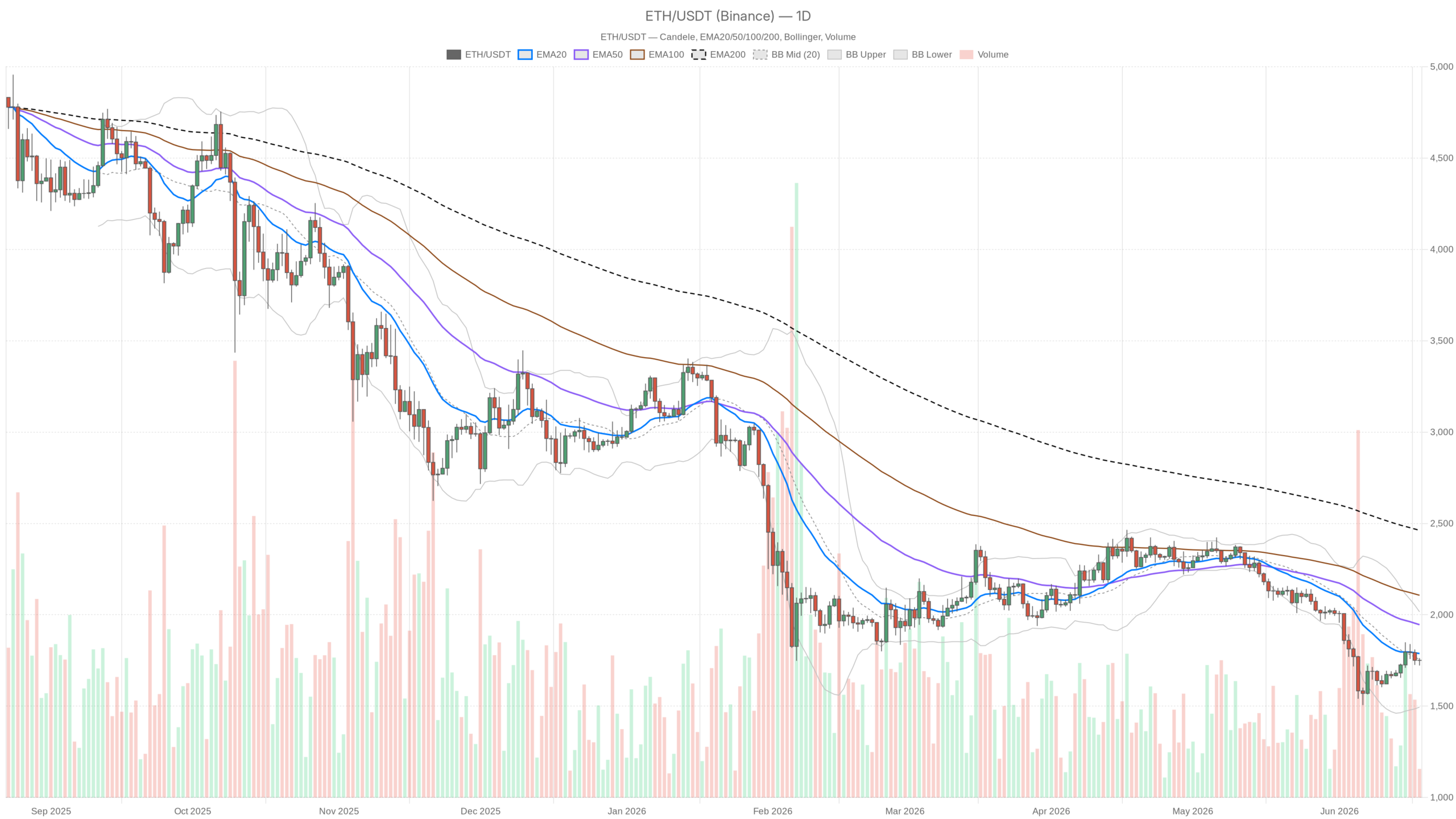
As of June 18, 2026, $ETH It is trading around $1,750, a level that is painfully familiar to anyone who has followed it in recent weeks. Today’s Ethereum price reflects sustained bearish pressure rather than a definitive collapse or recovery. A combination of shallow buying interest and systematic selling from higher time frames has sent the second-largest crypto asset into a structural impasse.
Important points
- Ethereum trading price is approx. $1,750 On June 18, 2026, the price fell below both the 20-day EMA and the 50-day EMA.
- The daily RSI is: 41.53reflecting bearish momentum without hinting at capitulation
- Indexing fear and greed 15deep in the realm of “extreme fear”
- Take a break at the top $1,800 Every day will be the first reliable sign of structural repair
- retention failure $1,727 Open the way to the $1,650-$1,500 zone
Daily chart: bearish structure that refuses to repair
The daily time frame sets the tone here, and it’s not a forgiving one. $ETH Closing time $1,750.31below both the 20-day EMA ($1,787.90) and 50-day EMA ($1,945.77). The 200-day EMA at $2,462.25 has thus far been an overhead, acting more as a reminder of how far the asset has fallen than as a target. With Bitcoin’s dominance reaching 56.1% and its market cap declining broadly, the macro backdrop provides: $ETH There is no relief. If the price is below all three major EMAs, we are dealing with a trend rather than a correction.
The daily RSI 41.53 reflects that reality without crying out surrender. Although it is in bearish territory below the neutral 50 line, it has not reached the extreme oversold levels that historically precede a strong rally. This is the RSI for assets that have been sold slowly, rather than those that have been sold aggressively. Stocks that are extremely oversold tend to attract bargain hunters. However, a slow grind at 41 tends to attract more sellers.
MACD supports this view. The MACD line is negative at -80.4, but the histogram has turned positive at +25.64, and the signal line is even more negative at -106.04. This histogram reversal is a slightly constructive detail on the daily scale, suggesting that bearish momentum is slowing. This is not a buy signal, but rather a warning that the urge to sell is losing some urgency. Losing momentum and reversing are two completely different things.
The Bollinger Bands on the daily frame shows a price of $1,755.59 just below the mid-band, which acts as an immediate resistance level. The $2,016 cap band is irrelevant in the current situation. lower band $1,494 Represents the actual downside reference if the structure breaks. With a daily ATR of $91.13, a trip to the lower band is only about $2.5 off the average daily range. Pivot is at $1,745.18, R1 is $1,768, and S1 is $1,727. $ETH Barely above the pivot, the bulls do not have any structural advantage.
Frames per time: flickering instead of flames
Going down to the hourly chart, things soften slightly, but not enough to change our strategic view. The price is almost flat at $1,750.63, hovering around the first half EMA20 ($1,751.76) and below the EMA50 ($1,760.70). What’s really interesting here is that the first half EMA200 is at the next level. $1,720.11 — Significantly below current prices — meaning the broader short-term trend is up from the deeper moving averages. This results in a slight discrepancy. The daily timeframe is bearish, but the hourly timeframe is technically neutral.
The RSI for the first half of the year is 47.42, just south of 50 and deep in no man’s land. The MACD histogram for the first half of the year reversed slightly to positive (+1.21), reflecting the same deceleration of negative momentum seen on the daily scale. On the other hand, Bollinger Bands show that the price is located almost exactly in the mid-band ($1,751.25), representing a compressed market rather than a directional commitment. The hourly ATR of $12.78 suggests a narrow intraday range and low confidence. Nothing here indicates the market is ready to move, it says the market is waiting.
15 minute frame: short-term pulse
The 15-minute chart is currently the only time frame where momentum is truly positive. The price of $1,750.83 is above both the EMA20 ($1,744.28) and EMA50 ($1,746.70), the MACD histogram is firmly positive at +1.87, and the RSI is hovering at 59.99, moving towards overbought territory for this short period. The 15-minute EMA200 is located at $1,762.39, which is above the current price and represents the closest meaningful overhead resistance.
For active traders, this short-term momentum is the context of execution, not theory. Intraday buyers have a slight advantage at the moment, but the window will close unless prices break through $1,757 to $1,762. Moreover, this micro-level setting must be adjusted against the everyday context. $1,787–$1,800 We will be selling into a resistance wall rather than a breakout.
Market sentiment: extreme fear speaks louder
The Fear and Greed Index is: 15 — Deep in the realm of “extreme fear.” Historically, retail declines tend to precede institutional accumulation in value zones, so this low level precedes a bailout rebound. However, extreme fear may also be a lagging indicator of a trend that continues. Given that the daily structure remains bearish with no reversal signals confirmed, it would be careless to treat sentiment readings alone as contrarian catalysts.
But this is meaningful input. The market is not satisfied with the status quo and marginal sellers may have lost their sense of urgency. This background is important for anyone tracking Ethereum price today. Not as a trigger, but as a reminder that emotional extremes can last as long as the trend lasts. This is worth noting, even if it is not viable on its own.
On the DeFi side, Uniswap V3 According to data from DefiLlama, fee activity has surged 25.6% in the past week and 164% in the past week, suggesting on-chain trading volume is increasing on the Ethereum network. This is not a price mover, but it does show that the ecosystem is not dead, i.e. users and protocols remain active. Whether it will lead to demand or not $ETH That in itself remains an open question.
Two scenarios worth noting
Two different paths are worth noting, and which one materializes depends almost entirely on whether the bulls can reclaim one resistance zone in the coming sessions.
bullish case
The bullish case hinges on whether the daily close breaks above the $1,787-$1,800 zone, reclaims the 20-day EMA, and shifts the short-term narrative from a failed bounce to potential base formation. If the MACD histogram continues to improve and the RSI continues to move above 50 and above $1,800 on a daily basis, it will be the first reliable sign that the bearish structure is being challenged. Disabling it is simple. Failure to hold $1,727 on a closing price basis opens the door to the $1,650-$1,500 zone.
bearish case
The bear scenario is structurally in control and does not require any heroic acts to unfold. only for $ETH If it trades below the falling EMA stack and fails to recover $1,800 on a daily basis, every pullback will be a selling opportunity. The immediate trigger is a break below $1,727, $1,694, and exposure of the lower band at $1,494. The invalidation here would result in the decisive and massive daily closing prices mentioned above. $1,870 — The area where 50-day EMA compression starts to become a problem.
Positioning points
Right now, $ETH The time frames are bearish on the daily time frame, neutral on the hourly time frame, and mildly constructive on the 15 minute time frame, all in zones that tell completely different stories. These types of disagreements are rarely resolved neatly in one session. The compression between $1,727 and $1,762 is the real battleground, and the first to break out of that range along with volume will likely dictate the next meaningful move.
An ATR of $91 per day means the amount is no small amount if a solution comes to fruition. Volatility is already factored in. Direction is not. Anyone participating in this market should respect that macro trends remain bearish, that extremes in sentiment may persist, and that the strength of one 15-minute bar will not cancel weeks of daily deliveries. Adjust the size accordingly.
FAQ
What is $ETH Are you currently trading?
As of June 18, 2026, $ETH The price is hovering around $1,750, below major moving averages such as the 20-day EMA at $1,787.90 and the 50-day EMA at $1,945.77. The 200-day EMA is well above the $2,462.25.
Why is Ethereum struggling to rise above $1,800?
$ETH is facing sustained selling pressure from higher time frames, with the falling EMA stack acting as dynamic resistance. The daily RSI confirms the bearish momentum at 41.53, and a rebound towards $1,787-$1,800 will hit a wall of selling appetite among traders located at higher levels.
Is the Fear & Greed Index of 15 a buy signal for Ethereum?
Not in itself. Extreme fear readings have historically preceded relief rallies and are likely to continue during extended downtrends. The daily bearish structure would need to show concrete signs of a reversal (such as a close above $1,800) before sentiment alone becomes actionable.
What are the major support and resistance levels $ETH?
Immediate support lies at $1,727 (daily S1), which breaks down to expose $1,694 and ultimately expose the lower Bollinger Band near $1,494. Upside resistance lies between $1,757 and $1,762, with a critical zone at $1,787 and $1,800, where the 20-day EMA resides.
Disclaimer: This article is for informational purposes only and does not constitute financial advice, investment recommendations, or a solicitation to buy or sell any financial product or cryptocurrency. The analysis provided is not indicative of future results. Investing in crypto assets and financial markets involves a high risk of capital loss. Always do your own research (DYOR) and consult a qualified financial advisor before making any decisions.
Articles are created with the help of artificial intelligence and reviewed by our editorial team.


